luxury cars-images This blog contains various forms of cars and at a glance most of the new information, present and future, this blog will always feature luxury cars, and sports cars, and provide information about the content, Toyota, Ford, Honda, BMW, Rolls-Royce, Tesla, Mitsubishi, Mazda, Chevrolet, SUV, Automotive, Pick-up, Sports Cars
  • LAMBORGHINI MODEL

    The most visionary models, these unique specimens are set to define the highest limits of technology and design. Unveiled at the most prestigious international Motor Shows, they offer an exclusive look at the most innovative solutions that Lamborghini may adopt in its future series-production models.

  • RAV4 Interior

    Premium materials and a focus on comfort raise RAV4 Hybrid’s level of refinement. Whether appreciating the views through the available panoramic glass roof or finding inspiration from RAV4 Hybrid’s attention to detail, you’ll enjoy a ride that’s ready to go the distance. Explore Interior

  • Ford F-150 Raptor

    The Ford F-150 Raptor pumps out so much fun and such oversize thrills, you'd assume that it had been outlawed years ago

  • Ford Mustang GT500

    Ford Mustang Shelby GT500 makes this car the most powerful car ever made by the American manufacturer. This is because the Ford Mustang Shelby GT500 is equipped with an engine capable of 760 horsepower

  • Tesla Roadster Fastest Electric Car

    Tesla claims the Roadster to be the fastest production car ever made! The second-generation Tesla Roadster can go from 0 to 60 miles per hour in under 1.9 seconds, and this is just for the base model.

Showing posts with label Porsche. Show all posts

2025 Porsche Cayenne Turbo GT

Porsche's most powerful SUV combines everyday practicality with the dramatic performance and thrills of a true sports car. Porsche may be making a green impression with its ever-expanding range of electric and hybrid vehicles, but it’s comforting to know that the German brand is still capable – and willing – to surprise. Case in point? The updated 2025 Porsche Cayenne Turbo GT, which takes everything Porsche has learned about combining electrification and performance… and ignores it. For now, at least. There’s an electric Cayenne coming, but it won’t be launched in Europe until 2026, or 2027 in Australia. Even when the Cayenne is fully electric, Porsche has confirmed that the petrol variant will remain “until and beyond 2030”. So there’s plenty of time to enjoy this, the most powerful Cayenne to date, a 485kW/850Nm twin-turbo V8 monster capable of completing the 0–100km/h sprint in 3.3 seconds. It should come as no surprise that the Cayenne Turbo GT comes from Porsche’s motorsport department, the engineering minds responsible for a number of high-performance Porsches, usually wearing the GT3 or GT4 badge. Not so with the Cayenne, which ‘only’ gets the ‘GT’ moniker. That’s not to disparage the Cayenne Turbo GT, which is essentially a performance monster as those two letters usually indicate on a Porsche.
The 2025 model year update brings performance upgrades, some exterior styling tweaks and new tech inside the cabin. But the upgrades also come at a price. The entire Cayenne range, including the Turbo GT, has seen a price increase. The range-topping Porsche Cayenne Turbo GT starts at $371,700 (before on-road costs and options). And as is typical with Porsches, extra options can quickly add to the price. Our test car, for example, with a host of extras, was priced at $412,641 (in NSW) according to Porsche’s online configurator. That’s almost double the price of the Cayenne S Coupe, which is powered by the same twin-turbo V8, albeit with 349kW and 600Nm. The Turbo GT, as a high-performance SUV derived from the motorsport division, produces 485kW and 850Nm. But there’s more to the Turbo GT than just higher power and torque figures.
Notable standard features include 22-inch alloy wheels, carbon-ceramic brake rotors with 10-piston front and four-piston rear calipers, a lightweight carbon-fiber roof, matrix LED headlights, four-zone climate control, heated front and rear seats, and carbon-fiber accents throughout the interior and exterior. Options installed on our test car included a 12.3-inch passenger display ($2,380), Porsche logo lighting ($600), a body-color key fob that stores in a leather pouch ($780), an $890 air quality system, and a $1,140 Deep Sea Blue interior accent package.
You'd expect a super SUV of this caliber to have few, if any peers. You'd be wrong. There are a host of SUVs from rival manufacturers vying for buyers at this rare end of the market. The most obvious candidates include the Cayenne's broader VW group stablemates – the Lamborghini Urus S ($409,744) and the Bentley Bentayga V8 ($395,800) are both powered by the Turbo GT's 4.0-litre twin-turbo V8. There's also the Aston Martin DBX 707 and its 520kW/900Nm V8. It starts from $428,400. All prices before on-road costs. Key details 2025 Porsche Cayenne Turbo GT Price $371,700 plus on-road costs Color of test car Algarve Blue Options Air quality system – $890 GT interior package (with contrast stitching in Deep Sea Blue) – $0 Accent package Deep Sea Blue – $1140 Passenger display – $2860 Porsche logo LED courtesy lights – $600 Key painted in vehicle color with leather pouch – $780 Active lane keeping incl. intersection assist and emergency stop function – $0 Price as tested $377,970 plus on-road costs Drive-away price $412,641 (in NSW) Aston Martin DBX Rivals | Bentley Bentayga | Lamborghini Urus
The Cayenne Turbo GT is a large SUV, but it comes with a couple of differences – it only has four seats with the second row featuring individual chairs separated by a center console, and it's fashioned in the coupe style of SUV. And that means a sloping roof line. The are five-seat Cayennes in the range, and there are traditional wagon SUVs too, but for the Turbo GT model, it's four seats and coupe only. It still casts an imposing presence on the road, thanks in part to its aggressive stance capped off by those spunky 22-inch satin-finish Neodyne gold alloy wheels. Set against the Algarve Blue metallic paint of our test car, they look a million bucks.
The Cayenne Turbo GT's overall dimensions – 4932mm long, 1995mm wide, 1648mm tall and on a wheelbase of 2895mm – pay dividends in the cabin which is at once spacious, purposeful and premium. It's received a major overhaul for this update, bringing new tech and a new cabin treatment that apes its Porsche Taycan electric sedan sibling. It certainly doesn't feel like an SUV when you slide into those Race-Tex-accented sports seats, finished with plenty of contrasting Deep Sea Blue stitching. The nautical theme is carried throughout the cabin, Deep Sea Blue adorning almost every surface – on the dashboard, embroidered logos on the headrests, armrests, steering wheel and even the floor mats. It wouldn't be my first choice of color, but it does lift the ambience inside. The seats themselves are nicely bolstered, supremely comfortable, and hug you in all the right places and in the right way. They're power-adjustable eight ways, and that means finding your perfect driving position is a cinch. And believe me, you'll want to find your perfect driving position to best experience what the Turbo GT has on offer. The steering wheel, finished in Race-Tex and with a racy yellow band at 12 o'clock, feels nice and chunky and perfectly frames the Turbo GT's digital instrument cluster, which can be configured to show as much or as little information as you want . I liked the five-dial set-up, a nod to Porsches of old and their five analogue dials. Storage options up front are plentiful, with cupholders, a nice central storage bin, decently sized door pockets, and another storage bin in the center console.
Share:

2025 Porsche Taycan GTS

Grand Touring Sport models typically join a Porsche product line sometime after the base and Turbo variants first break cover. The GTS formula invariably adds select Turbo-model gear otherwise unavailable on a base or S model to form a tantalizing new middle rung on the price/performance ladder. And so here we are driving the 2025 Porsche Taycan GTS seven months after its mid-cycle-enhanced breed first appeared. This pattern has played out for long enough to completely exhaust our supply of middle-child, just-right, 'tweener aphorisms. So let's quickly cover the litany of top-model gear that comprises the 2025 Taycan GTS package and get right into how this Malcom-in-the-middle model moves. The headline news is that electrical architecture and motor improvements made to this mid-cycle update bring lots of extra power. The previous Taycan GTS made 509 hp nominal, 590 with overboost/launch control; this one jacks those numbers up to 596 and 690. Porsche says that's enough to drop 0.4 second from the 0-to-60-mph time and 0.7 second from the quarter mile run (to 3.1 and 11.1 seconds). Standard equipment now includes adaptive air suspension with PASM (the GTS-specific tuning of which is credited with improving handling and roll-resistance by about 16 percent), Porsche Torque Vectoring Plus (an electronically controlled differential lock plus brake intervention), 20-inch rolling stock, and Porsche Electric Sound. Inside you get 18-way adaptive sport seats, the GT multifunction heated steering wheel, Sport Chrono package (with its push-to-pass feature to temporarily summon all 690 horses) and a Bose surround sound system. The cars we drove were further enhanced with Porsche Active Ride—a $7,150 option that, according to Porsche's internal spider-graphs, improves base-car pitch, roll, stability, and handling by about 80 percent while improving ride comfort by about half that. The GTS-specific tuning of this system supposedly ekes out a smidgen more handling and chassis roll resistance at some slight cost to pitch and overall body stability. Some older buyers may justify the price simply because it raises the body side whenever a door is opened to ease the climb in or out.
We selected a 2025 Porsche Taycan GTS Sport Turismo wagon variant for our drive route wound through the north-Georgia mountains. It's the most popular Taycan GTS body style, and all other long-roof Taycans are Cross Turismos with the SUV cosplay doodads. We'd spent the morning flogging the lightest 911 variant (a Carrera T) on these same roads and found it pretty ballsy of Porsche to invite comparisons with a car weighing a literal ton less. But it turns out, all the hardware and software Porsche throws on this new Taycan works some straight-up virtual-weight-loss miracles.
Sure, there's brute force involved: The Active Ride system's hydraulic pumps must have done Hoover Dam work to remove all pitch, roll, and dive as we worked the pedals and wheel for all they're worth (5kW per corner is the system's max instantaneous power draw). The driver remains blissfully unaware of both the Porsche Torque Vectoring and rear-steering working their magic at speed, however, and while the much more heavily laden helm can't match the 911's feel, it's darn decent as far as modern steering systems go.
We're still sore that of the myriad parameters a driver can adjust, one-pedal-driving is not among them. That said, the blend of regenerative braking (now up to 400kW worth!) and friction braking is completely seamless with remarkable brake feel. But we struggle to imagine anyone buying a $150,000 station wagon for track work, so the $9,070 carbon-ceramic brake option seems pointless unless your 150-mph autobahn commute gets frequently interrupted by clueless 60-mph left-lane interlopers.
The giant 265/35 front, 305/30 rear 21-inch Pirelli P Zero tires hung on with aplomb, only squealing a tiny bit right out at the raggedy edge of their friction circle. Speaking of which, passengers can monitor the lateral load on the $1,490 passenger display—ours noted a 1.14 g peak in a particularly squealy right-hander, and at least 1 g during a launch-control acceleration (the blue indicator “ball” that traces the friction circle covered up the decimal).
We pressed the push-to-pass button in the center of the mode-selector on the steering wheel after pulling out to overtake another car and felt a noticeable shove as the extra 94 horses and 48 lb-ft suddenly kicked in as if a giant polo mallet just struck us. Likewise, on a second pass within the 10-second power-boost window, cancellation of the boost was equally noticeable.
Price and On Sale Date Order books are open now for deliveries beginning late in the first quarter of 2025, with starting prices of $149,895 for the 2025 Porsche Taycan GTS sedan and $151,795 for the Sport Turismo wagon. The Carmine Red Sport Turismo we drove stickered at $199,935, but deleting the PCCB stoppers and everything else that didn't help it go, stop, or turn better would cut that to $163,205. Most people will find that pricey, but in the Porschesphere, it's right where a GTS goes: $62,000 more than the base Taycan, and $68,000 less than the top Turbo GT.
2025 Porsche Taycan GTS Specifications PRICE BASE $149,895-$151,795 LAYOUTS Front- & rear-motor, AWD, 4-5-pass, 4-door sedan, wagon MOTORS 596-690-hp/534-582-lb-ft (comb), AC permanent-magnet electric TRANSMISSIONS 1-speed auto (fr), 2-speed auto (rr) CURB WEIGHT 5,050-5,150 lb (mfr) WHEELBASE 114.2-114.3 in L x W x H 195.4-195.8 x 77.4 x 54.3-55.6 in 0-60 MPH 3.1 sec (mfr est) E.P.A CITY/HWY/COMB FUEL ECON TBD ON SALE March 2025
Share:

2024 Porsche Macan EV

2024 Porsche Macan EV Review
The Porsche Macan is the best-selling car and is a bastion of hope for Porsche, as nearly 80 percent of Macan customers are brand new and will likely continue to purchase other products from Porsche in the future. To maintain its success and gateway to high-end models, the German automaker has repackaged its small compact luxury SUV into something all-new and all-electric with the 2024 Porsche Macan EV . This model grew a bit over the standard gas model, but performance improvements and technology overhauls would propel it well into a successful future (and higher price point) as the all-new Macan 4 and Turbo EV.

Macan EV design
The Macan EV was launched with a lower standard performance model dubbed the Macan 4 as well as a high-performance variant dubbed the Macan Turbo. All Macan EVs should be equipped with AC charging ports on both sides of the vehicle for convenience, with DC ports limited to only one side depending on the market.

Porsche's previously announced new "Turbonite" style gray badging is offered as an exclusive option for the "Turbo" trim model. There will only be one bodystyle, but designers decided to incorporate a "coupe" aesthetic into the profile and design details of the new Macan. This also applies to the increasingly popular trend of separating the lower headlight units from the daytime running lights, which get the signature four-pattern Porsche look similar to the Taycan EV.

There will be 20- to 22-inch wheels on the two available powertrains, including a 22-inch lightweight forged wheel option and a special off-road wheel option. For less than two thousand dollars, you can paint two wheel options to match the bodywork, if you're naughty. The electric vehicle is larger than the current gas-powered Macan compact luxury SUV, but is still classified as a "compact", with its extended wheelbase (now 113.8 inches versus the standard Macan's 110 inches) an advantage over shared APD vehicles all of which use electricity. the platform on which the Macan EV is based; The EV is now also about two inches longer overall.
2024 Porsche Macan EV Exterior
Macan EV Power Specifications and Range
The more powerful of the two launch Macan trims, the Turbo, produces maximum output of 630 horsepower and up to 833 lb-ft of torque in launch control mode with Overboost function; This car routinely produces 576 hp when not in limited Overboost function. Power comes from two updated permanently excited synchronous motor (PSM) units, one connected to the front wheels and one connected to the rear wheels, offering all-wheel drive and torque vectoring and powered via a two-stage single-speed transmission. The Macan Turbo EV goes from 0-60 mph in 3.1 seconds with a top speed of 161 mph.

The Macan 4 produces 382 hp, or a maximum Overboost output of 402 hp and 479 lb-ft of torque through all four wheels, with a 0-60 mph time of 4.9 seconds and a top speed of 146 mph.

The Macan EV is said to have a drag coefficient of 0.25, making it one of the slipperiest SUVs out there (the Tesla Model Y is reported at 0.23). It also has a maximum towing capacity of 4,409 pounds for both trims, the roof can hold up to 165 pounds with the rack setup, and the Macan EV has a maximum wading depth of 13.3 inches, normal ground clearance of 7.2 inches, and a ground clearance increase of 8, 8 inches.

Macan 4 EV Macan Turbo EV
Base Power 382 hp 576 hp
Increased Max Power 402 hp, 479 lb-ft 630 hp, 833 lb-ft
Clean Usable Battery Pack 96kWh 96kWh
2024 Porsche Macan EV Side view
The available 100 kWh battery pack (96 kWh of which is said to be "usable") is said to be good for an estimated range of "500 km," or about 310 miles on a full charge, although that's not yet an EPA figure. , and likely only reflects the launch model Macan 4 and not the Turbo. In real-world testing of prototypes, MotorTrend estimates the Macan EV can travel up to 290 miles on a single charge. In the future, it's possible that Porsche plans to offer a lower entry-level EV trim that could come with rear-wheel drive, as well as a higher-performance model (Turbo S?) once launched.

Macan EV Charging, Chassis And Suspension Setup
The new Macan EV uses the same PPE chassis architecture as the Audi; Porsche claims it will be able to produce pure electric Macans along with gas models and other model line production at its plant in Leipzig, Germany. A double wishbone axle suspension setup supports the front and is configured around a front motor drive unit, with a multi-link axle at the rear.

A coil spring suspension setup is offered from the factory in some markets, available with improved Porsche Active Suspension Management (PASM) featuring new two-valve shock absorbers with a greater spread of damping characteristics and greater precision of adjustment for the driver. sports settings and comfort. However, at launch, all US Macan EVs will get an air suspension setup. The PASM system is also available with the Macan EV's air suspension setup with the same trick damper adjustments, although this model can also raise or lower the body for easier entry or at high speeds to improve aerodynamics (from -30mm to +40mm from base height). Suspension settings should offer Normal, Sport, Sport Plus, and Off-Road modes.
2024 Porsche Macan EV Interior
Macan Turbo EV models equipped with a performance rear axle get a slightly rear-biased 48-52 weight balance, with the rear electric drive unit mounted directly to the structure at four points for increased chassis rigidity and noise and vibration management. An electronically controlled differential lock on the rear axle is also standard on this model as part of the Porsche Torque Vectoring Plus system. Rear-axle steering will also be available on the Macan EV to improve handling and turning radius (with 15 percent more direct steering ratio to the front axle).

The Macan EV battery features a mixture of nickel, cobalt and manganese with a ratio of 8:1:1 in a 12-module package, 180 prismatic cells and a capacity of 100 kWh, which promises 30 percent greater energy density compared to the 2023 Taycan EV configuration. Additionally, the rear axle pulse inverter now gets silicon carbide to reduce switching losses (only silicon remains in the front setup). The battery pack can now also be easily repaired with its modular arrangement, which is designed so that each of the 12 modules can be removed and repaired or replaced individually should any problems arise.

The new Macan EV will use an 800-volt system, now with a charging capacity of up to 270 kW to charge the battery from 10 to 80 percent in less than 22 minutes. Any 400-volt charging kiosk will also be able to enable bank charging of the battery pack, essentially splitting the 800-volt battery into two separate units, which are then aligned, each with a nominal 400 volts, which can be charged in parallel. up to 150 kW over a single cable. The new Integrated Power Box (IPB) combines a separate on-board 11 kW AC charger, 6 kW high voltage heater, and DC/DC converter components into a single ignition unit capable of saving more than six units. pounds of body weight.
2024 Porsche Macan EV side back
Macan EV Interior And Technology
Inside the new Macan EV are a range of standard and optional screens, with all cars getting a 10.9-inch center dashboard touchscreen paired with a 12.6-inch driver display. You can also opt for an augmented reality head-up display unit (apparently the equivalent of an 87-inch screen in front of the driver), and passengers can enjoy an optional 10.9-inch passenger-side screen that's shielded from view while the driver is in motion.

The new standard informational ambient lighting settings change patterns based on whatever the vehicle is doing, with welcome greetings, charge status indicators, special Launch Control lighting modes, and more, in a variety of blues, reds, and greens. Porsche's voice assistant has also been updated for more natural Q&A, as well as faster response times, and can recognize whether the driver or passenger is asking a question based on the location of the voice in the car.

The new Macan EV runs on the same Android-based infotainment system as the new Porsche Panamera we recently covered. That means you now get access to familiar and popular digital apps like Spotify, Zoom, YouTube, and TikTok on the center and passenger screens (of course with limited functionality depending on whether the car is driving or not). The car navigation app has been heavily overhauled to improve route planning that includes charging stops, with preferences available for certain charging service providers and with live charger availability updates. Android Auto and Apple CarPlay (Porsche says 85 percent of its customers use Apple iPhones) are also now more integrated, with non-Porsche map apps now ported to the driver's instrument cluster for improved visibility.


2024 Porsche Macan EV View
There's also an additional 4.4 cubic feet of cargo space compared to the ICE Macan, thanks to slightly more space behind the seats, as well as the inclusion of a trunk that offers 2.9 cubic feet of volume.

The Second Of Four All-Electric Porsche Plans
The new Macan EV marks the second of four announced all-electric Porsches in the works or already available. That includes the Taycan EV sedan and shooting brake models, as well as the upcoming "e-718" coupe and potential roadster sports car, and a new electric SUV said to be big enough for three rows of seating to slot above the current model and anything else. future Cayenne SUV models, fuel or electric. The Taycan EV is assembled in Zuffenhausen, Germany, while the gas and hybrid Panamera, gas and electric Macan, and a future electric three-row SUV will all be assembled in Leipzig, Germany.
2024 Porsche Macan EV Wheel
Macan EV Delivery And Price
The Macan 4 EV starts at $80,450 and the Turbo EV starts at $106,950, with deliveries expected to begin in the second half of the year.

2025 Porsche Macan EV specifications
Starting price $80,450
Layout Two PSM motor units (one front and one rear); AWD (at launch); 5-door and 4-door compact electric SUV
Power 402-630 hp, 479-833 lb-ft
Share:

2024 Porsche 911 GT3 RS

2024 Porsche 911 GT3 RS Review
2024 Porsche 911 GT3 RS
My opportunities with the Porsche 911 GT3 RS were very limited, but I was determined to make the most of it. After all, million-dollar monsters don't grow on trees, not even at Christmas.

OK, this particular machine isn't worth a million dollars new, but if Porsche's 50-year-old catalog of rare RS arsenals is any indication, it will soon be worth something to collectors.

The Porsche 992-series 911 GT3 RS is the performance pinnacle of the current Porsche lineup. It is also the brand's fastest factory-spec road car around the 20.8km Nurburgring Nordschleife.

In October 2022, a Porsche 911 GT3 RS with the optional Weissach handling package covered the 20.8 km, 72 lap of the Nordschleife in six minutes 49.33 seconds, 10.6 seconds quicker than the 'standard' 911 GT3. The time was later adjusted to 6 minutes 44.848 seconds for reasons I don't fully understand.

So, how much does a 10.6 second time cost in Porsche dollars?

Important details of the 2024 Porsche 911 GT3 RS
Price is $537,600 plus travel costs
The color of the Ruby Star test car
Paint Options to Sample – Ruby Star – $32,440
Weissach Package – $76,420
Interior, with many leather items / Race-Tex, Black and GT-Silver – $8730
Brake calipers painted Black (high-gloss) – $1720
Race-Tex sun visor – $860
Lighted matt carbon door sill guards – $880
Colored LED matrix headlights included. Porsche Dynamic Light System Plus – $6100
Bose surround sound system – $2970
Accent pack logo – $1590
Light design package – $1050
Porsche logo LED door courtesy lights – $300
Price as tested was $670,660 plus on-road costs
$770,000 drive away (estimated)
Ferrari 296 GTB Rival | Lamborghini Huracan STO | Chevrolet Corvette Z06
2024 Porsche 911 GT3 RS  Exterior
For context, a standard Porsche 911 GT3 will set you back $466,827 including on-road costs. This 911 GT3 RS will cost $599,985 to park in your driveway.

So what's the extra $133K, besides two extra letters in the car's name?

Engine-wise, both the GT3 and RS have a 4.0-liter flat-six engine without a turbo, driving the rear wheels via a seven-speed dual-clutch transmission. The RS has 386kW and 465Nm compared to the GT3's 375kW and 470Nm, so it's not as big of a price difference as one might expect.

However, as my colleague Greg Kable reported when he drove the 992 GT3 RS in Europe in October 2022, there are more modifications to the RS engine than the spec list suggests. Even more. Essentially, the RS's engine has more in common with the brand's 4.2-litre motorsport unit than the GT3's 4.0-litre unit.

Additionally, the car's aerodynamics are at the next level, the suspension is custom-built, the steering has been improved, and the gearbox ratios are specially selected, as are the brakes.

The body is also largely unique, which might surprise you because it's instantly recognizable as a Porsche 911. Every panel except the roof is unique to the RS, and everything – including the roof – has aerodynamic protrusions that give it a unique feel. the car has an incredible 860kg of downforce at speed.

Some perspective on that: 860kg downforce at 285km/h is double that of the old GT3 RS and triple that of the current GT3. So all those black aero bits tacked on make a big difference to how much grip this car has in corners. Big Goodyear Eagle performance tires also help, 20 inches at the front and 21 inches at the rear, with a width of 335mm at each rear corner.

Get mena offers
2024 Porsche 911 GT3 RS Interior
But in fact, the proof of Porsche's hard work is in its efforts, right? And this RS is capable of driving like no other 911. The straight line is one measure: 0–100km/h takes 3.2 seconds, and 0–200km/h takes 10.6 seconds. Both times are 0.3 seconds quicker than the old 911 GT3 RS.

20 24 Porsche 911 GT3 RS
Seating Two
Boot volume –
Length 4572mm
Width 1900mm
Height 1322mm
Wheelbase 2457mm

Those were impressive times for a non-turbocharged, rear-drive performance car, but straight lines weren't what these cars were built for.

A much better measure is how it corners, because that's where the real fun is and where the car's performance excellence can be measured. Another lucky fellow, Rob Margeit, tested the GT3 RS at the Tailem Bend motorsport facility in Adelaide earlier this year.

He said: “If you want the rawest, most accessible, purebred Porsche 911 your money can buy, then the 911 GT3 RS is as close to a Le Mans race car as you will ever be allowed to drive.”

Rob was not given the opportunity to test drive the RS on real world roads. The test, like Greg's before it, is limited to the racetrack.

That's where my role is. My job was to complete the picture by finding out whether the 911 GT3 RS is also a fun road car, or whether its delights are only seen on the race track.
2024 Porsche 911 GT3 RS Seat
Melbourne to Reefton and back again
Reefton Spur is something of a Mecca for Melbourne-based motoring enthusiasts. It's basically a 20.8km bend that snakes over hills and through valleys in the Yarra Ranges. Its length, incidentally, is the same as the Nurburgring Nordschleife.

My test drive started at the Drive office in South Melbourne and headed east to Belgrave and then Gembrook in the Dandenong Ranges.

The night before, I had arranged for a friend who had just acquired a low-mileage Cayman to tag along. I debated this call because even though my intention was, “let's play Porsche for a day,” it might have come across as, “my Porsche is bigger than your Porsche.”

Actually it doesn't matter. Two cars, two fans, and a day of driving ahead. Plus, I know he'll have the last laugh as his Porsche will still be in his garage next week, while 'mine' will go back to its original owner.

Our meeting point was the Carnal Pleasures establishment in Belgrave. No, this is a classy cafe converted from a 1930s doctor's residence. The building's stone exterior lines a large central room that looks like an American Old West saloon, complete with a wooden staircase leading to an examination room above.

It's easy to imagine cowboys playing poker drinking downstairs and being lured upstairs by nice girls, but that never happens in this place. This is a great place to enjoy a first coffee, and the cafe name 'Earthly Pleasures' fits perfectly with what we're doing today.

I hadn't even herded the RS out of the cafe parking lot before we first encountered a fan. A young mother in a small SUV looks at RS and eats a banana. He did two laps of the car park just to look again.

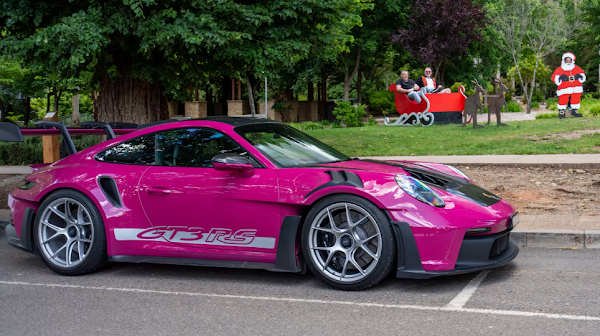
This brief meeting was not the last time the hospital attracted attention. Whether it was the unique Ruby Star paint job on the $32,000 test car, or perhaps the huge adjustable wings and all black aero kit… the GT3 RS was absolutely stunning, far more so than any other 911 I've ever driven.

The C412 from Belgrave to Gembrook slid easily under the RS's fat 335 section rear tyres, the suspension handling the bumps well without bothering us too much. This isn't a car designed for commuting, but it was perfect for our first cross-country cruise. However, I would advise against sipping coffee or doing a lippie while traveling.

By far the biggest problem is tire noise. Any road with even slightly rough asphalt will create a rumbling sound that is difficult to speak of. The 911 GT3 RS doesn't have much soundproofing as it doesn't help the car go faster and therefore just adds weight. The doors are made of carbon fiber reinforced plastic, as is the hood, and the glass is thinner, all in the name of reducing weight. This also allows more noise to enter the cabin. However, if you buy an RS, just take care of it.

Although the drivetrain has seven gears to spread out the performance, none of them have long-range ratios tuned for fuel economy. At 100km/h, the engine makes 3000 revolutions per minute, which suggests that the car's claimed top speed of 296km/h will need seventh place to do its job if it is to reach that speed before the 9000rpm stoppage.

Pushing the throttle in seventh doesn't produce jaw-dropping acceleration. In fact, the car at first grumbles as if annoyed that you're demanding a decent hit with a gear that's clearly the wrong one for the job.

Luckily, it's a joy to use the RS's magnesium shift paddles to downshift a few gears and up the revs to the point where the RS can really hit hard. Honestly, the RS's 'magnetically inserted' gear shift lever should be in the Louvre or MoMA, as its shape, feel and action are simply beautiful, right down to the sharp metallic snick that accompanies each pull.
2024 Porsche 911 GT3 RS Side back
That said, driving in Sport mode with the transmission in D isn't second-rate, because it doesn't matter. Porsche engineers have intelligently tuned the transmission to support your current driving style. If you're messing around it will shift quickly and keep the revs low and unobtrusive, but if your throttle and brake application shows more power then the stakes will also increase, selecting a lower gear with higher revs to be ready when You hit. he.

In Gembrook, we stopped for a quick photo outside The Motorist Museum, a vintage motoring museum that happens to be at the end of the Puffing Billy train line. There's nothing in common between the iconic steam train attraction of old and the 911 GT3 RS, so I'm not sure why I'm mentioning it here.

Wait, I have one. Hanging your feet out the window of Puffing Billy as it cruises along is one of the purest pleasures in the transportation world… as is driving a GT3 RS. Hmm, just keep going...

We turned north on Gembrook onto the C424 towards Launch Place, the name of another town with 911 GT3 RS segment potential and a road rated by enthusiasts. The C424 is much less trafficked than the C412, so we can turn up the intensity a bit and enjoy its curved curves and rolling undulations.

It's also an opportunity to roll down the windows and let more of the GT3 RS's exhaust note reach our ears. The RS gets a specially developed stainless steel exhaust system that doesn't actually sound all that great in the lower half of the rev range, although there's a pleasant baritone rumble when you ask the engine to tap into its deeper reserves.

It sounds much better when you're approaching a 9000rpm stop than it does at a 1200rpm idle, so given the opportunity, I'd downshift and let the revs climb, riding the rumble through the corners.

The engine is surprisingly easy to control even though it doesn't have a turbo or hybrid assistance to add torque. Naturally aspirated engines are rare in this era, but the RS's exhaust note and engine response are richer for it. The joy this car brings is due to its uniqueness; he refused to follow convention.

At Yarra Junction, we joined the B380 and pulled into Warburton for a refueling stop, but neither car needed it after less than 100km. I told Brett I was refilling the RS to make sure we had enough fuel to get to Marysville via the Reefton Spur. Despite only 60km to go, I wasn't sure how thirsty the RS would be to drive, and the next section offered the opportunity to do just that.

Another reason I stopped was because my butt and legs hurt. The RS fixed racing bucket seats are as uncompromising as the car itself. There are pads that are all buggery, the backrest angle is fixed, and I've been sitting on two of the five-point buckles since I've been wearing a conventional seat belt. Porsche calls them six-point seat belts because the crotch straps are V-shaped, mounted in two locations up front.

Either way, it's all part of the Weissach Package this test car sported, and not only does it add $85K to the overall price, but it also elevates the RS's singular focus to the extreme.

Here's a quick rundown of what the Weissach Package option brings, which is what you'll need to do if you want to own an RS that set a 'Ring Record.

The exposed carbon roof, bonnet, rear-view mirrors and rear wing – the latter with Porsche written across the bottom so that when you brake hard enough to trigger the rear wing's aero brake function, the car behind you knows what it's about to hit.

Mechanically, you get lightweight magnesium-alloy racing wheels and some carbon axle mods. Inside, there's a carbon roll cage with the aforementioned six-point safety belts for both seats, plus a fire extinguisher, fabric door pulls instead of door handles (easier to open when wearing racing gloves), magnesium gearshift paddles that Very easy to touch, and the 'Weissach Logo packs on various cabin surfaces.

The car I drove had several options other than the Weissach Package. It also has a special Ruby Star color ($32,440) that pays homage to Porsche's Rubystone Red that debuted on the 964 Carrera RS in 1991, color LED matrix headlights ($6100), a Bose sound system ($2970), an accent and lighting design package ( $2640 ), Porsche logo LED door courtesy lights ($300) and a few other items, bringing the total purchase cost to $670,660.

Travel costs, including stamp duty, will add $80–100K to the price, so let's say $770K for a long drive.

If you're serious about track days, you might want to consider the ceramic composite brakes at another $19K – not that we had any problems with the standard brakes during testing.

Important details 202 4 Porsche 911 GT3 RS
Engine Naturally aspirated 4.0-liter flat-six engine
Power 386kW @ 8500rpm
Torque 465Nm @ 6300rpm
Drive type Rear wheel drive
Transmission Dual-clutch seven-speed automatic
Power to weight ratio 266.2kW/t
Weight (curb) 1450kg
Refueled and revitalized, we were ready to tackle the special Reefton Spur to Marysville stage. Conditions were excellent: the weather was great and there was almost no traffic in the middle of the week.

Despite the Porsche's incredible capabilities – or perhaps because of them – the 20.8km journey from the bridge at Reefton to Cumberland Junction took an hour.

Anyone who knows this road will understand why we stopped and retraced our steps time and time again. Taking on a challenging and lonely stretch of road in one of the best sports cars in the world is driving nirvana. The irony is: the better the car, the sooner it ends. So turning around and walking again is a must.

On-the-go issues like tire noise and sore stumps are quickly erased by the Porsche's phenomenal capacity for forward progress. Other problems like work deadlines and family stress will simply disappear as the rest of the world disappears.

A supercar's greatest trick is to make you forget everything but the present. In other words, the performance supercar is the most demanding mistress imaginable. It expects your full attention at all times, and does not tolerate stray thoughts or distractions.

Focus on cars and roads, and the rewards will flow richer than what an oil sheikh does. But if your attention wavers, RS will work against you. This might just be a pain trying to make the RS into a commuter car, or it might be even worse if you lose concentration during more spirited battles.

The Porsche 911 GT3 RS is one of the best machines for carving up beautiful stretches of asphalt. I can't think of any other road car that feels as fast and stable as the Porsche GT3 RS.

Rob Margeit says, “nothing can match the supreme confidence” he finds behind the wheel. I now know what he meant. The RS is so raw but also so confidence-inspiring that I never felt intimidated, even on this narrow, winding road with a rock wall on one side and a long drop on the other.

The RS has a lot of firepower, but the amount of grip it produces – both mechanical and aerodynamic – needs to be experienced to be believed. Despite the dual challenges of the incredible powertrain power and the sometimes rough and uneven road surface, the RS simply flew across the asphalt, never jumping, slipping or skidding, and never threatening to get away from me. On narrow roads the feet feel light and agile, always ready to turn. However, on roads with heavier currents, this feels hampered.

My road drives never reach speeds where you need to turn off mental defense mechanisms and trust in aerodynamic grip. We also didn't press the brakes hard enough to understand the function of the rear wing's aero brakes. But even at this speed, the RS is very quick and a very exhilarating partner.

RS never threatens; it instills confidence and builds your self-confidence with its innate poise and incredible balance. Pushing into a corner came with a bit of understeer and only a little body roll before clearing the corner.

The RS also never keeps you guessing. It keeps you informed via the steering wheel, the seat of your pants, the pedals – not to mention its looks and sound – so you're never in doubt about how much of its capabilities you're using and how much more it has. give.

Eventually, we had to leave Reefton Spur and begin the long journey home. On our way across the horizon past the Lake Mountain turnoff – another great road for another day – and toward Marysville, we encountered a rare sight.

Six cars were parked at the Marysville lookout: Lamborghini Huracan, McLaren 570S, Ferrari F8 Tributo, C8 Corvette, Audi R8 V10 and Lotus Emira. We had entered the Prancing Horse VIP riding day on our way to Levantine Hill Winery for lunch. It seems appropriate to park the GT3 RS in their midst, although I'm not sure whether the Prancing Horse tour leader agrees with many of his clients flocking to Ruby Red Porsches.

It's a fair bet that the Porsche will outpace any car on the road, and certainly on the racetrack. All of these cars are designed for performance but keeping everyday life in mind. With the 911 GT3 RS, Porsche has created a one-eyed fanatic.

After the Prancing Horse convoy departed, we took a few photos and headed to the Marysville Pub for lunch and discussion. Stopping outside the pub, I left the hospital interior smiling and grimacing. That smile was for the journey we had just been on, and that smile was because my body was starting to complain.

In comparison, Brett was all smiles as he exited the Caymans and there was no sign of physical discomfort. His kicks were obviously good too, and he still had full use of his back and legs.

If money were no object, I would immediately own a 992 Series Porsche 911 GT3 RS… and I would never be able to live with it.

RennSport's GT3 is the pinnacle of Porsche 911 performance today. There's nothing more capable, nothing more desirable, and nothing faster with a Porsche badge. And, at $770,000 on-road for the example we tested, there's nothing more expensive in the range.

If you're the kind of person who buys a flagship car like this for ego-driven financial reasons, then the punishment the 992 RS will exact on your body will be well deserved.

This is not a car for movie stars, stockbrokers, or shallow real estate moguls. This car will put you to shame when it bumps and bounces down the road before you scrape your carbon lip on the driveway gutter because you forgot to use the nose lifter. Then you'll grunt and groan as you get up and out of that uncomfortable, uncompromising racing chair, stumbling on sore feet into the fancy restaurant you visited just to be seen.

Returning to the RS after a belt buckle is just as humbling as you perch on the RS's carbon racing seat bolsters before plunging into the cushioned seat base, landing face first on the big racing seat belt and holding two more against the small of your back.

But…

If you have the money, have done your research, and bought the fastest, track-ready 911 because you want to experience what uncompromising performance is like, then I'm jealous that you have this car in your garage. , ready and waiting for another fun day.

When we arrived home at the end of our big day, I was 10 years younger on the inside and 20 years older on the outside. I now have memories that will last forever and pain that feels like it will too.

Brett, on the other hand, has memory but no physical ailments from long days in the saddle. His Cayman may not have reached the high performance levels of the 992 RS, but I know he really enjoyed driving it.

Secretly, I'm sure he also enjoyed his short ride in the 992 RS on the Reefton Spur. And now, every time he takes his Cayman out of the garage, he'll enjoy driving it even more, knowing that the same engineering prowess that has produced incredible RS engines for 50 years also created his daily driver.
Share:

2024 Porsche Cayenne Turbo E-Hybrid First Drive

2024 Porsche Cayenne Turbo E-Hybrid Review

This 729-horsepower luxury UV doesn't give up on driving fun in its quest for PHEV efficiency.


The Cayenne, the SUV that Porsche loyalists once said would kill the brand, is not only the company's best-selling SUV – the golden goose that holds the company's coffers to fund an ever-improving portfolio of sports cars – but continues to evolve into paradoxical new dimensions of poise and performance which is astonishing.

The Cayenne has always managed to bring both worlds together, offering an engaging drive and everyday capabilities that many small SUVs can't deliver. Previous plug-in Hybrid and later E-Hybrid models began to show that Porsche was addressing one missing piece of the puzzle: savings.

With this new E-Hybrid model for 2024, which offers a much wider range than before, savings are finally key. Meanwhile, its improved suspension system offers greater comfort but features like rear-wheel steering and torque vectoring create an SUV that handles better than anything else this size. And there is also quite a lot of power, namely 729 horsepower. Let's dig into the details.

2024 Porsche Cayenne Turbo E-Hybrid Coupe Quick Stats
Twin-Turbocharged 4.0 liter V8 Hybrid Engine
Single Permanent Magnet Synchronous Motor
Output 729 Horsepower / 700 Pound-Feet
Eight-Speed Automatic Transmission
Base price $99,100 + $1,650 Destination
As Tested Price $199,080


2024 Porsche Cayenne Turbo E-Hybrid Exterior

Name Is Key

The new Cayenne E-Hybrid Turbo offers 729 hp and 700 pound-feet of torque when its V8 and electric motor are at full throttle. Even the smaller Cayenne S E-Hybrid offers 512 hp and 553 lb-ft of torque. These are big numbers for an SUV of any color but for something capable of going around 50 miles without using up a drop of gas? It was incredible.

In the E-Hybrid Turbo, you get Porsche's tried-and-true turbocharged 4.0-liter V8 with a nearly square 591 hp and 590 lb-ft of torque before the battery is used. For the Cayenne S E-Hybrid, it's the 3.0 that Porsche also ranks well. -liter V6, producing 348 hp and 368 lb-ft of its own.

That kind of range is offered by the new 25.9-kilowatt-hour battery pack. That's up almost 50 percent compared to the old E-Hybrid's 17.9 kWh. This new battery is paired with an overall more sophisticated electrical system with a few other tricks, such as being able to suck back 88 kilowatts from the electric motor in braking regeneration. More on that later.

Those kilowatts come from a new 174 hp electric motor sandwiched between an internal combustion engine and an eight-speed automatic transmission. Its placement means the motor can increase engine torque to produce maximum output. Alternatively, he can drive the car himself with full access to every gear. That means you can go up to 84 mph on the highway without starting the engine. Again, amazing.


2024 Porsche Cayenne Turbo E-Hybrid Side view

Smooth is Fast

When I got into the new plug-in Cayennes, Porsche started by handing me the keys to the top-of-the-line Turbo E-Hybrid Coupe. The fastback feel of this SUV only gives up 2.5 cubic feet of storage space (down from 25.8 to 23.3) in exchange for a sharper look that's enhanced by some classic red PORSCHE graphics on the sides – graphics I'll admit feel a bit out of place. until I later realized how fast it was.

The day started in terrible city traffic as we made our way through the morning rush hour in Barcelona. The drivers here are not as polite as the drivers in Rome, but they are also impatient with foreigners who are not entirely sure which lane to take when turning. I was repeatedly mobbed by swarms of buzzing two-stroke scooters, which made me grateful for all of the Cayenne's standard Park Assist ultrasonic sensors, each of which beeped to warn me of any stealth overtaking.

But as I navigated traffic and finally made it out onto the highway, I was also impressed by how smooth the new Cayenne's powertrain was. I was cruising at 120 kilometers per hour (75 miles per hour) before I realized I still hadn't fired the V8.

When the engine revs as it passes someone, the switch from EV to hybrid is so smooth I still can't tell the difference. I had to switch the digital gauge cluster to display the tachometer to be sure. When I purposely cycled back and forth from pure electric to hybrid, there was no interruption and almost no sound.

In its comfort setting, the suspension only amplifies that. Although the roads in this part of Spain are generally smooth, neither the split joints in the road nor the odd bit of asphalt caused any commotion in the cabin. The experience is serene and serene.

Now I know what you're thinking: This doesn't sound like a sports SUV. My goal that morning was to prove the greatness of its performance.


2024 Porsche Cayenne Turbo E-Hybrid Wheel

Track Time

Past the traffic and up into the mountains north of Barcelona brought me to a beautiful hidden race track called Parcmotor Castellani. When I arrived, I expected to be driven to a different Cayenne that had a track set up. Not. I was instructed to tow the same Turbo E-Hybrid Coupe to the pit lane and, without even changing the tire pressure (or wearing a helmet), I was sent for a lap session in what turned out to be a fun high-speed race. circuit.

I'm well aware that virtually no Cayenne owner will track their car, but in this kind of program, it's very rare to drive on the road and the track in the same car. That I moved from one place to another without any preparation shows Porsche's confidence that it can handle it.

And yes, it can. It's no surprise that the Turbo E-Hybrid is fast. A 0-60 time of 3.5 seconds makes that clear. However, it is the distribution of energy that is more important. The torque from the electric motor means the Cayenne can power out of faster corners without hesitation, boosting charging to provide a boost at higher speeds – ample driving force for this technical track.

You can tell this is a fast SUV from the numbers, but you'll have to drive it to feel how well it revs. Porsche not only brought the rear axle steering system for use here but also the Porsche Torque Vectoring Plus rear differential. Together, they produce something incredibly nimble.

I say surprising because I got a little out of shape on my first run at speed. Expecting an understeer, I turned aggressively and aimed for the inside apex. Consistently, I had to make late corrections to avoid jumping over the curb, then had to make more corrections when the rear came out due to hard acceleration.

This Cayenne is a delightful companion on the track and a great time. And, yes, the suspension did its job, ensuring things were handled beautifully and even maintained a bit of body roll despite my higher stance.

That spread – smoothness on the road and unexpected composure on the track – is thanks to the two-valve adaptive air suspension. Not only can it perform the usual tricks of raising the rig for off-roading or dropping it for track activities, but it can also vary compression and rebound damping on the fly to ensure optimal handling in all conditions. Best of all, it's standard equipment.


2024 Porsche Cayenne Turbo E-Hybrid Interior

Turbo versus S


Although my time on the track was limited to the Turbo Coupe, I also drove the V6 Cayenne S E-Hybrid through some beautiful mountain roads in and around Montserrat. I have to say: S is the right choice for me. It offers the same battery and motor combination, so the initial electric torque spike is the same. And, despite being down 217 hp compared to the Turbo, the Cayenne S E-Hybrid still has a combined 512 horsepower on offer.

In tight bends and corners, that's enough. However, this is where I started to feel uneven brake performance. I struggled to stop calmly and smoothly. Only later, while talking to a Porsche engineer, did I realize what was going on: the E-Hybrid's braking system reconfigured itself depending on the driving mode.

There are effectively two different braking modes the car can switch between. Softer modes are used in E-Power and Hybrid Auto modes, while Sport and Sport Plus get more aggressive settings. As I spent most of my time on the road switching back and forth between modes, and experiencing different driving behaviors, I kept finding myself needing to add more braking force at the end or, conversely, stopping too early.

But in the real world, I don't expect this to be a problem. No one will turn the steering wheel-mounted driving mode dial as hard as I did that day. Once I noticed the difference, I started to appreciate the extra braking response when I was driving hard and the extra smoothness when weaving through traffic.

Select Your Plug-In

While this SUV will never be Porsche's biggest styling powerhouse, the updated Cayenne's looks and aesthetic remain clean and attractive. For the E-Hybrid, there isn't much of a visual difference.

Standard features, however, are significantly upgraded over the base Cayenne. Matrix Design LED headlights, eight-way power seats, the aforementioned PASM, and even the Sport Chrono package come without ticking a single box. However, you will need to write a sizable check.

The final piece of the puzzle is cost, and as you can probably guess, considering the amount of performance and standard equipment, that cost is quite substantial. The base, the 2024 Porsche Cayenne S E-Hybrid starts at $99,100, and the Coupe at $104,400. Meanwhile, the Turbo E-Hybrid SUV is much more expensive at $146,900, and the Coupe is $151,400.

Yes, ouch, but it's hard to feel too bitter about it. With enough electric range for most people to get to work and back without needing to waste a drop of petrol, plus the incredible speed and performance on offer here, this is a near-perfect package for those who spend a lot of money and need more practicality than a car. the rest of the Porsche lineup. Of course, it won't surprise anyone on the street, but it will open the eyes of anyone you take for a ride.

2024 Porsche Cayenne Turbo E-Hybrid Coupe


  4.0-liter Twin-Turbocharged V8 Hybrid ENGINE
  Single Permanent Magnet Synchronous MOTOR
  OUTPUT 729 Horsepower / 700 Pound-Feet
  Eight-Speed Automatic TRANSMISSION
  DRIVE TYPE All Wheel Drive
  25.9 Kilowatt-Hour Lithium-Ion BATTERY
  SPEED 0-60 MPH 3.5 Seconds
  MAXIMUM SPEED 183 Miles Per Hour
  EFFICIENCY TBD
  EV RANGE 56 miles (WLTP)
  CHARGING TIME 2.5 Hours @ 240 Volts
  CHARGE TYPE 110 Volt / 240 Volt
  WEIGHT 5,664 Pounds
  SEATING CAPACITY 5
  CARGO VOLUME 25.8 / 55 Cubic Feet
  PULL 6,613 Pounds
  LOAD 1,424 Pounds
  BASE PRICE $99,100 + $1,650 Destination
  BASE PRICE CUT $148,550
  TESTED PRICE $199,080
Share:

2019 Porsche Taycan Turbo S

Porsche Taycan Turbo S Review
As a fan of the automotive world, have you ever heard of the Porsche Taycan electric car? Yes, this car is a type of sports car that uses full electricity or electric power in all its parts.

First introduced in 2015 under the name Porsche Mission E at the Frankfurt Motor Show. Then, after production was underway and completed in 2019. This car was published at the same event using the Porsche Series Electric Car theme.

Of course, this car also has different levels and series if you look at its performance. If you look at the series, the Porsche Taycan has 3 car models namely Porsche Taycan Turbo S, Porsche Taycan 4S Cross Turismo, and Porsche Taycan Turbo Cross Turismo.

These three cars give different impressions in terms of performance, exterior, and price. Electric cars are now starting to be used in several developed countries. In Indonesia itself, this car was only introduced privately last February.

Overall, the designer of the Porsche Taycan electric car is named Michael Mauer. A famous automobile designer from Germany who worked for the Saab and Mercedes-Benz automobile companies. If you look at his quality, of course, Michael is a genius.

Taycan itself comes from Turkish which uses the concept of "Lively Young Hours". This is demonstrated by its elegant exterior appearance and high performance. Even though this car does not use a turbocharger, the name Turbo is still given to both series.


Porsche Taycan Turbo S Exterior
The body of this electric car is made from specially processed steel and aluminum. Special techniques for installing the roof, sides, and seat of the car frame are designed to increase driver safety against the risk of accidents.

Apart from that, the entire frame and components of the car also consist of aluminum which aims to reduce weight to increase speed. According to existing data, this car has approximately 37% aluminum and the rest consists of steel.
Porsche Taycan Turbo S Model
For battery specifications, the Porsche Taycan electric car uses a new battery with a permanent magnet synchronous motor. The single-speed gear ratio of the Taycan is 8.05:1 with a two-speed slip differential transmission at the rear.

Then there is also a first gear gearbox which has maximum acceleration. The engine is also equipped with high acceleration when entering second gear with speed and efficiency. This type of Porsche car uses a 93 kWH 630 Kg Lithium-ion battery pack.

The weight of the battery is useful for keeping the center of gravity low with a mounting location on the rear chassis. When evaluated on the track, this electric car was able to rotate with stable performance and could last until the battery was completely empty.

For the Charger Port, this car has 2 parts, namely on the left side and the right side. Each port has its own channel, both DC and AC. With 2 charging channels, you can do it anywhere and anytime there is space.

Overall, this car looks typical of the style that Porsche cars display in general. For the Taycan series, the side exterior of the car can look like a typical Porsche-style Fender model. The car is also made to look sexy and smooth from front to back.
The Taycan itself is decorated with a futuristic appearance so that it can attract the hearts of today's teenagers. If you look, the door handles on both sides of the car are very stylish with their minimalist curves.

Then, the Porsche Taycan electric car is also equipped with a "Swipe" control system to open the charging hole from the front fender. The futuristic touch creates a new atmosphere with a minimalist and elegant appearance.

This electric car uses Matrix LED headlights with a touch of straight lines. From the front alone, the car can already be recognized as a Porsche product. For the rear side, futuristic details are displayed with curved lines and the name Taycan.
Porsche Taycan Turbo S Back
Apart from that, the bottom side of the steps and mirrors are also given carbon fiber to make them look better. The upper hood uses a panoramic roof and gives an exotic impression. The door glass frames are also made without frames so the shape is the same as sports cars in general.

For those of you who want to buy the latest sports car with a youthful, futuristic, elegant, and luxurious exterior? Maybe the Porsche Taycan could be the best choice. In fact, the interior appearance is also very luxurious and you won't regret buying it.

Overall, this car uses a digital screen without any analog. Of course, the shape is made futuristic with a distinctive Porsche dashboard. The power steering grip is also covered in leather so the grip is comfortable.

The car's transmission is made small under the steering wheel with a minimalist shape. In fact, all programs and settings for this car are also done from the dashboard touchscreen. For the AC hole alone, it is made simple and the settings are done from the touch screen, both temperature settings and direction.

Porsche Taycan Turbo S Interior view
As for speed, the Taycan Turbo S series can reach speeds of 260 mph. The engine power of this series is also 751 HP with a torque of 1050 Nm. The car can go from 0 to the top in just 2 minutes.

Apart from the Turbo S series, there is also a version below, namely the Porsche Taycan Turbo Cross Turismo with a maximum speed of 250 Kmph and 616 horsepower. The torque provided is 850 Nm, so it is average for medium sports cars in general.

There is also a lower version of this car, namely the 4S Cross Turismo with a maximum speed of 240 kmph. Its power is 482 horsepower with 650 Nm of torque. This series is indeed cheap because the marketing target is made for today's young people.

However, if you look at its power and speed, this car can already compete in the automotive market. The Turbo S's maximum speed cannot be underestimated with stable battery power. Therefore, this car is very special, especially in terms of performance.
Porsche Taycan Turbo S Interior
all three Porsche series are available so you can buy them. But before that, the main question is whether this car is worth buying? Of course, the answer depends on your own interest in sports cars.

Basically, the Porsche Taycan is an electric car that requires more power from a battery charge. The car also has the maximum distance it can travel because of the large battery capacity. You have to consider wisely the use of this car.

If you want to drive in the city, then this car can be used as intended. But if you want to travel outside the city, you should first think about the energy and power available. The Porsche Taycan electric car has a maximum range of 416 km so it's not too far.

At least this car can be used to travel long distances from the city of Jakarta to the cities of Tegal or Sukoharjo. Apart from the distance traveled, you also have to pay attention to the fuel. Currently, in Indonesia, there are still few places that provide electric car charging stations.
If there is, the charging power will also be expensive and it will take you a long time. Indonesia is currently still not suitable for electric cars. The reasons are the distance traveled, battery power and there are also spare parts that are still difficult to get when the car experiences problems.
Porsche Taycan Turbo S Wheel

That's why you are advised to think about it first before buying it. Nowadays, electric cars are still in their infancy, so few people use them. In Asia and the Middle East alone, only a small number of people use electric cars.


Share:

Popular Posts

Followers