luxury cars-images This blog contains various forms of cars and at a glance most of the new information, present and future, this blog will always feature luxury cars, and sports cars, and provide information about the content, Toyota, Ford, Honda, BMW, Rolls-Royce, Tesla, Mitsubishi, Mazda, Chevrolet, SUV, Automotive, Pick-up, Sports Cars
  • LAMBORGHINI MODEL

    The most visionary models, these unique specimens are set to define the highest limits of technology and design. Unveiled at the most prestigious international Motor Shows, they offer an exclusive look at the most innovative solutions that Lamborghini may adopt in its future series-production models.

  • RAV4 Interior

    Premium materials and a focus on comfort raise RAV4 Hybrid’s level of refinement. Whether appreciating the views through the available panoramic glass roof or finding inspiration from RAV4 Hybrid’s attention to detail, you’ll enjoy a ride that’s ready to go the distance. Explore Interior

  • Ford F-150 Raptor

    The Ford F-150 Raptor pumps out so much fun and such oversize thrills, you'd assume that it had been outlawed years ago

  • Ford Mustang GT500

    Ford Mustang Shelby GT500 makes this car the most powerful car ever made by the American manufacturer. This is because the Ford Mustang Shelby GT500 is equipped with an engine capable of 760 horsepower

  • Tesla Roadster Fastest Electric Car

    Tesla claims the Roadster to be the fastest production car ever made! The second-generation Tesla Roadster can go from 0 to 60 miles per hour in under 1.9 seconds, and this is just for the base model.

Showing posts with label Toyota. Show all posts

2025 Toyota RAV4 GX 2.5L SUV FWD Hybrid

Based on the information available, here is a review summary focusing on what's generally highlighted for the RAV4 Hybrid, including details relevant to the GX trim where possible:

 Key Takeaways for the 2025 Toyota RAV4 Hybrid

The Toyota RAV4 Hybrid is consistently praised for its excellent fuel economy, practicality, and user-friendly interior. The GX trim, often positioned as a well-equipped base or near-base model (depending on the market), offers a strong package focused on efficiency and core SUV

Powertrain & Efficiency

  • Engine: It utilizes a 2.5L Hybrid Electric System paired with an Auto CVT (Continuously Variable Transmission).

  • Fuel Economy: This is a major strength. Depending on the market and specific testing cycle, the hybrid models achieve very impressive figures, often around 4.7L/100km to 4.8L/100km combined (or EPA estimates around 39 MPG combined).

  • Performance: While not a sports car, the hybrid powertrain provides smooth and responsive driving. The net combined power for the hybrid system is often cited around 160-163 kW (or 219 net combined hp in some regions).

  • Drivetrain: You specified FWD (Front-Wheel Drive), which contributes to its top-tier fuel efficiency figures compared to AWD versions.

GX Trim Specifics & Features

The GX trim tends to offer essential features:

  • Wheels: Often comes with 17-inch alloy wheels.

  • Infotainment: Typically includes a functional system, sometimes an 8.0-inch display with standard features like wireless Apple CarPlay/Android Auto. Higher trims get larger screens (10.5-inch) and digital clusters.

  • Interior: Focuses on functionality with decent space, known for being easy to get in and out of due to its SUV ride height.

  • Cargo: Good utility with a boot capacity usually around 542L to 580L, expandable when the rear seats are folded.

 Safety & Technology

  • Safety Suite: Toyota generally bundles its safety features across the lineup (often Toyota Safety Sense), which includes:

    • Pre-collision systems with pedestrian detection.

    • Adaptive cruise control (Full-speed range).

    • Lane departure warning with lane-keeping assist.

    • Automatic high beams.

  • Parking/Visibility: May include standard features like a rear-view camera, though features like a 360-degree camera are usually reserved for higher trims.

Pros & ❌ Cons (General Hybrid Model Observations)

ProsCons
Exceptional Fuel Economy in the segment.Handling is competent but generally described as workaday, not particularly exciting compared to some rivals.
Spacious and User-Friendly Interior.Interior materials might feel less premium than some competitors in the mid-range trims.
Standard Safety Features across the range.Towing capacity is modest (often around 1500kg braked).
Reliability and Cheap Servicing reputation.


Share:

2024 Toyota C-HR

Automotive
2024 Toyota C-HR
The first-generation C-HR Hybrid was one of the only hybrid small SUVs you could buy when it launched in late 2019, but in 2024, you are spoilt for choice.

There's the Nissan Qashqai e-Power and its unique set-up, the second-generation Kona now available with a hybrid, and the Mitsubishi Eclipse Cross plug-in, not to mention this car's Toyota Corolla Cross hybrid stablemate.

Now kicking off at $42,990 before on-road costs, the new GXL is $11,275 pricier than the previous point of entry, but to be fair, the outgoing model was offered only with an 85kW/185Nm 1.2-litre turbo-petrol engine.

As for the Koba, pricing now starts at $49,990, also up by more than $11,000 compared to before.

However, the top-spec GR Sport sees the biggest jump, increasing around $16,500 to $54,990, putting it well and truly into hot hatch territory.

An affordable Toyota hybrid the 2024 C-HR is not.

To put it into perspective, the Honda HR-V e:HEV can be had for $47,000 drive-away, putting it at around the same price as the range-opening C-HR GXL, but the former is fitted with more upmarket features.

Likewise, the cost of entry into a Hyundai Kona Hybrid starts at just $36,000 before on-road costs and extends to $46,500, while the fully loaded and much more practical Nissan Qashqai Ti e-Power is $51,590.

However, it might be the Corolla Cross that gives the C-HR the most trouble, with prices ranging from $36,480 to $50,030, it's an easier sell because it feels more substantial and has a broader appeal.

Still, Toyota Australia is aware of the new C-HR's high pricing and is banking on the styling of the 'Coupe High-Rider' to appeal to young couples or empty-nesters who don't want something as dated-looking as a Corolla Cross.

To be fair, the C-HR is attention-grabbing thanks to its signature 'hammerhead' front lighting, flat nose, low roof line, and chiseled derrière.

Fun fact: It is also the first Toyota model with flush-fitting door handles!

For the money, standard equipment includes 17-inch alloy wheels, sports seats, a 7.0-inch driver's display, 12.3-inch infotainment system, six-speaker sound system, keyless entry, push-button start, and a bevy of safety systems ( more details below).

Stepping up to the Koba nets you 19-inch alloys, bi-LED headlights, heated front seats, suede interior highlights, a head-up display, 12.3-inch digital instrument cluster, nine-speaker JBL sound system, wireless smartphone charger, and a powered tailgate.
2024 Toyota C-HR Enginer
As for the GR Sport, it scores a more potent powertrain, and there are also upgraded brakes, a heated steering wheel, GR floor mats and steering wheel, and aluminum scuff plates.

Three options are available to C-HR buyers, a $775 two-tone premium paint finish, a $1550 two-tone plus premium paint finish, and a $2700 two-tone plus premium paint finish with panoramic roof.

Does that sound like an equipment list to justify a near-enough $50,000 and beyond small SUV? Not to me.

You can now get full battery-electric vehicles or full-fat hot hatches for less money than the new C-HR, so you'd have to really love the styling to opt for Toyota's new small SUV over other models on the market.

Key details 2024 Toyota C-HR
Price GXL: $42,990 plus on-road costs
Koba: $49,990 plus on-road costs
GR Sport: $54,990 plus on-road costs
Options Two-tone premium paint – $775
Two-tone plus premium paint – $1550
Two-tone plus premium paint and panoramic roof – $2700
GXL drive-away price: $47,646 (VIC, before options)
Koba: $55,640 (VIC, before options)
GR Sport: $60,850 (VIC, before options)
Hyundai Kona Rivals | Honda HR-V | Toyota Corolla Cross
2024 Toyota C-HR Exterior
How big is a Toyota C-HR?
At least the cabin of the C-HR is a pleasant enough space to be.

It's a Toyota after all, so there is an abundance of hard and scratchy – albeit, hard-wearing – plastics all around, but I like how comfortable the driver feels in here thanks to sweeping door cards that draw your attention forward.

The touchpoints are also nice, with leather found on the steering wheel and shifter, and everything is laid out ergonomically and intuitively.

It's always nice to see buttons for climate controls in 2024, and the C-HR has a dual-zone set-up, while the infotainment system is large and easy to navigate.

The GR Sport flagship also gets a scattering of racier bits in the cabin, including red accenting, branded steering wheel, and aluminum scuff plates.

Storage options are plentiful, although not all that practical. You can get a large bottle in the door pocket, there's a shallow tray for your smartphone and wallet, two cupholders, and a small underarm storage cubby. You'll be able to empty your pockets in the C-HR, but it won't accommodate much else in the front row.

In the second row, though, space is a little lacking luster.

Sitting behind my driving position, I found it hard to get comfortable as there wasn't a lot of leg and head room available for my six-foot-tall (183cm) frame. In fact, if I sit back and upright, my head will foul the roof. I imagine children and smaller adults will be able to fit comfortably, but it is snug.
2024 Toyota C-HR Interior
It's also just quite sparse in the second row. There's no fold-down center armrest, there are no air vents, there's only one back-seat map pocket, and there's no door pocket, just a shallow cupholder and storage tray built into the door cards.

And only in mid-spec Koba and flagship GR Sport grades do you get a single USB-C charging port for second-row passengers.

The funky design comes at a cost, and it is the C-HR's practicality.

Opening the boot of the front-wheel-drive C-HR variant reveals a cavity capable of swallowing 388 liters of volume, compared to 318L in the C-HR of old.

You'll still be able to fit groceries, small luggage cases and the like, but for families with a pram, you'll be better off looking at something like a Hyundai Kona or Nissan Qashqai.

The top-spec GR Sport also has a smaller boot because of the second electric motor driving the rear axle, dropping capacity down to 362L.

Fold the rear seats down and that space swells to 1155L in the GXL and Koba, and 1134L in the GR Sport, making a trip to Ikea or Bunnings a possibility, but rear boot space is not this model's forte.

2024 Toyota C-HR
Seats Five
GXL/Koba boot volume: 388L seats up
GXL/Koba: 1155L seats folded
GR Sport: 362L seats up
GR Sport: 1134L seats folded
Length 4362mm
Width 1832mm
GXL Height: 1558mm
Koba/GR Sport: 1564mm
Wheelbase 2640mm
2024 Toyota C-HR Back
Does the Toyota C-HR have Apple CarPlay and Android Auto?

All versions of the 2024 Toyota C-HR are equipped with a 12.3-inch multimedia touchscreen with Apple CarPlay and Android Auto functionality. However, the former can be connected wirelessly, whereas the latter requires a cable.

For owners who don't want to use the smartphone mirroring feature, there is also built-in satellite navigation across the new C-HR range, as well as digital radio.

The large, widescreen display looks crisp and feels snappy when jumping around the different functions.

The Japanese brand also offers a myToyota Connect smartphone app with 12 months of free access to Connect+ and Multimedia Connect for all new C-HR buyers.

The myToyota Connect app allows access to an online service booking tool, C-HR instruction manuals, recall notices, and Ampol service station discounts.

However, remote vehicle status monitoring, remote climate-control adjustment, and a vehicle locator are walled behind the Connect+ service, which will cost customers $9.95 per month after the initial 12-month period.

The Multimedia Connect functionality is another $12.50 per month after the complimentary period ends, and allows users to set up multiple infotainment profiles, and push in-car satellite navigation to smartphones for last-mile directions.

Is the Toyota C-HR a safe car?
The 2024 Toyota C-HR is yet to be tested by ANCAP or Euro NCAP, and therefore does not have an official crash-test safety rating.

For what it's worth, Toyota has traditionally performed well in crash testing and fits a lot of required safety equipment as standard for a five-star score.

What safety technology does the Toyota C-HR have?
Despite not having a crash test score, the 2024 C-HR is fitted with a long list of safety equipment that bodes well if, or when, it is examined by ANCAP.

Each grade comes with Toyota's Safety Sense suite that bundles autonomous emergency braking (AEB) with pedestrian and cyclist detection, intersection collision avoidance, emergency steering assist, adaptive cruise control, traffic sign recognition, lane-trace assist, lane-departure warning, and automatic high beams.

Other standard active safety systems include a driver attention monitor, blind-spot monitoring, safe exit assist, rear cross-traffic alert, semi-autonomous parking, a surround-view monitor, and front and rear parking sensors.

Stepping up to the Koba and GR Sport adds adaptive high beams.

All new C-HRs are fitted with 10 airbags.

Autonomous Emergency Braking (AEB) Yes Includes pedestrian, cyclist, junction
Adaptive Cruise Control Yes Includes curve speed reduction
Blind Spot Alert Yes Includes Safe Exit Assist
Rear Cross-Traffic Alert Yes Alert and assist functions
Lane Assistance Yes Lane-departure warning, lane-keep assist, lane-centring assist
Road Sign Recognition Yes Includes speed limit assist
Driver Attention Warning Yes Includes fatigue monitor
Cameras & Sensors Yes Front and rear sensors, 360-degree camera
How much does the Toyota C-HR cost to run?
Each new Toyota C-HR comes with a five-year/unlimited-kilometre warranty, which matches the industry standard, but trails Kia and Mitsubishi's seven- and 10-year periods respectively.

Scheduled service intervals are every 12 months or 15,000km, whichever occurs first.

The C-HR also boasts capped-price servicing for its warranty period, with each annual maintenance costing just $200.

This means that over five years, owners could shell out as little as $1000 to keep the C-HR on the road, which is slightly costlier than the Honda HR-V ($995), but much more affordable than the Hyundai Kona Hybrid ($2535).

Due to the newness of this model, our insurer was unable to provide a comprehensive quote for the 2024 Toyota C-HR.

For reference, a Hyundai Kona Hybrid will cost $1504 to insure, while a Toyota Corolla Cross is $1920 and a Honda HR-V is $2280, based on a comparative quote for a 35-year-old male driver living in Chatswood, NSW. Insurance estimates may vary based on your location, driving history, and personal circumstances.

At a glance 2024 Toyota C-HR
Warranty Five years, unlimited km
Battery warranty Five years, unlimited km
Service intervals 12 months or 15,000km
Servicing costs $600 (3 years)
$1000 (5 years)
Is the Toyota C-HR fuel-efficient?
With all versions of the new C-HR fitted with a hybrid powertrain, fuel efficiency is a forte.

Officially, the GXL and Koba feature an official fuel economy figure of 4.0 litres per 100 kilometres, whereas the GR Sport boasts a 4.1L/100km number.

The reason for the variance is that the GXL and Koba make use of a 1.8-litre petrol engine that is paired with a single electric motor with a combined output of 103kW that drives the front wheels.
Share:

2024 Toyota Tundra

2024 Toyota Tundra Review
2024 Toyota Tundra review: Australian first drive. The US-built Toyota Tundra represents uncharted territory for the Japanese brand in Australia. We find out what Australia's top-selling brand brings to this fast-growing segment. 

2024 Toyota Tundra
Australia’s love affair with the ute is only growing – even after the demise of locally built load-luggers such as the Holden Commodore and Ford Falcon. Dual-cab utes regularly front up as the best-selling types of cars each month, but a growing cohort of manufacturers are beginning to offer even more ‘ute’, with American-built full-size pick-ups.

Ram trucks have graced Australian roads for years, now, in right-hand-drive guise, and newer rivals such as the Chevrolet Silverado and Ford F-150 ensure heavy-hauling transport keeps moving.

They represent the next step up for dual-cab ute buyers, and are particularly sought after by people after the ultimate towing ability you can have on a regular driver’s licence.

Toyota is the latest manufacturer to show interest in offering its own full-size pick-up, and has begun a trial of 300 Toyota Tundras on local roads in a world-first exercise.

It’s the first time anywhere in the world Toyota has taken a vehicle built in one country, shipped it to another, re-engineered it and undertaken final assembly with a local partner, with plans to still sell it as a Toyota model inside its own dealerships.

That local partner is the Walkinshaw Automotive Group (formerly in charge of Holden Special Vehicles), which already handles the remanufacturing of the Ram 1500 and Chevrolet Silverado.

Toyota already sells plenty of towing vehicles in our market, but the brand is preparing to offer the Tundra pick-up locally by importing it as a left-hand-drive vehicle, as built in the United States, and then remanufacturing the Tundra to right-hand drive with help from the Walkinshaw Automotive Group.

Toyota’s plan with the Tundra is to lease out its collection of 300 Tundras to customers over the next 12 months, before ultimately deciding on whether the car will be green-lit for general sale out of Toyota dealerships.

Key details 2024 Toyota Tundra
Engine 3.5-litre six-cylinder twin-turbo petrol
Power 290kW @ 5200rpm petrol
36kW electric
326kW combined
Torque 650Nm @ 2400–3600rpm petrol
790Nm combined
Drive type Dual-range four-wheel drive
Transmission 10-speed torque converter automatic
Power-to-weight ratio 117.3kW/t
Weight 2778kg
Spare tyre type Full-size
Tow rating 4500kg braked
Select media outlets were invited to the Australian Automotive Research Centre in Anglesea, Victoria to learn more about the program and evaluate the Toyota Tundra on private roads – both on and off the beaten track.

While there was lots of detail in Toyota’s Tundra presentation – which I’ll get into shortly – there are still many unknowns about the Tundra’s official introduction to Australia. First, the brand was unable to provide a price, or price range, for the car.

Instead, it charges a hand-picked group of roughly 280 customers (20 Tundras reserved for internal testing) $2500 per month on a full-service lease plan that includes scheduled servicing, mechanical repairs, insurance, registration, replacement tyres and roadside assistance.

In return, the customers must supply feedback on how their experience is going. Toyota says the $2500-a-month lease price is subsidised, considering the feedback aspect.

Customers will have the vehicles for the 12-month period before having to give the car back.

We also don’t know exactly when the trial will conclude and Toyota will make its decision on whether the project will be expanded into general sale. However, if it does, the Toyota Tundra will be offered in all dealerships around the country.

As for the car, the Toyota Tundra is initially offered in Australia in a single specification – Tundra Limited with a 'CrewMax' body (the longer of two available dual-cab models) and a short 5.5 foot (168cm) tub. The carmaker says there are some individual studies it’s undertaking with other variants in the Tundra line-up, but at the moment the official trial solely focuses on the Tundra Limited.

Toyota Australia’s wish for including this model in our local line-up centres around its towing ability. Whether it’s a horse float, car trailer, or a great big boat – the Tundra can tow up to 4500kg (after being fitted with a load-rated 70mm tow ball).

It stocks inbuilt towing features including an integrated brake controller, plus a specific towing mode that automatically tweaks shift points, throttle response, and even aerodynamics. The Tundra’s front end has a drop-down spoiler that adjusts as soon as you hook up a trailer on the rear end.

2024 Toyota Tundra
Seats Five
Payload 758kg
GVM 3536kg
GCM 7825kg
Length 5955mm
Width 2040mm
Height 1985mm
Wheelbase 3700mm
The Toyota Tundra’s gross vehicle mass (GVM) is 3536kg and the gross combination mass (GCM) is 7825kg.

Power is supplied by a twin-turbocharged 3.5-litre V6 petrol engine that provides output to a dual-range four-wheel-drive system. The difference for this powertrain, though, is the fact it’s joined by hybrid assistance. Toyota’s coy to call it a hybrid itself, because the hybrid component focuses on providing ultimate pulling power.

Instead, the brand refers to it as the i-Force Max system, incorporating a 290kW/650Nm petrol motor with a 36kW/250Nm electric motor-generator – and a nickel metal hydride battery – for combined system outputs of 326kW and 790Nm.

It also means the Tundra moves away from a standstill using electric power, with the engine kicking in at higher speeds. That’s a particularly unique aspect for such a heavy-hauling, large car.

Getting our first look up close and personal, it’s immediately clear that the Tundra looks nothing like what the brand has offered Down Under before. It’s got a wide front fascia with two headlights set at the extreme edges, plus a big front grille to inlet air to feed the twin-turbo engine.
2024 Toyota Tundra Exterior
Down the side, the design features boxy wheel guards hiding 20-inch alloy wheels, a high-set window line, while the rear gets ‘TUNDRA’ embossed in the tailgate.

There’s plenty to appreciate inside the cabin as well.

Above all, it’s absolutely cavernous. In the first row you feel as though you’re seated in an entirely different postcode to your passenger and the centre console could almost be used as a desk.

There’s a big, lazy seat for front-row occupants to get comfy in, and although there’s little in the way of side support, it at least makes the Tundra an easy truck to slide in and out of. The synthetic leather seats offer both heating and ventilation, while other amenities include dual-zone climate control, wireless phone charging, a full-width powered rear window, five USB ports, 12-speaker JBL audio system, and wireless Apple CarPlay and Android Auto.

On the latter, the gigantic 14-inch display uses similar infotainment software to what you’ll find in other Toyota models like the Corolla Cross. It runs a clear picture for the surround-view cameras, while smartphone mirroring displays boldly on the big screen.

Completing the tech array is a 12.3-inch digital instrument cluster. A slew of safety equipment is included, such as autonomous emergency braking, adaptive cruise control, lane-centring, lane-departure alert, rear cross-traffic alert, blind-spot monitor, 360-degree camera, and all-round parking sensors. The car itself has eight airbags and two ISOFIX points in the second row.


2024 Toyota Tundra Interior
However, Toyota has said that it does not intend to get the car safety-tested by ANCAP.

Aiding practicality is a slew of storage options at the driver’s disposal – huge door pockets, trays all around the gear selector, a deep glovebox, an even deeper centre console bin, and four cupholders.

Materials used inside the cabin are high quality and feel particularly hard-wearing. What’s better, there is no sense that the quality has suffered in the changeover from left- to right-hand drive.

Walkinshaw’s conversion is done to a high standard and it feels like a complete factory build. There’s only a slight hint of wind noise heard from the big mirrors at 100km/h on the move, which felt slightly out of character for Toyota – but otherwise there are no obvious ways to tell it’s a converted vehicle.

Thanks to the new-generation Toyota Tundra sharing its TNGA-F underpinnings with the Toyota LandCruiser 300 Series and Lexus LX, the conversion process utilises the steering rack, firewall, wiring harness, pedals, heating and ventilation systems (including the blower motor), and carpeting and trims from the LandCruiser or LX.

Moving to the second row, the amount of space on offer is similarly gargantuan. I sat alongside two other journalists and there was clear air between us, while leg room is no problem either. My head just touched the roof while in the middle seat, but it’s otherwise an incredibly comfortable second row to spend time.

The materials used in the second row aren’t quite as soft-touch as those found in the front but build quality remains high.

Drive time in the Toyota Tundra was a limited first impression held at the same proving ground in which it was first tested for local use.

First up was tow testing with a 3500kg trailer (the upper limit for many of the dual-cab utes you’ll see on the roads today) and a 4500kg trailer. I found it interesting that even with such a heavy load on the back, the Tundra still pulls away from a standstill silently. At about 50km/h the petrol motor fires up to take over, but the seamless change between the two power systems was nearly imperceptible.

Our testing with the trailers incorporated the high-speed bowl and makeshift country road sections. Obviously it feels like you’ve got a huge weight on the back, when towing either 3500kg or 4500kg, but the Tundra performs strongly in terms of getting up to speed and handles sustained motorway speeds remarkably well.

It even sounded pretty meaty under heavy throttle load – Toyota pipes accentuated aural feedback inside the cabin that sounds awesome. On-the-move consumption fluctuated between 15.0–22.0 litres per 100 kilometres between towing and while unshackled, though this first look was hardly indicative of what consumption will be like during normal road usage.

The 10-speed transmission can detect when there’s a trailer hooked up and will change its character whether the car is in Eco, Normal or Sport modes. Overall, it’s slick to change gears and reacts quickly to changing throttle inputs.
2024 Toyota Tundra View
The Tundra holds steady within Australian-sized lane markings despite its size, and it’s a surprisingly easy car to see out of – even when there’s a trailer attached. As well, there’s good adjustability of the steering wheel to get a nice perch over the big bonnet. I just wished the steering wheel went slightly higher for taller adults like my 194cm height.

Ride control is a worthy call-out over larger road impacts. The Tundra features double-wishbone front suspension and a multi-link, coil-sprung rear end. It basically pummels through road joins, surface changes, and mounds like there’s nothing there.

Its suspension does jiggle, to an extent, when on imperfect highways, but it's still a large car that’s well insulated from sub-par roads. Again, the levels of noise and vibration are impressively subdued for a car that’s been through a remanufacturing process.

When threading the Tundra through a series of hilly turns, its steering weight is almost unnervingly light. It makes it easy to place on the road, but doesn’t do much for feel or feedback for whatever’s under the car surface-wise.

2024 Toyota Tundra Sideback

There was no chance to give the Tundra a proper off-road test, but it handled gravel roads brilliantly. It feels surefooted over uneven surfaces, and its stability-control systems keep the car in check over tricky, loose gravel.

The Tundra comes fitted with a dual-range four-wheel-drive system with a limited-slip rear differential, but in all honesty, this car is not intended for Australian off-roading on narrow fire trails. It’s a purpose-built towing machine in which it performed extremely well, at least for our initial drive.

All signs so far point towards a polished execution of a remanufactured Toyota Tundra. We'll keep you updated with everything Toyota gives us following its trial period on Australian roads, but for the time being we think it's well worth introducing this model to Australia.
Share:

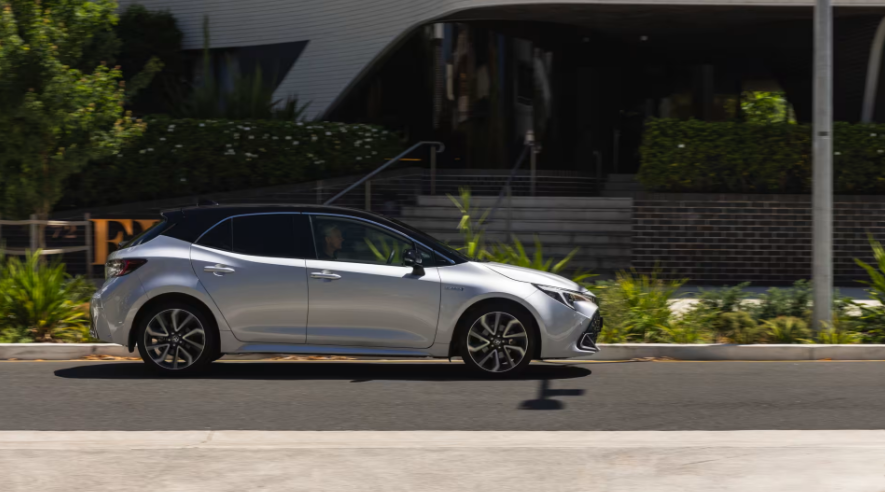
2024 Toyota Corolla ZR Hybrid hatch

2024 Toyota Corolla ZR Hybrid hatch Review
The top-of-the-range Toyota Corolla hybrid hatch combines the company's leading petrol-electric technology with the highest level of equipment. But is it worth the $40,000 price tag?

2024 Toyota Corolla ZR Hybrid hatch
The Toyota Corolla needs little introduction: the world's best-selling car (53.4 million to October 2023), and one of Australia's longest-running new car nameplates, arriving here in 1967 following its overseas launch a year earlier.

But surging sales of SUVs and electric cars mean the Toyota Corolla is on the verge of losing its 10-year winning streak as Australia's best-selling passenger car to the battery-powered Tesla Model 3.

And it looks like Toyota will lose the same record in the small car category to its old rival, the Hyundai i30 – amid severe stock shortages for Toyota over the past two years.

The current generation Corolla hatch arrived in Australia in 2018, and in that time has seen the arrival of the new Mazda 3, Volkswagen Golf, Kia Cerato, Subaru Impreza and Honda Civic, all of which have seen price increases. But Toyota has one advantage that everyone but Honda has failed to match: hybrid power.

The introduction of mid-life styling and technology updates in 2022 suggests that the current Corolla will probably be with us for at least another year or two before a new model arrives. Is it still worth considering in 2024?

How much does a Toyota Corolla cost in Australia?
There are 12 variants in the Toyota Corolla range, with hatchback and sedan body styles, petrol-only or petrol-electric hybrid power, and three equipment levels: Ascent Sport, SX and ZR.

The car on test was the top of the range hatchback, the ZR Hybrid, which is priced at $39,100 plus on-road costs.

The price has risen $1480 since the end of 2023 with no equipment changes, and is well above the 2018 launch price of $31,870, although the current model is better equipped.

The test vehicle was finished in Silver Pearl paint with a black roof – a $1350 option – and a no-cost red and black interior, bringing the price to $40,450 plus on-road costs, or about $44,500 a drive away in New South Wales, according to Toyota Australia's online price estimator.

Rivals include the Volkswagen Golf 110TSI Life ($39,190), Hyundai i30 N Line Premium auto ($37,300), Mazda 3 G25 GT ($38,420), Subaru Impreza 2.0S ($37,990), Kia Cerato GT ($36,390) and Skoda Scala Signature ($42,490 drive-away - Far). All prices above do not include on-road costs unless stated otherwise.

Standard features exclusive to the ZR include 18-inch alloy wheels, upgraded bi-LED headlights, 12.3-inch digital instrument cluster, head-up display, synthetic leather-look and suede seats, heated front sport seats, eight-way power. -adjustable driver's seat, eight-speaker JBL stereo and ambient cabin lighting.

Features carried over from the cheaper model include an 8.0-inch touchscreen with wireless/wired Apple CarPlay and Android Auto, satellite navigation, wireless phone charging, keyless entry and start, dual-zone climate control, front and rear parking sensors, display behind. cameras, and a full suite of advanced safety technologies.
2024 Toyota Corolla ZR Hybrid hatch Performance
The Corolla ZR Hybrid hatchback is the only model in the regular lineup to come with a tire repair kit in lieu of a full-size spare wheel or space saver.

Important details of the 2024 Toyota Corolla ZR Hybrid hatch
Price is $39,100 plus travel costs
The test car color is Pearl Silver with Black roof
Two-tone premium paint option – $1350
Red and black interior – no expense
Price as tested was $40,450 plus on-road costs
Drive away price $44,506 (NSW)
Hyundai i30 rival | Volkswagen Golf | Mazda3

How much space does a Toyota Corolla have inside?
The Corolla doesn't have the flashiest or most high-tech interior in the small car class, but with buttons and dials for the main audio and air conditioning functions – and a clean layout – it's simple and easy to use.

Drivers looking for a sporty feel can sit low in the car, with eight-way power adjustment on the driver's seat, and tilt and reach adjustments on the faux leather steering wheel making it easy to find a comfortable position.

The sport seats in this ZR grade are a highlight, offering good comfort and excellent support for a simple hybrid hatchback – not a high-performance car – combining synthetic leather-look trim with suede inserts that add a sporty feel. They offer heating and lumbar support.

If it were our money, we'd tick the box for red accents at no cost; a more restrained all-black option is also available.

All major interior surfaces touched by passengers – the armrests, the tops of the doors, the dashboard and the center console area where your knees rest – are wrapped in synthetic leather, although some of the padding in the armrests could be softer.

Amenities up front include dual-zone climate control, a wireless smartphone charging pad, keyless entry and start, an electric parking brake, illuminated rearview mirrors, two USB-C ports and a 12-volt outlet.

While the glove box is large, storage elsewhere is limited, with a small compartment in the center console that can't fit much more than a wallet and sunglasses. The door bins aren't as large as some rivals, and front occupants will find cell phones, glasses, wallets and keys in cup holders or on wireless phone charging pads.

Rear seat space has been a weak point of this generation of the Corolla hatch since its launch in 2018. At 6ft (183cm), I was able to fit in the rear driving position, with adequate head and legroom – but my knees were touching. seat in the front, and it will be a tighter squeeze for taller adults.

Carrying three passengers in the back in a pinch is possible, but it's better suited to two people.

Ease of ingress and egress is hampered by the sloping roofline and small door openings, and the black roof lining exacerbates the cramped feeling at the rear.

Rear seat passengers are treated to rear air vents, cupholders in the doors, a folding center armrest, two map pockets, three child seat top tether points and two ISOFIX anchors. However, there are no USB ports or pockets on the doors for storing wallets, devices, or other items, and the tops of the doors are made of hard plastic and scratch easily.

With a capacity of 333 litres, the ZR Hybrid has the largest boot in the Corolla hatchback range as it swaps the spare wheel – either full-size or space saver – for a tire inflator kit for repairing small punctures at the side of the road.

This means the boot goes from one of the smallest in the small car class to a roomy space beyond its capacity, with enough space for a full-sized suitcase, a carry-on suitcase and a few soft bags.

However, there are no facilities in the cargo area other than shopping bag hooks. Because the trunk is quite deep with the spare wheel removed, the load lip is also quite high, and the rear seats don't fold flush with the trunk floor.

2024 Toyota Corolla ZR Hybrid hatch
Seat Five
Boot volume 333L seating
Length 4375mm
Width 1790mm
Height 1435mm
Wheelbase 2640mm
2024 Toyota Corolla ZR Hybrid hatch Exterior
Does the Toyota Corolla have Apple CarPlay and Android Auto?
Standard on all Toyota Corolla hatchbacks and sedans in Australia is an 8.0-inch infotainment touchscreen with wireless and wired Apple CarPlay, wired Android Auto, Bluetooth, voice control and AM, FM and DAB digital radio.

All variants except the Ascent Sport petrol and hybrid hatchback, as well as the Ascent Sport petrol sedan are equipped with embedded satellite navigation.

At eight inches, the screen is small – compared with 10 or 12 inch screens on similarly priced competitors – and the thick black bezel around the screen makes it look cheaper. Toyota offers a 10.5-inch touchscreen in other markets, but not in Australia.

This infotainment software isn't the fastest, sharpest, or most exciting in its class, but it's relatively easy to use and responds fairly quickly. Wireless Apple CarPlay worked well in our tests, although we found that if we wanted to charge the phone via the USB port – but still use wireless CarPlay – we had to leave CarPlay connected before plugging in the phone, as doing it the other way around wouldn't happen. enable CarPlay.

It's worth noting that there's a wireless smartphone charging pad in front of the shifter, which is powerful enough to top up your phone while navigating and streaming music.

The 12.3-inch digital instrument cluster is clear and bright, but doesn't offer much customization in terms of layout – although it can display widescreen navigation maps, which many other cars with digital instrument screens can't.

What's rare in this class is the installation of a head-up display that shows vehicle speed, current speed limit and other important information. This is a handy feature that means you no longer have to look down at the instrument cluster.

The eight-speaker JBL sound system is adequate, but doesn't deliver the sound quality or quality we've come to expect from 'premium' branded sound systems.

Rear view camera quality is below average – and grainy at night – with a simple guideline that doesn't move when you turn the wheel.
2024 Toyota Corolla ZR Hybrid hatch Interior
Is the Toyota Corolla a safe car?
The Toyota Corolla 2.0 liter petrol and 1.8 liter hybrid were awarded five stars by the Australasian New Car Assessment Program (ANCAP) in 2018 based on crash tests conducted in Australia.

Those scores will expire after December 31, 2024 – unless Toyota submits the Corolla for retesting under its current crash test criteria, which are much stricter than those in 2018 when the vehicle was first assessed.

202 4 Toyota Corolla ZR Hybrid hatch
ANCAP rating Five stars (tested 2018)
Safety report Link to ANCAP report

What safety technologies does the Toyota Corolla have?
Standard safety technologies include autonomous emergency braking (AEB) with pedestrian/cyclist/motorcycle detection and intersection assist, adaptive cruise control, lane keep assist, lane following assist, blind spot monitoring, rear cross traffic alert, speed sign recognition, exit warning, and front and rear parking sensors.

There are also seven airbags, including one for the driver's knees.

Some advanced safety systems are overkill and have been adapted to react to the slightest possibility of a collision – rather than risk intervening too late.

There was one false activation of the AEB system – during a rapid lane change approaching a traffic light, when the car thought we were about to hit a line of cars waiting to turn – and on several occasions the blind spot monitoring system hit the brakes if a car was passing in parallel parking, even though the car was in reverse gear and stopped where it was, not into the line of traffic.

However, the lane keeping assist system is well calibrated and not too intrusive in the city. The lane centering assist technology – marketed as Lane Trace Assist – works naturally, although like most similar systems, it struggles on tight motorway bends.

When stopped at the front of the queue at a traffic light, pedestrians walking in front of the car will trip the front parking sensors. At other times, we found the sensors – and the distance display on the infotainment screen – reacted slowly to increasing distance to the car in front or behind when trying to park in a tight space.
2024 Toyota Corolla ZR Hybrid hatch Seat
How much does it cost to maintain a Toyota Corolla?
The Toyota Corolla is covered by a five-year/unlimited kilometer vehicle warranty for private buyers (excluding commercial use), including the hybrid battery.

If buyers follow the service schedule according to the logbook, Toyota will extend the warranty on the gasoline engine, hybrid components and driveline to seven years/unlimited kilometers, and “up to” 10 years/unlimited kilometers for the hybrid battery pack if that is the case. inspected annually by a Toyota dealer.

Servicing costs are among the cheapest in the car industry, at $245 for each of the first five visits, separated by 12 month/15,000km intervals – amounting to $1,225 over five years/75,000km.

Among petrol-powered cars, only the Honda Civic – available in petrol and hybrid – is cheaper, at $199 for each of the first five services at shorter 12-month/10,000km intervals.

Five-year/75,000km servicing is priced at $1,739 for the Hyundai i30 2.0-litre hatchback, $2,031 for the Kia Cerato 2.0-litre wagon, $2,168 for the Mazda 3 G25, and $3,356 for the VW Golf Life (or $2,650 for a prepaid service plan). Meanwhile – due to shorter distance intervals – a five-year or 50,000km service for the Hyundai i30 hatchback 1.6-litre turbo and Kia Cerato costs $1625 and $1922 respectively.

After the first five services, Toyota maintenance becomes more expensive. The next five services at a Toyota dealer (up to 10 years/150,000 km) are said to cost between $380.80 and $700.50, with an annual average of $501.20.

The Dunlop SP Sport Maxx 050 (225/40R18) on the Corolla ZR Hybrid is priced from $262 (from Bob Jane T-Marts), at the time of writing in December 2023.

One year's comprehensive insurance cover from a leading provider costs $1604, based on a comparison quote for a 35-year-old male driver living in Chatswood, NSW. Insurance estimates may vary based on your location, driving history and personal circumstances.

For context, the same insurance quote calculator lists $1243 for a Hyundai i30 N Line Premium hatchback, $1184 for a VW Golf Life, $1198 for a Mazda 3 G25 Astina – or, for some electric alternatives to the left of the field, $2997 for a BYD Dolphin Premium, $2004 for an MG 4 Excite 64, $2079 for MG 4 Essence 64, or $1986 for GWM Ora Extended Range.

A look at the 2024 Toyota Corolla ZR Hybrid hatch
Five year guarantee, unlimited km
Service interval 12 months or 15,000km
Service fee $735 (3 years)
$1225 (5 years)

Is the Toyota Corolla fuel efficient?
Toyota claims the Corolla ZR Hybrid will use just 4.0 liters per 100 kilometers of regular 91-octane unleaded petrol in mixed driving – or 3.8L/100km for city vehicles and 4.3L/100km on motorways or rural areas, where hybrid vehicles less efficient. they have fewer opportunities to use electric motors.

Over a week and 700km of testing across city, motorway and country roads, we observed 5.7L/100km on bowser fuel, which – while still very frugal for its class – is still 40 per cent higher than the claim.

However, it's worth noting that, before a spirited country road drive – when we were working the engine hard – the trip computer showed 5.0L/100km, or about 5.3L/100km at the pump. This amount comes from intra-city travel and around 400 km of highway driving.

On a 195km test run on the Hume Highway south of Sydney – which has a speed limit of 110km/h – we observed fuel consumption of 4.9L/100km on the trip computer, equivalent to 5.2L/100km on the fuel bowser.

In city driving – where the hybrid system can capture energy under braking and use the electric motor to propel the car at low speeds – we often see fuel consumption in the 4.0 to 4.5L/100km range, sometimes dropping to the high 3L/100km range. 100km , which is half of what a petrol hatchback would use in similar conditions.

We found the trip computer read fuel consumption about five percent better than in reality.

What is the Toyota Corolla like to drive?
The Toyota Corolla ZR Hybrid combines a 1.8-litre four-cylinder petrol engine with an electric motor and small lithium-ion battery to produce a combined power output of 103kW.

Around town, the hybrid system works well, accelerating from rest – the most energy-intensive part of everyday driving – to speeds of between 25 and 35 km/h on electric power, depending on how gently you press the accelerator pedal. , before the petrol engine kicks in to help.

It feels nimble at low speeds, but above 60km/h or 70km/h it starts to run out of power – even by small hatchback standards, not sports car standards.

Overtaking on country roads may require some planning, and this results in a lot of noise from the petrol engine, as the continuously variable transmission keeps it at the optimal RPM for maximum power output.

Plus, switching between petrol and electric power is almost seamless.

The battery is small – and not intended to cover significant distances using electric power – but it can store enough energy to let the car get through traffic without starting the petrol engine too often. This battery is charged by the petrol engine, or energy captured during braking, so it does not need to be plugged in externally.

The 18-inch alloy wheels and low-profile sport tires on the ZR mean it's not as comfortable over bumps as other Corolla models – you can feel sharp edges and imperfections in the road – but it's by no means too stiff or harsh to ride.

The steering is light but direct and accurate – although the 11.4-metre turning circle is quite large for a car of this size – and the brake pedal is easy to modulate, with a smooth transition from the electric motor's regenerative braking to regular 'friction'. disc brakes.

The sportier suspension setup around town makes for a more engaged feel on bumpy country roads, and it turns out to be a fun car to drive.

It feels agile and sharp when turning corners, it's not bothered by mid-corner bumps, there's not much body roll, and the Dunlop SP Sport Maxx tires hold up well in fast corners.

The only downside here is a lack of power at speed, which becomes apparent when you're tackling a twisty country road and want to have some fun behind the wheel. But there's a Corolla for enthusiast buyers, the GR 220kW hot hatch – built with the same good bones as this ZR.

The advantage of this sporty Dunlop rubber is that there is a lot of tire roar at highway speeds – especially on rough surfaces – that the sound system can't completely drown out. There is also a wind whistle at high speed.

The bi-LED headlights offer good illumination in both low and high light conditions, although not the best we've seen in a small car or SUV.

Important details of the 2024 Toyota Corolla ZR Hybrid hatch
Engine 1.8 liter four-cylinder petrol and electric engine
Combined power 103kW
Torque 142Nm (engine only)
Aggregate figures are not quoted
Drive type Front wheel drive
Continuously variable Automatic Transmission
Power to weight ratio 73.6kW/t
Weight (curb) 1400kg
Spare tire type Tire repair package
Tow rating None
Turning a circle 11.4m

Should I buy a Toyota Corolla?
If you're shopping for a small, stylish, fuel-efficient city car – and don't plan on carrying rear passengers or taking frequent road trips – the Toyota Corolla Hybrid should be at the top of your shopping list.

The ZR Hybrid trim is well equipped, safe, attractive inside and out, easy to drive around town, fun to drive on twisty roads, and most importantly affordable to operate thanks to its economical fuel use and low servicing costs.

However – as touched on above – there are some drawbacks to consider, namely limited interior and boot space compared to its main competitors, a lot of wind noise and a lack of power at motorway speeds, and infotainment technology that still lags behind the best small cars available. for sale. .

The lack of a spare wheel on the ZR Hybrid is a consideration for rural buyers, who might be better served by a model in a different class, but with a smaller boot.

If these weaknesses are not your priority, the Toyota Corolla hybrid is the right choice.

How to buy a Toyota Corolla – next steps?
If the price is fair to you, and you're happy with the compromise of no spare tire, the ZR Hybrid hatch is the most stylish and best-equipped model in the range.

However, if you're willing to compromise on some luxury features, the entry-level Ascent Sport Hybrid – with its $1000 Convenience Pack, which adds parking sensors and rear cross-traffic alert technology – is better value for money, as is the mid-range SX Hybrid, which ditches the base model's plastic steering wheel for a leather look, among other additions.

The hybrid commands a price premium of about $3000 over the regular petrol model, as the fuel savings are significant enough to pay back the higher purchase price within a few years of ownership.

As with many Toyota hybrid models in Australia, you may have to wait longer to take delivery of a Corolla hybrid than small car competitors from Mazda, Subaru, Hyundai or Volkswagen.

Waiting times range from three to 12 months, according to buyers who have recently purchased a Corolla hybrid in Australia. The exact wait time will depend on the dealer you purchase from, where you are in the dealer's order queue, and the model class, body style and color you select.

To contact a Toyota dealer for the most accurate delivery time estimate, click here to find the nearest showroom. You can also find Toyota vehicles for sale at Drive.com.au/cars-for-sale.

We also recommend testing the Volkswagen Golf Life, which is Small Car of the Year for the second year running, having beaten the Toyota Corolla hybrid – as well as the Hyundai i30 hatch – to the 2022 awards.
Share:

2023 Toyota Crown

2023 Toyota Crown Review
We were blown away by the Toyota Crown's bold styling, exceptional ride comfort, and spacious cabin. High fuel economy is another big bonus. The base engine's performance is lacking, and some buyers may balk at the price, but overall we highly recommend the Crown for sedan buyers looking for something different from the norm.

Excess

Fuel economy is high with the base powertrain
Interesting style
Comfortable ride quality

What's new

An all-new sedan that replaces the Avalon
Every Crown has an all-wheel-drive hybrid powertrain
2023 is the first year of this new Crown for the US market

Summary

It won't be a surprise when Toyota discontinues the Avalon luxury sedan in 2022 as most buyers have been interested in SUVs for more than a decade. But it's a bit surprising to see Toyota re-enter this sedan class with the all-new 2023 Toyota Crown. Like the Avalon, the Crown is larger than the average midsize sedan but not large enough to qualify as a large sedan. The Crown differentiates itself from the Avalon with a higher ride height and distinctive styling.

Despite its unconventional looks, the Crown will likely appeal to an audience that prefers comfort and luxury over performance. In this area, the Crown is successful with its soft suspension and spacious interior. The real advantage comes in the form of fuel economy, with an EPA-estimated 41 mpg in combined city and highway miles from the base hybrid engine and standard all-wheel drive. There's a more powerful engine included with the top Platinum trim, but you'll give up 11 mpg in return.

Softer suspension tuning benefits ride comfort but sacrifices driving enjoyment as a result. Other sedans such as the Kia Stinger, Volkswagen Arteon, and Genesis G80 Corner with more poise and confidence but are still comfortable. But none of these products can compete with the Crown's fuel economy.

If you've been considering the Avalon, we're confident the new 2023 Toyota Crown will easily meet or exceed your expectations. Like the Avalon, it has premium status compared to other Toyotas, although it cannot be compared to a Lexus or similar luxury vehicle. The Crown has no direct rivals unless you move up to a more expensive and more luxurious luxury sedan. Other options worth checking out include the Kia Stinger and Volkswagen Arteon. Read our test team's Expert Ratings below for a full report on the Crown's highs and lows.
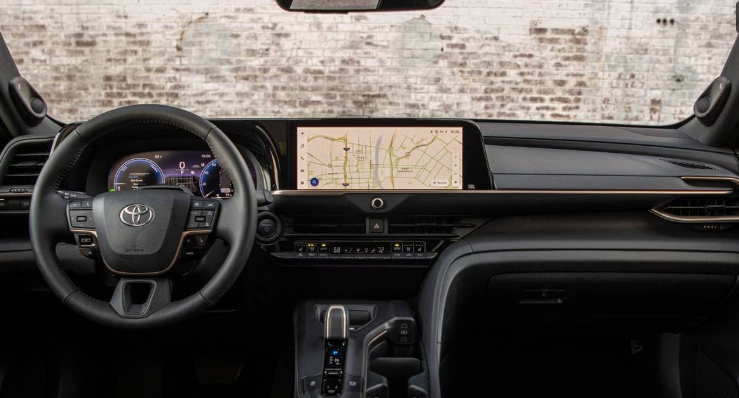
2023 Toyota Crown Dashboard

How does Crown drive? 

We don't have high expectations for the Crown's driving experience considering it's a large hybrid sedan that focuses on comfort. But our test car, a Crown Platinum with the upgraded Hybrid Max powertrain, surprised us. It's a fun, easy-to-carry vehicle. Acceleration is smooth from a stop and responsive when you have to pass on the highway. It's also very fast. At the Edmunds test track, our Crown test car went from 0 to 60 mph in just 6 seconds, which is much quicker than most of the competition. Unfortunately, the XLE and Limited trims aren't as fast.

The Crown, despite modest grip from its all-season tires, felt particularly willing to play on twisty roads. His bar is relatively low, but he remains calm and provides enough feedback to give you confidence in exploring his abilities.

Comfort


How comfortable is the Crown? The crown provides comfort. Our test car had the top-of-the-line Platinum trim so it was equipped with adaptive suspension. It provides an excellent ride on almost any surface you throw at it. The softest setting did a great job of handling some of the worst road surfaces, and even the sportier setting still felt quite comfortable but reduced some body movement.

The cabin is also well protected from wind and road noise. We found the upgraded Hybrid Max powertrain on the Platinum trim to be quite quiet in our testing, but the standard hybrid felt noisier when you pressed hard on the accelerator. Another area where we found the Crown underwhelmed was rear seat comfort. Although spacious, the backrest angle of the rear seats is uneven, so you have to adjust a bit before finding a fairly comfortable position.
2023 Toyota Crown Exterior

How is the interior? 


The Crown sits a little higher than a typical midsize family sedan, and that helps with getting in and out of the cabin. Large door openings provide good head clearance. The space inside is relatively generous, but we wish the driver's seat offered more adjustability and was a little lower due to the odd SUV-like front end. Otherwise, the Crown offers reasonably good visibility thanks to a wide rear window and small blind spots. The Platinum trim's surround-view camera system also helps a lot when parking.

Technology


How is the technology? Toyota has stepped up its technology offerings in its newest vehicles, including the Crown. The touchscreen user interface has a bit of a learning curve, but the good news is that all the physical controls are easy to use and easy to see. The standard 12.3-inch touchscreen is large and responsive when used. Toyota's latest software also looks more modern. Toyota's voice recognition system is now one of the best in the business and lets you control functions like climate temperature or even ask questions like a smart home assistant.

All Crowns come standard with Toyota Safety Sense 3.0, the latest suite of advanced driver aids Toyota offers. Most of its functions, from adaptive cruise control to Proactive Driving Assist, work well to reduce driving stress and don't interfere with driving in general.

Storage


How is it stored? The Crown's trunk is average in size at 15.2 cubic feet. The rear seats can be folded to increase cargo space if you need it. Up front, the medium-sized center armrest housing has double hinges that let you open it from the driver or passenger side. Dodgy! Otherwise, storage is mostly limited to a wireless charger in front of the shifter and an expandable cupholder with a removable partition. The glove box is small, and there's no overhead sunglasses storage.

If you need to install a child safety seat, we found the top tether to be quite easy to access, which is unusual for most sedans. There's plenty of rear seat room to move the seat in and out, and the Isofix anchors are easy to access behind a removable pull tab.

Fuel Savings


What about fuel savings? The EPA estimates the Crown with its base powertrain will return an impressive 41 mpg in combined city/highway driving. The more powerful Crown Platinum with the Hybrid Max powertrain (which we tested) dropped drastically to 30 mpg combined. And in our testing, it did even worse, returning a disappointing 26.9 mpg on our standard test route. This may be an isolated result, but it could also indicate that the Kingdom may be thirstier than the official figures suggest. It's a little too Max and not quite Hybrid.

Mark


Is Crown good value? The Crown's interior design is a bit disappointing considering the price. The interior is well done, like any new Toyota, but nothing inside looks premium or even premium, which you might expect given the Crown's higher price compared to rival sedans. We're sure most of this car's price goes into the hybrid powertrain, but that might not be a convincing enough selling point for potential buyers.

Toyota's warranty coverage is fairly typical for its class with bumper-to-bumper coverage of three years/36,000 miles and five years/60,000 miles for the powertrain. Scheduled maintenance for the first two years is also free.
2023 Toyota Crown Interior

wildcard


In Hybrid Max form, the Crown is more fun to drive than we expected. It feels a bit heavy but has decent power and is willing to move if you try to coax it into some corners quickly. While we're not fans of the two-tone paint treatment that Toyota offers (seriously, guys, who think that looks good?), the Crown's overall look is futuristic and commands attention on the road. The slightly higher ride height is also an interesting design choice but has some ergonomic advantages and adds to the Crown's overall unique personality.

The Crown is designed for people who prioritize comfort over performance, so we recommend sticking with the base XLE trim. The Platinum trim's more powerful engine is more fun, but it's hard to justify the big price increase, especially considering you don't get a significant feature upgrade.
2023 Toyota Crown Seat

Toyota Crown Model

The 2023 Toyota Crown is offered in three trim levels: XLE, Limited, and Platinum. The XLE and Limited have a 236-horsepower hybrid powertrain, while the Platinum uses an upgraded version with 340 hp. The XLE and Limited trims use a continuously variable transmission, while the Platinum features a traditional six-speed automatic transmission. All models come with all-wheel drive. Feature highlights include:
2023 Toyota Crown Back side

XLE
Starting the Crown lineup with:


19-inch rims
LED headlights
The front seats are heated and power-adjustable
Fabric upholstery
60/40 split folding rear seat
Dual-zone automatic climate control
Digital instrument cluster
12.3 inch center touchscreen
Multiple USB charging ports
Android Auto and Apple CarPlay smartphone integration (wireless connectivity for both)
Wireless charging pad
Six-speaker sound system

The crown also comes with:


Forward collision mitigation (warns you of an impending collision and applies the brakes in certain scenarios)
Adaptive cruise control (maintains a driver-determined distance between the Crown and the car in front, working until it stops so it can be used in traffic)
Lane-keeping assist (directs the car back into its lane if the car starts to cross a lane marker)
Blind spot warning with rear cross-traffic alert (alerts you if the vehicle is in a blind spot when changing lanes or when reversing)
Safe exit assist (can prevent passengers from opening the door when traffic is approaching from behind)
2023 Toyota Crown Top

Limited Build
on XLE with:


Two-tone alloy wheels measuring 19 inches
Upgraded LED headlights
Panoramic glass roof
Automatic windshield wipers
Keyless entry and keyless start
Leather upholstery
Ventilated front seats
Heated rear seats
Heated steering wheel
11-speaker JBL audio system
Front and rear parking sensors with automatic braking
Platinum
The Platinum is distinguished by an upgraded powertrain and an optional two-tone paint job that covers the hood, roof, trunk, and most of the rear fascia in black paint. He also added:

Two-tone alloy wheels measuring 21 inches
Paddle shifters
Adaptive suspension (adjustable to improve ride comfort and handling poise)
Surround-view camera system (shows a live view of the area around the car)
Advanced Park System (car can park itself in parallel and perpendicular parking spaces)
Share:

Popular Posts

Followers