luxury cars-images This blog contains various forms of cars and at a glance most of the new information, present and future, this blog will always feature luxury cars, and sports cars, and provide information about the content, Toyota, Ford, Honda, BMW, Rolls-Royce, Tesla, Mitsubishi, Mazda, Chevrolet, SUV, Automotive, Pick-up, Sports Cars
The most visionary models, these unique specimens are set to define the highest limits of technology and design. Unveiled at the most prestigious international Motor Shows, they offer an exclusive look at the most innovative solutions that Lamborghini may adopt in its future series-production models.
Premium materials and a focus on comfort raise RAV4 Hybrid’s level of refinement. Whether appreciating the views through the available panoramic glass roof or finding inspiration from RAV4 Hybrid’s attention to detail, you’ll enjoy a ride that’s ready to go the distance.
Explore Interior
Ford Mustang Shelby GT500 makes this car the most powerful car ever made by the American manufacturer. This is because the Ford Mustang Shelby GT500 is equipped with an engine capable of 760 horsepower
Tesla claims the Roadster to be the fastest production car ever made! The second-generation Tesla Roadster can go from 0 to 60 miles per hour in under 1.9 seconds, and this is just for the base model.
A bit more capability and refinement, with some additional screen functionality and safety equipment. Here's the 2024 model refresh that everyone's looking at the 2024 Jeep Gladiator, which largely gets a cut-and-paste of almost everything refreshed on its Wrangler ancestor in response to that model's newfound Ford Bronco competition. But these are different models, so we'll review what's been updated on both and focus on the new unique things on the new Gladiator pickup.
Inside and Out Cosmetics
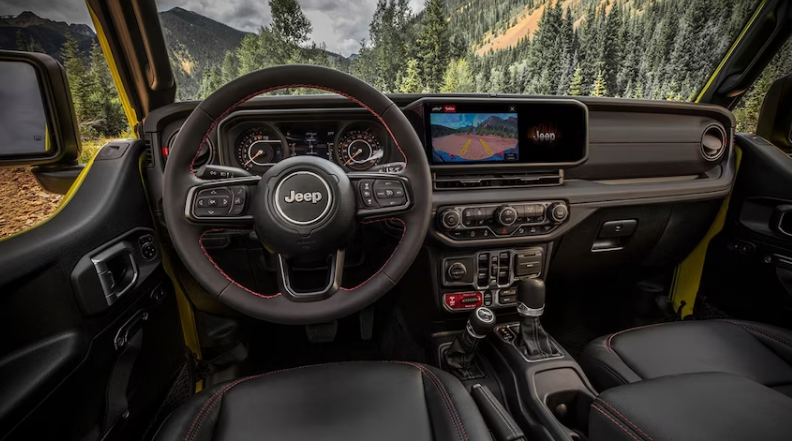
Outside, there's a new seven-slot grille, the removal of the whip antenna and integration into the windshield, plus seven new wheel designs. Inside is a new, reconfigured instrument panel with round outboard vents and a slim rectangular vent in the center to make room for a larger 12.3-inch LED display. It features full-array local-dimming (FALD) technology that makes it easier to see in direct sunlight—like when the roof is removed and the windshield is folded.
The display runs the Uconnect 5 infotainment system, which supports wireless Apple CarPlay and Android Auto and, like the Wrangler, includes Jeep Adventure Guides software that displays Trails Offroad programming. This third-party app makes off-roading easier for beginners, by revealing the difficulty level in advance and providing turn-by-turn guidance along Jeep Badge of Honor's 62 plus 140 or so off-road trails that all earn curated points. -Interesting descriptions and frequent updates as the path develops over time. (A more expansive catalog of 3,000 lines is available via subscription for just $40/year.)
Lower-spec models get a black interior with gray accents, Mojave models get a new Mantis Green (military olive color) option with orange accents, and Rubicon models get red interior accents on black.
Security Improvements
Standard curtain airbags are a major upgrade forced on the Bronco, and the Gladiator is geometrically different from the Wrangler, with both taking a different approach to weatherproofing than the Ford. Since automotive airbags are the only ones frequently exposed to the weather, sealing is critical. The Ford's bag pops out on a "living hinge" where the Jeep tears through the sonically welded seams. The outboard rear seats get seatbelt pre-tensioners and load limiters, and structural modifications improve side-impact protection. Blind-spot and cross-path detection and the ParkSense rear park assist system are standard on upper trims and available on Sport S, Willys, Mojave, and Rubicon.
Convenience And Convenience
The front seats are available with a 12-way power adjustment that is electrically sealed in the event of an underwater crossing. Adaptive cruise control with a stop function is standard on Sport S trim and above. All Gladiators now get soundproofing designed for diesel engines, along with acoustic glass, plus a new seven-microphone array and noise cancellation to improve voice recognition—both when interacting with Uconnect 5 and Bluetooth-connected phone calls.
Capacity Enhancement
Maximum towing is still 7,700 pounds and the maximum payload rating is a best-in-class 1,725 pounds. That's just 15 pounds more than last year's top, only now those ratings are leveled on the same model (Sport trim, eight-speed automatic, with 4.10:1 axles). That's nearly 200 pounds more payload than last year's equivalent max-tow model could carry, and 3,700 pounds more towing load than the previous max-pay version (manual with 3.73:1 axles) could carry in 2023. (Note that the gross combined weight rating only rises 50 pounds to 12,850, so there's still no max towing at max carry.) Off-Road+ riding mode and a Mojave-style locking rear differential are now available on 2024 Willys models, along with standard auxiliary control switches. All of this makes the Willys a cheap/starter pickup for hardcore off-roaders—especially when equipped with the first of three upfit kits that can now be ordered from the factory from American Expedition Vehicles (AEV). This Upcountry kit features a 2.0-inch suspension lift and Pintler wheels mounted with 35-inch tires, and while pricing isn't available yet, we're told it will be considered the most affordable midsize truck in the 35s.
When and how much?
Production of the 2024 Jeep Gladiator is scheduled to begin in late 2023, with pricing not expected to change much, except to cover increased standard equipment levels of the new range-topping models.
The four-wheel-drive 2024 Jeep Wrangler facelift will ditch the V6 – and introduce a new turbocharged petrol four-cylinder engine – when it arrives in showrooms in April next year.
The updated Wrangler brings revised looks, new technology, and upgraded safety features – including side curtain airbags – to the Jeep 4WD that has been in overseas showrooms in its current form since 2018.
Pricing has not been revealed by Jeep Australia but is expected to rise beyond $81,450 to $90,450 plus on-road costs of the current model.
These prices are already significantly higher than they were at the Wrangler's launch four years ago – when the top-of-the-range V6 petrol Rubicon four-door could be bought for less than $65,000 plus on-road costs.
All models will now be powered by a 2.0-litre turbocharged four-cylinder petrol engine producing 200kW and 400Nm – 9kW less, but 53Nm more than the previous 3.6-litre petrol V6 engine.
Jeep promises improved fuel efficiency, although it doesn't provide exact figures. Towing capacity remains unchanged at 2495kg.
The four-door Sport S model returns as the entry-level variant in the range – replacing the four-door Night Eagle – below the four-door Overland, and the two-door and four-door Rubicon.
New on the outside is a revised grille with slimmer slots, an antenna integrated into the 'Gorilla Glass' windshield (replacing the old model's cable antenna), and new 17-inch and 18-inch wheel designs.
Available in Bright White, Black, Firecracker Red, Sarge (army green), Hydro Blue, High Velocity (yellow), Silver Zenith, Earl (light blue), Granite Crystal (grey), and Anvil (blue-gray) options. ) paint colors at launch, with Tuscadero pink to be added starting production in March 2024.
Inside, there's a new 12.3-inch infotainment touchscreen (up from 8.4 inches) running the latest Uconnect 5 software, with wireless Apple CarPlay and Android Auto, as well as a customizable home screen.
Side curtain airbags are now available on all models, in addition to the existing dual front and side airbags.
The entry-level Sport S receives cloth seats and a cloth dash panel, while the Overland and Rubicon add a synthetic leather-look dash cover, with 'McKinley' seat trim on the former, and new Nappa leather seats on the latter.
All models receive extra-soft interior materials, an updated sound control system, a revamped instrument cluster, and an accessory rail above the dash.
Now standard on the Sport S is a heated steering wheel, heated front seats, and ambient interior lighting, while the Overland and Rubicon get 12-way power-adjustable front seats with a four-way lumbar (except the two-door Rubicon, which omits the power passenger seat).
Under the skin, Rubicon models get a Dana 44 HD 'full-float' rear axle that "separates the wheel hub assembly from the axle shaft, improving weight distribution to the axle tubes... [and allowing] to improve lateral camber force compliance and facilitate fine adjustment it's easier to enlarge the tires,” according to Jeep Australia.
The Rubicon also gets a forward-facing camera for low-speed off-roading.
The Sport S and Overland models use a Selec-Trac four-wheel drive system with full-time capability – as well as a "normal duty" suspension – while the Rubicon adds a "performance" suspension and Rock-Trac four-wheel drive with a 4:1 low gear ratio, electronic locking differential front and rear, and electronic front sway bar disconnect.
The 2024 Jeep Wrangler will arrive in Australian showrooms in April next year, with pricing to be announced closer to launch.
2024 Jeep Wrangler Australia price
Wrangler Sport S four-door – $TBC
Wrangler Overland four-door – $TBC
Wrangler Rubicon two-door – $TBC
Wrangler Rubicon four-door – $TBC
New features in bold are specific to that variant, or two of the three variants.
New features of the 2024 Jeep Wrangler Sport S:
2.0-liter turbo engine
New front grille and 17-inch alloy wheel design
The Gorilla Glass windshield now has an antenna in it
Side curtain airbags
Backseat reminder
12.3-inch Uconnect 5 touchscreen with wireless Apple CarPlay, Android Auto
Increased noise, vibration, and harshness
Ambient LED interior lighting
Nexen Roadian all-terrain tires
Fabric dash panel
Heated front seats
Heated steering wheel
240 amp alternator
Automatic headlights
Normal duty suspension
New features of the 2024 Jeep Wrangler Overland:
2.0-liter turbo engine
New front grille and 18-inch wheel design
The Gorilla Glass windshield now has an antenna in it
Side curtain airbags
Backseat reminder
12.3-inch Uconnect 5 touchscreen with wireless Apple CarPlay, Android Auto
Increased noise, vibration, and harshness
The Dana M220 rear axle is anti-roll
12-way power-adjustable front seats
240amp alternator
The side mirrors are black
McKinley premium leather seats
The back panel of the chair is hard
Soft spare tire cover
New features of the 2024 Jeep Wrangler Rubicon:
2.0-liter turbo engine
New front grille and 17-inch alloy wheel design
The Gorilla Glass windshield now has an antenna in it
Side curtain airbags
Rear seat reminder (four doors only)
12.3-inch Uconnect 5 touchscreen with wireless Apple CarPlay, Android Auto
Increased noise, vibration, and harshness
Performance Suspension
HD Dana 44 full-float rear axle
Acoustic laminated front door glass
12-way power-adjustable driver's seat
12-way power-adjustable front passenger seat (two-door only)
Orders For The All-Electric Jeep Avenger Reach 40,000 Units Drives Up Brand’s B-SUV Share In Europe
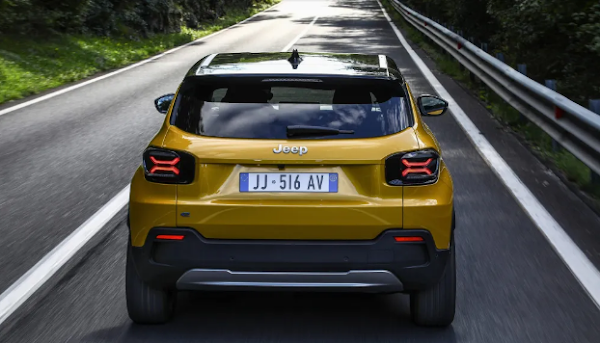
In a market increasingly defined by electric mobility, the all-electric Jeep® Avenger (JJ) has emerged as a game-changer for the iconic Jeep brand in the competitive B-SUV segment of the European market. Since its unveiling at the Paris Auto Show last year, this European Car of the Year 2023 recipient has garnered over 40,000 customer orders, establishing itself as a force to be reckoned with.
Jeep’s popularity in the B-SUV segment has grown significantly, fuelled by the Avenger’s popularity. Between January and August of this year, the brand’s sales within this segment increased by a remarkable 33.5% compared to the previous year, outpacing the segment’s industry growth rate of 12.8%. This robust growth can be attributed to the Avenger, which has made its mark in various European markets over the last three months.
The Avenger’s commercial success is complemented by its impressive list of industry accolades. Designed and produced as a quintessential Jeep vehicle, it has already garnered 10 industry awards, including the prestigious 2023 European Car of the Year. It was also recognized as the Best Family SUV in the 2023 Women’s World Car of the Year and awarded Electric Car of the Year in the Top Gear UK Awards.
A notable trend is the significant demand for the Battery Electric Vehicle (BEV) version of the Jeep Avenger, accounting for over 40% of confirmed customer orders. This highlights the growing interest among customers in the all-electric version of this remarkable SUV.
In addition to the Avenger, the Jeep Renegade (BV) has maintained strong sales momentum, keeping pace with the previous year’s volume. With over 32,000 units registered, compared to 31,705 in the same period of 2022, the Renegade continues to be a customer favorite.
In Europe, Jeep has secured a fifth-place ranking in the SUV segment, boasting a market share of 10.6%, up from 9.6% the previous year. The Italian market is particularly receptive to Jeep, where the brand commands an overwhelming 49.9% market share. The Renegade continues to dominate the B-SUV segment in Italy, capturing 7.9% of the market share, which rises to 11.4% when combined with the Avenger’s 3.5% share.
Jeep’s success extends beyond Italy, with strong results in Germany, Spain, Poland, and the Netherlands, where the brand enjoys double-digit market share percentages.
The Avenger encapsulates the essence of the Jeep in a compact SUV. It combines capability, style, functionality, and technology to express “concentrated freedom.” With a unique 400-volt electric motor, the Avenger boasts a stress-free range of up to 400 kilometers (248 miles) WLTP and up to 550 kilometers (342 miles) in city driving. Its fast-charging capability provides 30 kilometers (18.6 miles) of range in just three minutes.
The Avenger offers four distinct trim levels, each tailored to meet specific customer needs. These include Avenger, Longitude, Altitude, and Summit. Impressively, 80% of Avenger units sold feature the two highest trim levels, Altitude and Summit, showcasing customers’ preference for technology and exclusivity. The preferred color among buyers is Vulcan (black), accounting for 30% of total sales.
The range-topping Jeep Compass Trailhawk poses a unique selling proposition, somewhat unrivalled in the compact SUV segment, offering genuine off-road capability while remaining a practical city runner.
But starting at $51,250 before on-road costs ($55,845 for our tester), it isn’t cheap for a compact SUV and, despite being ‘Trail Rated’, it’s still more city car than off-road explorer given its lack of transfer case or true low-range gearing.
Perhaps though, Jeep anticipated that owners were likely to spend most of their time on inner-city blacktop.
It’s really only up against the 20-odd thousand cheaper Suzuki Jimny as a genuine compact off-road rival but eclipses it in terms of refinement and technology.
Price aside, it’s a fairly unmatched all-rounder in this segment. The issue is that its price encroaches on larger, more capable off-road options that can be had for a few thousand more, like the various dual-cab 4x4 ute options, seven-seat 4x4 wagons, and of course its more off-road capable Cherokee Trailhawk sibling. But none of these alternatives are compact city SUVs.
So what exactly is Jeep going for with the Compass Trailhawk? We spent a week in the car and it was apparent from the outset that this is a compact SUV given some off-road armour and gadgetry, rather than being a genuine off-roader made city-friendly.
This is a vehicle for those strictly wanting a city SUV that’s also off-road capable and for that reason, it’s kind of the only option. A rare conundrum these days is when consumers are more often than not saturated with options.
Put simply, before delving into its features and performance, the Compass Trailhawk will be outdone in some way or another by its on- and off-road competitors, but no one compact SUV will outdo it both on- and off-road. Bit of a riddle, that one, but it may be where the Trailhawk shines, even if it feels like an odd fit in the market.
Diesel Grunt and Faux 4x4 Gadgetry
The Compass Trailhawk, unlike the rest of the range, is only offered with a 2.0-litre turbo-diesel. This feels fitting given its off-road adventure-ready credentials because, when you couple this fuel-sipping diesel with the 60-litre tank, you’re looking at around 800 clicks between fills.
The nine-speed auto sends drive mostly to the front wheels but will send drive back when a slip occurs. Four drive modes alter the traction control, offering Auto, Snow, Sand/Mud, and Rock settings to cover most scenarios.
Under the drive modes, there are also a few off-road-focused modes, including 4WD Low, Hill Descent Control and 4WD Lock. These are your friends off-road, but this is where the wizardry comes in because there’s no transfer case or true low range despite brandishing the Trailhawk badge. Instead, 4WD Low will hold first gear, which isn’t a new concept and does work, as long as you’re not a purist. The 4WD lock feature is the handiest, maintaining the drive to the front and rear.
On and Off-road Goer
I will say, it genuinely surprised us off-road during a day of testing on mild tracks and soft sand at Bribie Island just north of Brisbane. We expected to have to really push it outside of its comfort zone, like the guys you see on YouTube taking an old beaten-up Subaru Forrester down rough single-track terrain until it’s utterly destroyed, but it puffed its chest out and got the job done.
So perhaps Jeep’s ‘Trail Rated’ certification, one that involves passing through the harsh Rubicon Trail in California, was awarded without nepotism.
While it’s capable off-road and may have earned its Trail Hawk badge, it still feels like a compass with more clearance, slightly more aggressive tyres and revised front and rear bumpers. Let’s put it this way; it’s more city-SUV than it is off-road conquerer.
And on that, the improved ground clearance (225mm), approach angle (30.3 degrees) and departure angle (33.6 degrees) are all respectable numbers and didn’t let the Trailhawk down as an out-of-the-box off-roader.
The stiff suspension and not a great deal of articulation, however, did. It still feels like it’s set up to be nimble around town, with the compromises shining through off-road.
Once off-road, on a moderate access trail, we left the Trailhawk in ‘auto’ but popped the 4WD Lock on, which sent a drive to all four wheels and adjusted the traction control. A couple of small climbs lifted wheels, but the system braked the airborne wheel to simulate a locker, call it a ‘brake locker’ if you will, and the Compass soldiered on. The system did this without any confusion or hesitation.
We shot over to the beach access track, where we dropped tyre pressures to a suitable 20psi and gave the Sand mode a try while also engaging the 4WD Lock. This mode kept the traction control at bay, allowing the slip needed in soft sand. Where it wasn’t handy was on the beach trying to maintain 30km/h to follow our camera car (a mighty TD42 GU Patrol).
The Trailhawk was revving its head off, doing up over 3000rpm, which doesn’t feel great for any length of time in a diesel. We found we had to jump back to ‘Auto’ and turn the 4WD Lock off the moment we were up and moving as it holds the lower gears and limits speed.
Also worth noting is that when you drop the tyre pressure, the onboard tyre pressure monitoring will continue to warn you – not a bad thing, though, and the system is dead-on accurate because it matched our gauge down to the pound.
The suspension not only made lifting a wheel all too easy on tracks, but it also made for a pretty jarring ride on even soft sand, with whoops just about launching you through the sunroof. Okay, maybe not that bad – but a softer ride would help things along.
Tyres will also let the Trailhawk down in the mud, but that’s easily fixed and a common limiting factor on most stock 4x4s running factory all-terrains.
Overall, we ended the adventure pretty damn impressed. Most Compass Tailhawk owners won’t find the limit of it off-road and with more aggressive rubber it will serve all of your weekend adventure needs.
After the day at Bribie Island, holding high revs, thrashing it and keeping it in 4WD Lock, the little Compass returned a fuel average of 9.9L/100km. That’s a pretty frugal outcome in our eyes.
On the road, the firm suspension suddenly becomes a strong point and while the diesel feels a little lazier than petrol options in this segment, its meaty torque spread gets the Compass up and moving quickly enough.
It isn’t fast, but it isn’t sluggish, either. The nine-speed auto isn’t the most urgent cog-swapper about, but once you learn to lean on the car’s torque it’s absolutely sufficient in terms of acceleration from both a standstill and out of corners. Just expect a little delay from the 'box.
We returned dead-on 8L/100km after almost a week of purely on-road, short city trips, which is pretty good. Had we spent more time on the highway, the figure would have dropped closer to Jeep’s 6.9L/100km official claim.
Grip and traction are good considering it’s predominantly a front-driver on knobblier tyres than your usual city SUV, and if you punch this thing mid-corner and experience some traction loss, the rears quickly jump into secure grip. The system works well and doesn't trip over itself.
The digital dash is fairly advanced and not short of display options and onboard data, all accessed via steering wheel controls. Coolant temp, trans temp, oil temp and battery voltage are all there for you to monitor in real-time, especially useful when off-road and giving the little Compass a hammering.
Digital dashes aren’t everyone’s cup of tea, but this system has a pretty damn good faux analogue display that is responsive and easy to view. You’ve got a good range of displays available, too, depending on what you’re into.
There are some really irritating warnings in this car, with one of the most startlingly abrasive warning noises out. We were disabling as much as possible each time we got in.
In the words of my partner, “I’d crash if I heard that!” An exaggerated statement, but nonetheless it scares the shit out of you when it beeps at max volume. We’re told you can turn it off, but for the limited time spent in the car, we put up with it. It’s one of those systems where it’s difficult to know what it’s beeping at you for, making it difficult to isolate what you’ve done. It deters you from relaxing a bit during already tense peak-hour runs.
Active lane management is almost constantly intervening, too. We suspect some of Brisbane’s less-than-ideal roads and lane markings may have been the reason for this, as it was worse on a few particular sections of the road. Once we were out of the city, the system calmed down substantially.
The infotainment screen is sensational and the vehicle comfort screen was the go-to for air-conditioning adjustments. It works really, really well.
Our car's optional Alpine nine-speaker premium audio system absolutely bangs, too. I’m not familiar with the standard audio system, but this one provided ample doof even with the blood-curdling warning beeps occasionally yelling at me.
The centre infotainment display offers a logical layout and all of the functionality you could ever want. The tabs down the bottom make operation simple, and many of the adjustments, for example, air-conditioning, can be adjusted with voice control.
‘Hey Jeep’ wakes the voice alert up but that’s not really my style so I used my hands instead. Call me old-fashioned.
A camera view screen gives you various front and rear views, which as mentioned earlier came in handy. Your obvious Apple CarPlay and Android Auto get the job done wirelessly.
The comfort screen is cracking on this car, and while I usually opt for manual controls for things like air-con, volume and so on, this screen completely changed that. I was adjusting all of the interior temperatures and fan speeds using the touchscreen, including firing up the seat vents. It’s just so simple to operate and beats the analogue controls all day.
You also have various analogue climate control, volume and other buttons, so you can turn the screen off and use basic controls if you so please.
The Home Screen function gives you a simple, configurable menu with all your favourites displayed. It’s a pretty refined infotainment experience for this segment, particularly when you look at the more off-road capable but unrefined Suzuki Jimni, for example.
Front and rear seats in the Compass are comfortable and relatively snug, though being a compact SUV, the rears may be a squeeze for taller adults. The seats up front offer a couple of driver positions, useful if sharing the car among a family.
Tech and Features
The Compass is certainly refined, with a technology-rich offering inside and out, fulfilling its urban adventurer aspirations.
For 2021 and carrying over to ‘22, the Compass Trailhawk scored a new 10.1-inch Uconnect 5 infotainment system, a 10.25-inch digital cluster, and a redesigned interior with various hard and soft-touch finishes. The Trailhawk also sports red interior stitching accents, slightly sportier seats, and even some (most likely faux) carbonfibre trim pieces.
A new surround-view camera system provides plenty of assisted visibility, all accessed conveniently through the infotainment system – handy when squeezing in and out of tight spots. It also proved useful off-road.
Perfectly placed for easy phone storage is a wireless charging pad behind the gear shifter, with the benefit of adding juice as you go.
Aside from that, though, the cabin does feel short of storage until you dig a little deeper. Jeep claims a redesigned central tunnel gives the Compass just shy of five litres of storage in the centre compartment, which is enough for most and served us just fine.
In terms of standard safety tech on the Trailhawk, it gets the whole shebang with Jeep’s Advanced Driver Assistance System (ADAS) featuring intelligent speed assist, traffic sign recognition, pedestrian emergency braking, drowsy driver detection and active lane management. We’ll get into some of our gripes with this particular system, further down in the review.
The Compass scored a full five-star ANCAP safety rating, with six airbags onboard.
Standard keyless entry with push-button start and hands-free (dangle your leg under the rear bumper) tailgate means the key stays safely in your pocket at all times.
From the outside, the Trailhawk looks tougher than the rest of the Compass range, with revised bumpers to enhance approach and departure angles giving it the appearance of being higher than it is. It also boasts a redesigned grille, full LED headlights with daytime runners, skid plate, in-your-face red tow hooks (two front, one rear), off-road suitable 17-inch alloys with Falken all-terrain tyres, and of course the loud-and-proud Trailhawk decals and esteemed ‘Trail Rated’ badge.
Our tester also had the optional dual-pane panoramic sunroof, ventilated and heated front seats, heated steering wheel and Alpine nine-speaker premium audio system. All useful extras, particularly the ventilated front seats that up here in Queensland are a lifesaver in summer.
Cost and Ownership
As mentioned, our tester will set you back $55,845 excluding on-road costs, made up of the base price ($51,650) and Trailhawk Premium Package ($4,195) consisting of ventilated front seats, heated steering wheel, heated front seats, dual-pane panoramic sunroof, and Alpine nine-speaker premium audio system.
Jeep offers a five-year/100,000km warranty, capped-price servicing, and lifetime roadside assistance. Visits to the dealer come around every 20,000km/12 months and will set you back $399 under the capped-price servicing scheme.
VERDICT
Given we pitted this thing against a Jimny, as its primary off-road competitor, it smashes the Suzuki in everything but gnarly off-road going. The Compass Trailhawk really is the only compact offering that’s actually good off-road, and refined on-road.
The diesel won’t be everyone’s cup of tea, but range and fuel economy make up for that lazy diesel feel. It’s also not a particularly noisy oiler, so it feels like the most suitable option.
It’s simple really; if you only drive on-road, the Trailhawk isn’t necessary. If you strictly attack 4WD tracks and you want something compact; get a Jimny. If you’re someone who wants day-to-day on-road refinement, with the ability to venture off the beaten path come the weekend; a Compass Trailhawk is the pick.
2022 Jeep Compass Trailhawk specifications
Body5-door compact SUV
Driveon-demand all-wheel
Engine2.0-litre inline four-cylinder turbo-diesel
Transmission9-speed automatic
Power125kW @ 3750rpm
Torque350Nm @ 1750rpm
Weight1621kg
L/W/H4398/1819/1657mm
Wheelbase2636mm
Ground clearance225mm
Approach and Departure Angle30.3 degrees (approach); 33.6 degrees (departure)
When Jeep tried to disrupt the Ford Bronco's debut with the V8-powered Wrangler 392 Concept, the world knew it was only a matter of time.
And now the Jeep Wrangler Rubicon 392 is here and ready to crush asphalt, sand, dirt, rocks, trails, and maybe the ego of the Ford Bronco owner. For starters, here's the information you've been waiting for. Yes, the production-ready Rubicon 392 is the 392 Concept that you met some time ago.
There are several differences, starting with the 6.4-liter Hemi V8 engine installed under the hood. This is the same as the concept but the power has increased from 450 hp to 470 hp. Torque is also rated at 470 lb-ft, which Jeep says is enough for the Wrangler to hit 100 km/h in 4.5 seconds. Also a distance of 400 meters in 13 seconds. The engine uses an 8-speed automatic equipped with paddle shifts - a first for a Wrangler. The AMax's gear shifting utilizes engine torque and gear swapping, similar to that used on the Grand Cherokee Trackhawk.
However, the Wrangler Rubicon 392 was not designed to be an exhibition display. Like the concept, the Wrangler Rubicon 392 has a two-inch increase in height. The frame rails are upgraded and it uses an upgraded suspension with unique geometry, Fox shock absorbers, upper control arms, and brakes. It comes with 33-inch tires on 17-inch wheels. The Rubicon 392 can also navigate water as high as 82.5 cm. Uses a Hydro-Guide air intake system with three-level ducts.
This device directs water away from the engine, even if waves break over the hood. In addition, if the engine hood is covered in mud this system will still function safely. The Rubicon 392 gets a full-time Select-Track 4WD system with a low-range gear ratio of 2.72. Four selectable modes include 4WD Auto, 4WD High, Neutral, and 4WD Low. The Dana 44's front and rear axles have thicker axle tubes and for tough off-road situations, the electronic locking and electronic disconnect of the front sway bar are still present. Furthermore, nearly all of the Hemi V8's torque is available at low revs. When descending a hill, the 48:1 crawl ratio means the driver can use the engine brake effectively.
Visually, the Rubicon 392 features cool badging, special wheels, and a hood with a large scoop. The air grilles are also optimized to better cool the V8.
We always love this time of year. Summer has faded away, the air has a nice crispness to it, and we've welcomed a new long-term test vehicle into our stable. After saying a fond farewell to our 2021 Four Wheeler SUV of the Year award-winning GMC Yukon AT4, we happily welcomed the new 2022 Four Wheeler SUV of the Year-winning Jeep Wrangler Rubicon 392. At the risk of wearing out the phrase, Jeep's new 2022 Wrangler 392, equipped with the company's potent 6.4-liter V-8 engine, is the absolute pinnacle of what a Wrangler can and should be. To say we're excited for the year to come would be an understatement.
We've got big plans for the next 12 months. Of course, there will be 'wheeling—that one is a given. We'll also report what it's like to live with the V-8 Wrangler daily, which we suspect is what more people are going to be curious about. Without further ado, let's get into it.
Abysmally Poor Fuel Economy
Equipping a vehicle with the aerodynamics of a suburban house with a massive 6.4-liter, 470-hp V-8 engine is not without its downsides. If there's one thing that we've learned this first quarter, it's that there are really only two downsides to fitting a V-8 engine in a Wrangler, and neither is particularly surprising. From the factory, the 2022 Jeep Wrangler Rubicon 392 comes with an EPA fuel economy rating of 13 cities, 17 highways, and 14 combined. For reference, a 3.6-liter V-6-equipped Jeep Wrangler is rated at 20 mpg combined. This doesn't take into consideration, however, the larger 35-inch tires, increased ride height, or 4.56:1 gearing of the Xtreme Recon package.
For our first three months and 5,200 miles, we managed an average fuel economy of 11.92 mpg. Our best highway tank eked out just 14.85 mpg, and we saw a worst run of 9.26. Though not particularly impressive in an overall sense, being just two mpg under the EPA average isn't really all that bad. In a practical sense, we put 436 gallons of premium gas in the Jeep during this time, costing $2,578. This works out to about 49 cents per mile in fuel cost alone.
Interestingly, with no change to our driving situation or style, we noticed that for the first 2,200 miles, we could only muster about 10.5 mpg average per tank. After the 2,200-mile mark, our fuel economy steadily increased to about 13.5 mpg average per tank and has remained there. Also of note: The Wrangler 392 doesn't appear to care whether it's driving in the city, up a mountain road, or in a four-wheel drive on trails; there's no discernable change to the economy, it has been returning.
The second downside is the Jeep's range. Returning less than 12 mpg with a 20-gallon tank means that we're filling the Wrangler with dino juice about every 225 miles. In our daily routine, that's about every four days. And we've also learned that the distance-to-empty meter is pretty spot-on, with zero miles left meaning exactly that.
The Sky One-Touch Top Was A Mistake
In our first three months with the Wrangler Rubicon 392, we've loved just about everything about it, except for one nagging thing. When we ordered our test vehicle, we asked Jeep to send us a clone of the vehicle that won our 2022 Four Wheeler SUV of the Year test. With that came the power retracting Sky One-Touch soft top. During our week of testing, we found it to be a fun and novel way to quickly enjoy an open-air 'wheeling experience. What we didn't consider was just how quickly that novelty would wear off. Though it's not quite as loud as the traditional Wrangler soft top, the Sky One-Touch power top is anything but quiet. Cruising along at highway speeds, it's difficult to hold a conversation with anyone in the back seat. Maybe our opinions will change as the year continues, but for now, we wish we could go back and opt for the standard hard top instead.
The new instrument cluster for the interior experiences significant performance improvements. Rubicon 392 branding is found inside the seats and comes standard with several features such as leather trim, infotainment group, safety and advanced safety groups, and a body-colored hard top. Mopar will also offer a wide variety of accessories specifically for the Rubicon 392. Jeep didn't mention a price, but you can bet this will be the most expensive Wrangler. The highest price still belongs to the Wrangler High Altitude at just under 50,000 US dollars. It could be that the Rubicon 392 is priced at around 60,000 US dollars (around Rp. 801 million). We'll have to wait for the exact price in the first quarter of next year.
Not: Loud interior thanks to Sky One-Touch top, incredible thirst for premium fuel, lack of interior storage space
Logbook Quotes
It's Still A Wrangler
With a sticker price approaching $90,000, we came into this test with higher expectations than were probably warranted. It took us the first month to come back down to the reality that the Wrangler 392 is still, at its core, just a Wrangler. The Jeep still has manually adjustable seats, which are heated but not cooled. The interior can feel cramped at times, without an overabundance of storage space. For better or worse, the smallness of the rear cargo area has cramped our Costco shopping style (which has probably saved us a fair bit of money). And the Wrangler 392 absolutely handles like a lifted Wrangler, not the equally priced Euro luxury box.
As the first quarter has carried on, we've accepted these "Jeep things" and are quite happy with the 2022 Jeep Wrangler 392. It's an absolute blast to drive, gets compliments everywhere we go, and is not only the best Wrangler we've ever driven but among the most fun SUVs that we've slid behind the wheel of. We're about due for the Jeep's first service and have plans for some great road trips and 'wheeling adventures this winter. We cannot wait to see what the next 9 months have in store and we're excited to share it with everyone.
Unbelievably Powerful 6.4-Liter V-8 Engine
Tucked under the hood is the same 6.4-liter V-8 engine that has been used in other Stellantis group performance vehicles, including the Jeep Grand Cherokee SRT, Dodge Durango SRT, Dodge Charger 392, and more. It churns out 470 hp and 470 lb-ft of torque and is the most powerful Wrangler that Jeep has ever offered. Understandably, we've found the Wrangler 392 to be nothing but pure joy to drive. Power delivery is smooth enough that calm city driving is an easy task, and when throttle input is kept low the exhaust is incredibly quiet. For a high-strung performance vehicle, the Wrangler 392 is remarkably well-mannered. Need to merge in a hurry? The Wrangler 392 will run from 0-60 in 4.86 seconds, which isn't much slower than the 702-hp Ram TRX. We may or may not have utilized this feature for a time or two.
One of our favorite features of the Wrangler 392 is its active exhaust system. When cruising along at light throttle the Jeep is relatively quiet. Tip into the throttle a bit and the exhaust opens up, releasing a rush of excitement out of the quad exhaust tips. Looking for that great (read: loud) exhaust tone all the time? A simple press of the dash-mounted button activates the active exhaust system. Best of all, the Jeep remembers the last exhaust setting, so if you park it with the active exhaust on, it will stay on the next time the Jeep is started. Thankfully, we live in a neighborhood that appreciates loud cars and off-road toys. However, if you're surrounded by killjoys, the Wrangler 392's exhaust might ruffle some feathers. Even with the active exhaust turned to "good neighbor" mode (read: off), the Jeep starts with a rowdy burble, pop, and crackle.
Report: 1 Of 4
Previous reports: N/A
Base price: $75,595
Price as tested: $88,675
Long-Term Numbers
Miles to date: 5,203
Miles since the last report: N/A
Average mpg (this report): 11.92
Test best tank (mpg): 14.85
Test worst tank (mpg): 9.26
Maintenance
This period: N/A
Problem areas: N/A
"We've only been driving this Jeep for a week, and we've already been gifted a duck!"
"Hey, look, we're at the gas station, again … "
"I am shocked and disappointed at how few Jeep waves we've gotten from fellow owners. "
"Dang this exhaust sounds amazing cruising through parking structures. "
"For some reason, it's always a Charger owner that tries to start a race. "
"I've washed the Jeep 12 times now and the top hasn't leaked yet, so that's a bonus. "
"Why on earth will the rear 12-volt plug not power a fridge/freezer? Doesn't Jeep know that's the one thing we all want?"
Options as Tested
Firecracker Red Paint ($395), Trailer Tow Package ($350), Integrated Off-Road Camera ($695), Sky One-Touch Power Top ($2,050), Xtreme Recon 35-inch Tire Package ($3,995), Destination & Delivery ($1,595)
Jeep introduces the new Wrangler hybrid at the 2022 Detroit Auto Show.
The variant is dubbed the 2023 Wrangler Willys 4xe and brings several off-road goodies you'd expect from the automaker. The new Wrangler will be sold with LED headlights and fog lights as standard features. Other equipment includes a nine-speaker Alpine sound system, all-season floor mats, and 17-inch black-painted alloy wheels. There are also visual improvements in the form of a black grille and a Willys sticker on the hood with the 4xe's Electric Blue motif. A Sun and Screen package will be an available option for the Willys 4xe, adding an 8.4-inch touchscreen and Sky One-Touch Power-Top. The SUV doesn't receive a powertrain update, continuing to pair a 2.0-liter turbocharged four-cylinder engine with a hybrid dual-motor setup. The resulting combined output is 375 horsepower (280 kilowatts) and 470 pound-feet (637 Newton-meters) of torque. All of this is combined with Jeep's TorqueFlite eight-speed automatic gearbox. It also offers an all-electric driving range of 21 miles (33.7 km) – the same as the rest of the Wrangler 4xe lineup – and a 17-kilowatt-hour battery pack. Jeep will give this SUV a suspension lift from the factory, increasing its ground clearance to 10.1 inches. Additionally, it receives a limited-slip rear differential, plus off-road upgrades like the regular Wrangler. The Willys 4xe will be equipped with heavy-duty Dana 44 axles, chunky mud-terrain tires, 30-inch water fording capability, and 2.72:1 Selec-Trac full-time four-wheel drive. Jeep North America boss and senior VP Jim Morrison calls the 2023 Wrangler Willy 4xe "the ultimate combination of capability and electrification, plus a touch of vintage." The 2023 Jeep Wrangler Willys 4xe goes on sale in the fourth quarter of this year. When it reaches showrooms, the price tag will be 55,590 US dollars (Rp. 830.8 million) - including destination charges, but not tax credits. This starting price makes it the cheapest Wrangler 4xe hybrid available, beating the 2023 Wrangler Sahara 4xe which starts at US $ 56,360.
A good deed turned into a refresher course: that’s how I ended up driving the 2023 Jeep Wrangler Willys 4xe.
Flashback to a week ago. Jeep had brought the new-for-2023 Willys trim of its Wrangler 4xe to the Automobile Journalists Association of Canada’s (AJAC) annual EcoRun challenge. EcoRun shines a spotlight on, well, the eco-friendly vehicles available to consumers. And the plug-in Wrangler is the best-selling PHEV out there. At the end of the event, instead of loading the SUV onto a truck in Kelowna, British Columbia, I’d be driving it back to a dealership just outside of Vancouver.
As luck would have it, I’d then be driving the entire 2024 Wrangler lineup days later, in Utah.
While you’ll have to wait another week to hear about that, we here at AutoGuide thought it was important to get in a quick refresher on the current Wrangler 4xe. Here’s what I gleaned from my 250-mile (400-kilometer) road trip.
New PHEV Entry Point
The Willys 4xe arrived late on the scene last year, for the 2023 model year. It brings the price of the plug-in lower—if only slightly—to $56,530 (CAD 62,190) including the destination. While only slightly cheaper than the existing Sahara, the Willys offers a flavor that’s more in keeping with the Wrangler’s vibe. No 20-inch wheels here; you’ve got chunky 17s wearing 32-inch Bridgestone mud-terrain tires. The Willys also adopts the Rubicon’s shocks (and the resultant ride height increase) and a rear limited-slip differential. Throw in some retro-tastic styling cues, like the black-out nose and the “Electric 4 Wheel Drive” decal out back, and coat the rest of it in stand-out Punk’n paint, and the Willys 4xe looks excellent.
There are no other visual changes; Jeep is saving those for the ’24 model. But again, this is the Wrangler we’re talking about: even small children can draw it from memory.
Choose Your Own Adventure
The 4xe offers buyers an additional level of control over the electrified powertrain. There are three E-Selec drive modes: Hybrid, Electric, and E-Save. The first two are pretty self-explanatory. Hybrid is the great all-rounder, and the default, unlocking the full 375 horsepower and 470 pound-feet of torque when requested. The 4xe isn’t a hot rod—that’d be the Rubicon 392 and its Hemi V8—but it’ll scoot to highway speeds in around 6 seconds. You know, before aerodynamics take over. The hand-off between propulsion systems isn’t the smoothest out there, but to this writer, that’s not a problem. For the Grand Cherokee maybe, but the Wrangler need not be too refined.
Electric cuts power to just 134 hp and 181 lb-ft, but you’d be surprised at how able the Wrangler remains in around-town driving. Officially it’ll do 21 miles (34 kilometers) on a charge, but I saw the estimate creep upwards with careful throttle use.
E-Save allows the driver to hold onto all those electrons for later deployment. Except not. Sorta. Ish. When activated, E-Save will prioritize the 2.0-liter gas powerplant as much as possible, sure. But keep a close eye on the gauges and you will see the electric motors offering a hand here and there, especially at low speeds. It’s unlikely to ever affect the remaining charge percentage since the 4xe will build it back up via regenerative braking, but it’s noteworthy nonetheless.
This granularity makes it easy to plan ahead to maximize the different propulsion systems. I’d stick to E-Save heading up some of the mountain passes outside Kelowna, then swap to Electric on the ride down, essentially coasting while regaining charge. Even with a tight schedule to get the Wrangler back in time, and starting with a 1-percent charge, I averaged 11.0 L/100 km (21.4 mpg).
Hook the 4xe up to a 110-volt outlet and you can recharge the 17.3-kWh battery pack in 12 hours. Plug into a 32-amp Level 2 setup and you can be done in a little over two hours.
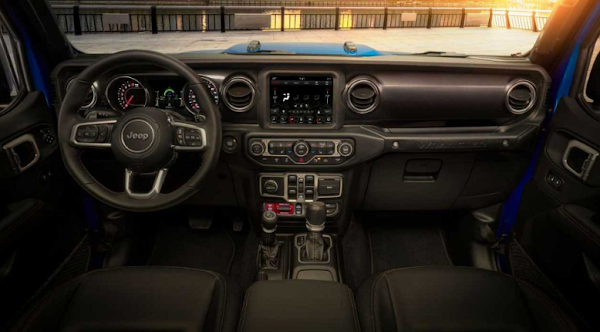
As is the case with the exterior, the 4xe’s cabin is essentially the same as that of the gas-powered Willys. The simple and short dashboard harkens back to the original Jeeps, with a light dusting of modern tech in the shape of the central, 8.4-inch touchscreen and driver information display. A gaggle of buttons below takes a bit of getting used to, but good on Jeep for sticking to physical controls here, with chunky rotary dials that can be handled with gloves.
The Willys isn’t some stripped-down workhorse, though. The AC is super-effective, and the cloth seats even come with heating for the front forks. The view out that upright windshield, with the high-clearance fender flares framing the shot, is easily as iconic as the Porsche 911. It’s a feel-good perch that’s hard to match.
The four-door Unlimited body style has quickly become the main seller for Wrangler, and it’s easy to see why. The second row is as spacious as an RAV4, though taller folks will be mindful of the body frame.
Uconnect 4 is still one of the more user-friendly infotainments out there, even though this iteration is slow and unpretty. The Wrangler’s Off-Road Pages app remains a great companion piece, providing quick access to details like pitch and roll, the current drivetrain setup, and accessory gauges.
Not The Handful It Once Was
The Wrangler has something of a reputation as a wanderer. The same hearty platform that makes it such a beast off-road can have it feeling vague and unwieldy on the tarmac. Yet my return trip would only cover asphalt. Oh yeah, and despite the images, it all took place in a downpour right up until the final 30 minutes before the dealership.
But you know what? The Wrangler 4xe was a fine road trip companion. Yes, it's noisy inside, especially with the constant dings of raindrops on the three-piece Freedom Top. But surely that’s what the bass-heavy sound system is for. The tiny steering corrections to keep it pointed in the right direction blend into the background, too. Those chunky tires give the Wrangler a squidgy ride that didn’t beat me up over the nearly five non-stop hours we spent together, either.
The adaptive cruise control works well, keeping the right distance from the car out front, and the blind-spot monitoring never misses a beat.
Verdict: 2023 Jeep Wrangler Willys 4xe
With its smattering of options, this particular 2023 Jeep Wrangler Willys 4xe rang to the tune of CAD 71,015 including destination, or about $66,990 in the US for an equivalent build. Don’t forget that it may be eligible for federal and state/provincial incentives, however.
The 4xe remains a hugely appealing variation of the best-selling off-roader. It’s easy to use, quick when you need it, and yet capable of exploring nature in near-silence—something its cross-town rival simply can’t do. The Willys brings the point of entry closer for more people while staying true to the Wrangler’s rough-and-tumble roots. You can possess your sugary confection and also consume it.