luxury cars-images This blog contains various forms of cars and at a glance most of the new information, present and future, this blog will always feature luxury cars, and sports cars, and provide information about the content, Toyota, Ford, Honda, BMW, Rolls-Royce, Tesla, Mitsubishi, Mazda, Chevrolet, SUV, Automotive, Pick-up, Sports Cars
  • LAMBORGHINI MODEL

    The most visionary models, these unique specimens are set to define the highest limits of technology and design. Unveiled at the most prestigious international Motor Shows, they offer an exclusive look at the most innovative solutions that Lamborghini may adopt in its future series-production models.

  • RAV4 Interior

    Premium materials and a focus on comfort raise RAV4 Hybrid’s level of refinement. Whether appreciating the views through the available panoramic glass roof or finding inspiration from RAV4 Hybrid’s attention to detail, you’ll enjoy a ride that’s ready to go the distance. Explore Interior

  • Ford F-150 Raptor

    The Ford F-150 Raptor pumps out so much fun and such oversize thrills, you'd assume that it had been outlawed years ago

  • Ford Mustang GT500

    Ford Mustang Shelby GT500 makes this car the most powerful car ever made by the American manufacturer. This is because the Ford Mustang Shelby GT500 is equipped with an engine capable of 760 horsepower

  • Tesla Roadster Fastest Electric Car

    Tesla claims the Roadster to be the fastest production car ever made! The second-generation Tesla Roadster can go from 0 to 60 miles per hour in under 1.9 seconds, and this is just for the base model.

Showing posts with label Electric. Show all posts

2024 Tesla Cybertruck

2024 Tesla Cybertruck Review
Tesla's Cybertruck has been one of the most popular vehicles in recent years, having landed like an asteroid on extinction levels amidst a largely static and boring truck market in 2019. This was before the Ford F-150 Lightning, Rivian R1T, Chevrolet Silverado EV, Ram 1500 Rev, or GMC Hummer EV either launched or went on sale. Since then, all of these trucks have debuted and reached the driveways of paying customers. Meanwhile, the stainless steel body and doorstop-shaped Cybertruck experienced many challenges and production delays, even changing from its original design as the realities of making pickup trucks in this century loomed ever closer to one that seemed sent back from a dystopian future.

Finally, the Tesla Cybertruck is complete, production is underway, and the truck is starting to be shipped to customers. First announced almost the same week four years ago, the Cybertruck has been both praised and criticized throughout its long and highly public launch for its controversial looks and big promises. So, what actual production of the Cybertruck will look like,
2024 Tesla Cybertruck Interior
While we knew the first Cybertruck would get all-wheel drive, we didn't know its actual layout until now. The pickup will use a three-motor setup with one 300 hp motor up front with an electro-mechanical locking differential, plus a pair of motors on the rear axle (each driving one wheel, so no need for a differential), for a total of up to 845 hp.

The electronic locking front diff is a first for Tesla, and we wonder if it will allow the driver to lock it selectively when needed or if it will be fully automatic. Dual rear motors are nothing unusual—Tesla's Model S sedan and Model Again, this is a welcome if not new feature; we've seen it on the GMC Hummer EV and Rivian R1T.


2024 Tesla Cybertruck Exterior
That maximum output of 845 hp is reserved for Beast mode, the most powerful setting made for off-road and performance driving, in the top-end Cyberbeast trim. At full power, this allows the Cybertruck to accelerate to 60 mph in less than 3.0 seconds, according to Tesla, and helps it beat the Porsche 911 in the quarter mile "while towing the 911 [behind it]," said Tesla CEO Elon Musk. If true, that's an impressive figure for the Cyberbeast's claimed specs of 6,843 pounds, which makes it about 50 pounds lighter than a 2024 Ford F-150 Lightning Platinum (6,900 pounds) and significantly lighter than a 2024 GMC Hummer EV which weighs 8,976 pounds. SUT with its tri-motor setup.

Tesla says the Cybertruck will also have a towing capacity of up to 11,000 pounds with Cyberbeast and AWD specs, while the standard RWD version is only capable of towing up to 7,500 pounds. The standard AWD spec will weigh 6,603 pounds and produce a maximum output of 600 hp with a 4.1-second 0-60-mph time. Tesla says these trucks also offer a payload capacity of up to 2,500 pounds. Towing and payload figures for the entry-level rear-drive model will be announced soon, as the model won't appear until 2025 at the earliest.
2024 Tesla Cybertruck Dashboard
It remains to be seen how towing will affect the range estimates quoted by Tesla for various Cybertruck models. The upcoming $60,990 rear-drive base model is expected to go 250 miles per charge and go from zero to 60 mph in 6.5 seconds. The all-wheel-drive model is claimed to go 340 miles per charge and hit 60 mph in 4.1 seconds, while the Cyberbeast is said to hit 60 mph in 2.6 seconds (on prepared surfaces, without a launch) and go 320 miles per charge. charging.

The battery is also capable of producing 11.5 kW of two-way power, so you can use the Cybertruck as a rolling generator for your home. If you're away from home, you can use the integrated 120-volt and 240-volt outlets thanks to its new battery architecture. The Cybertruck will use a new V3 Supercharger capable of producing 250 kW of power, and you'll get an additional 128 to 136 miles of range in just 15 minutes. If you need more power, it looks like Tesla will offer a mysterious range extender, which adds more than 120 miles of range on the Cyberbeast configuration and more than 130 miles on the standard AWD. On
2024 Tesla Cybertruck Wheel
The first thing we noticed is that the actual production Cybertruck is much smaller than the prototype we saw in 2019 and the early examples displayed during the Tesla exhibit at the Petersen Automotive Museum. The prototype was a larger truck with a taller suspension and taller tires. Production trucks are not only lower to the ground but also physically smaller. It's even more in line with the Ford F-150, at 223.7 inches long, 70.5 inches high, and at most 80.0 inches wide (without the rearview mirrors, even when folded it still makes the width 86.6 inches). Why "most?" Federal regulations dictate that anything wider has additional marker lights on the roof; The Cybertruck doesn't have one, so we'd say it's the same 80 inches wide as most other full-size pickups.

The suspension consists of an adaptive air suspension system, just like other top-tier Tesla models, but Beast mode will give the Cybertruck "up to 17 inches of ground clearance," according to Tesla. Based on the Cybertruck order page it looks like it's only for Extract mode, but still. The tires have unique Goodyear sidewalls on larger wheels. We also see that 18-inch wheels will be optional for the Cybertruck, potentially providing more sidewall for off-road tires. The stock tires will be made by Goodyear with an overall diameter of 35 inches and 20-inch rims.

One of the main storylines that emerged in the Cybertruck production reveal was the poor build quality of many of the prototypes spotted in the wild. In the context of Tesla's past problems with fit and finish on other models, as well as the obvious challenges that stainless steel bodywork poses for manufacturing, this seems especially damning. Additionally, most other automakers' test models and prototypes are not continually dissected for indications of build quality and are teased, and only the final product matters.

This being the final product, it appears that Tesla made great progress in fitting and finishing the Cybertruck, although it is unknown whether the trucks shown at the debut event were specially prepared or made in a new model typical of the next customers who will see them. We just don't know. From what we can see on the first trucks delivered to customers, there are still some wavy panels and odd seams between body panels, but again, much better than the prototypes we've seen over the years. On the Cybertruck that we inspected in person at a local Tesla showroom, some of these imperfections were quite glaring. We also found panel misalignments and gaps around the A-pillars where they meet the fenders, between the fenders and the front nose panel, and many other panels.

The Cybertruck is also equipped with a monoblade wiper mounted on the driver's side windshield. This is one of the largest wiper blades your writer has ever seen, including when they were technicians and serviced used Mercedes-Benz cars with the famous single-center wiper. The windshield needs to be large enough to wipe across the entire windshield, and the good news for Tesla technicians is that you don't have to remove and replace the glass to replace the wiper motor, as there is a panel to access it. That means there's a round cutout on the driver's side of the windshield with a matching cutout on the passenger side, potentially allowing the RHD model to place the blade there—if there is one, that is.

We're also curious how well these triangular mirrors will work on the Cybertruck. From what we could see on the L.A.-based truck, the steep angle formed when stopping outside the rearview mirror could potentially be a blind spot when using it. Yes, we know Tesla uses a camera system for FSD and Autopilot, and you'll be able to see what's around you when looking at the screen. But if rearview mirrors are going to be there (as required by Federal Motor Vehicle Safety Standards), at least make them useful. These rearview mirrors will also extend outward and increase the standard maximum width of 86.6 inches to 95 inches for towing.

Speaking of useless rearview mirrors, the interior rearview mirror is very small. We wonder how useful it will be considering the Cybertruck is meant to be driven with the tonneau cover closed. The rearview mirror may be a screen like GM trucks opt for interior rearview mirrors. With cameras on the Cybertruck's rear doors, this isn't out of the question. If you think an angled skylight can be used as a traditional interior mirror, think again. It ends in the same line of sight as the interior rearview mirror.

It appears a roof and cargo rack are also planned for the Cybertruck. We can see removable panels on the outer edges of the roof and bedside, marking provisions for rack mounting. Roof and bed angles can be difficult to adjust, especially when trying to make something visually functional with its slanted surface or when the surface needs to be straight to accommodate a load or tent.

Under the floor of the bed, there is a storage area like the one on the Honda Ridgeline. This gives you an additional 67 cubic feet of storage. The bed will also have a 2,500-pound payload capacity for whatever can fit in the 4-foot-wide, 6-foot-long bed. The bed also doesn't have wheel protrusions like a regular truck bed, so that's the actual usable size, and cargo capacity with the tonneau cover in use is still 120.9 cubic feet, according to Tesla.

While it doesn't follow in the Model S Plaid's footsteps with its odd airplane-style yoke, the Cybertruck does feature squircle-shaped wheels. The rim is flat on top and bottom, while the sides remain rounded. At least it gives you something to hold on to when making sharp turns, unlike a yoke wheel. We expect a round steering wheel will be an option on the Cybertruck, as it is on other Teslas. That yoke-ish wheel shape still isn't as easy or intuitive to use in the 2.5-turn lock-to-lock ratio that standard rack-and-pinion steering has, so it's good news that Tesla is using variable steering. -by-wire system here, which should work more like an implementation of the Lexus yoke idea and require less hand stroking.

Tesla is not the first to market a steer-by-wire system, as Infiniti has had the system since 2014, although it is unclear if there is a mechanical backup for emergencies such as an over-clutch steering column on the Infiniti. The good part is that it will have a four-wheel steering system for good maneuverability.
Share:

2024 Audi RS E-Tron GT

2024 Audi RS E-Tron GT Review
I came out of turn six, 'Siberia', at the Phillip Island Circuit. The track here winds to the left, then to the right, past a hay barn and up towards a large left-hand trail and the summit at Lukey Heights. On the radio is one of the Audi Sport instructors setting the pace in the 441kW/800Nm twin-turbo V8-powered Audi RS Q8 SUV, a car I've just driven on the circuit with. He is skilled, experienced, and hard-working—loud white SUV.

On the other hand, I was a bit rusty, I hadn't ridden here in years, and was rolling around the fastest motor racing circuit in Australia this time.

Even though he ordered me to press my right foot, I slowly lowered the accelerator, and even at half speed, I was able to master the RS Q8. He pushed the furious V8 monster to the limit, but my fully electric Audi RS E-Tron GT sedan was as calm as a Sunday afternoon.

This was my first experience driving a full-electric vehicle in a dedicated high-speed environment, and considering the way the swoopy E-Tron easily kept up with the brutish RS Q8, I knew it wouldn't be the last.

How much does the Audi RS E-Tron GT cost in Australia?

The Audi RS E-Tron GT is priced from $248,200 before options and on-road costs. That makes it $68,000 more expensive than its 'non-RS' counterpart, the Audi E-Tron GT, but $100 more affordable than its Zuffenhausen cousin, the Porsche Taycan GTS.

Beneath its aerodynamic profile (0.24 Cd), the RS E-Tron GT packs a pair of electric motors, a 93kWh battery, Quattro all-wheel drive, rear-axle steering, and an 800-volt electrical infrastructure that allows up to 270kW DC fast charging.

Output is listed at 440kW and 830Nm, but a peak of 457kW is available in the car's temporary 'boost' mode. That's more than the Taycan GTS (380kW/440kW boost/850Nm) but less than the Taycan Turbo (460kW/500kW boost/850Nm).

Buyers get a six-year Chargefox charging subscription, the convenience of driver (DC) and passenger (AC) side charging ports, 21-inch wheels, and nine color options at no additional cost.

And, for the return trip, there's a Bang & Olufsen 3D Surround Sound 710-watt, 16-speaker sound system as standard.

Important details of the 2024 Audi RS E-Tron GT

Prices Start at $248,200 plus travel costs
The color of the Daytona test car is grey, pearl effect
Options available Carbon and black exterior package – $15,000
Sensory package – $8400
RS Design Package – $4550
22kW AC charger package – $6900
Optional 21-inch wheels – $1800
Carbon brakes – $12,500
Black Audi Badge – $700
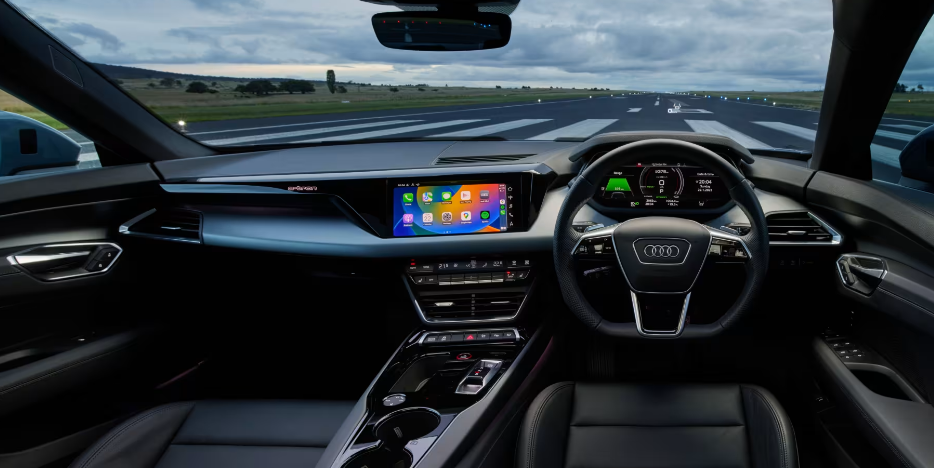
2024 Audi RS E-Tron GT Dashboard
The Audi RS E-Tron GT claims a 0-100km/h sprint time of 3.3 seconds and is electronically limited to a top speed of 250km/h.

2024 Audi RS E-Tron GT

Seat Five
Boot volume 350L
Length 4989mm
Width 1964mm
Height 1414mm
Wheelbase 2900mm

I started this journey in the Audi RS E-Tron GT to understand whether an electric vehicle could still stimulate the senses as a performance car, or whether the carnival driving sensation of the initial burst of acceleration would soon wear off. You throw some angles into the mix.

Right here, now, and almost wishing the RS Q8 hadn't gotten in my way, I've gotten past the initial question and am now asking "What else can this thing do?"

Forget Scalextric, slot car racing is now a 1:1 scale hobby, albeit an expensive one.

The RS E-Tron GT, as the name suggests, is a sporty 'Rennsport' implementation of the Audi E-Tron GT four-door sedan.

It offers dual motors with a power output of up to 475kW (in boost mode) and 830Nm of torque via a two-speed transmission to all four wheels. Even its regular output of 440kW is a 90kW increase on the 'regular' E-Tron GT (a 350kW / 390kW increase) and places the RS E-Tron GT in the upper echelon of not only electric cars but also supercar power numbers.

But we knew it would happen.

Tesla has created a platform that calls out to the world that electric cars can go incredibly fast, so much so that straight-line performance has been completely democratized.

When I was younger, I had a set of 'Top Trumps' cards featuring a 1984 Ford RS200 rally car as a vehicle to play with when flexing acceleration numbers. This Group B monster recorded a 0-100 km/h time of under 4 seconds, a figure often considered so amazing that it must be wrong.

Today you can do that in the MG 4 XPower hatchback.
2024 Audi RS E-Tron GT Exterior
A circuit like Phillip Island asks more of a car than just straight-line performance from a standing start, and it was in this fast and technical environment that the E-Tron showed that it was more than just a one-trick pony and big numbers.

Getting through the first corner at high speed often feels challenging as the car moves, naturally drifting toward the center of the circuit on the corner exit. Not so with the Audi Electro.

For starters, the car is wide. Very wide.


The 1964mm width is a total of 112mm, exceeding the width of the Porsche 992 911 (1852mm). The wheels are pushed out, with a 1687mm front track and 1667mm rear track with large 9.5-inch front tires and 11.5-inch wide rears. Combined with all-wheel-drive and all-wheel-steering capabilities, the Audi feels firmly attached to the ground. What a proper slot car.

The problem is, as we head back through the double-apex Southern Loop and into the hairpin turn of the Honda/Miller corner, I know that I'm not set up to explore the limits of the e-tron's grip levels.

Once again Jeff crackled over the radio and said to “push out through turn three”, but again I knew I would end up behind the RS Q8 if I did. Once again I took off well before braking towards the hairpin (and swans) behind it.

Here there is no need to throw anchor hard and test the capabilities of the car's 409mm front rotor and 366mm rear rotor. By applying the brakes firmly but not too hard, I shed speed behind the swooping, squirming SUV and was able to easily maneuver the corner into a tight left-hander.

Important details of the 2024 Audi RS E-Tron GT

Dual electric motor engine
Power Boost mode 440kW / 475kW
Torque 830Nm
Drive Type wheel drive
2-speed automatic transmission
Power to weight ratio 187.6kW/t
Weight (curb) 2345kg
Spinning an 11.0m circle

Under power, you can hear the roar of the motor revving, and where there was a rush of wind and the exhilarating sound of tires, with the helmet I was wearing, I was almost surprised how much I didn't notice or even care about the lack of power. engine noise.

This is largely due to the PlayStation-like 'gearless' driving style, where your role is to manage fast, slow, left, right, kick, punch, and jump.

You are not concentrating on the timbre and vibration of the engine to understand where you are in the gear selection process. You don't have to consider braking too early or worry about missing a change and hitting the barrier when the power is on.

2024 Audi RS E-Tron GT Interior


You just drive.


Concentration is still required, mind you. Just in a different way.

It's more than just knowing there's a 2535kg V8 SUV right in front of you that you don't want to go near… although you could, just as easily, it's about considering your environmental variables in a way that respects the environment. the speed at which things are happening, or could happen.

Moving the power confidently and smoothly so as not to disrupt the approach that has become the rhythm of performance driving is now paramount. The amount of speed you can increase in such a short time and distance means you now have to constantly readjust your angle planning.

Saw the steering or stab the throttle and you can throw the whole turning equation out of balance and get into trouble. You move quickly and very easily in this car, so small inputs and a fluid mindset are key.

The way the car can also reduce speed quickly means there is an opportunity to enter Phillip Island's dozens of corners faster, and then, go faster in preparation for the next corner.
2024 Audi RS E-Tron GT Back side
We pushed on for the final lap and picked up speed on the Island's spectacular front straight. Here the speedo passes 200km/h very quickly, and it feels like there's a lot more to it. Part of me wants the RS Q8 out of the way so I can see how much more the GT can deliver.

Even without the unlawful explosion, the E-Tron has shown that the electric platform has a lot to offer high-performance drivers, and in this case, it can work for drivers of varying abilities behind the wheel.

Beginners will feel supported by the car's stability and may be surprised by how fast it is, while more experienced drivers will feel confident in pushing the limits of their abilities as they steer the car towards its own pace.
2024 Audi RS E-Tron GT Wheel

Lots of fun. There are many advantages. So what's the catch?


Priced at $248,200 before options and on-road costs, the Audi RS E-Tron GT won't be included in the track-day specials for most buyers. It's not just about price, the E-Tron has a physical problem... with physics.

After a few laps, you'll probably wonder how things are going, and this is where the RS E-Tron GT isn't quite ready for mass adoption in motorsport clubs.

On a three-lap run, we used an average of 86kWh of energy per 100km. This is the result of excessive use of power and limited regeneration opportunities, meaning the car uses more brakes than the motor recovers power.

With a 93 kWh battery, that gives us a range of around 100 km, or in Phillip Island currency, around 18 laps of the 5.3-kilometer circuit, assuming, of course, you start with a full 'tank'.

This means that without at least a 50kW charger on site, enjoying the RS E-Tron GT at almost any motorsport venue in Australia will be a time- and lap-limited activity. Hopefully, there aren't two or more EVs enjoying track time and wanting to share a charging station at the end of the day.

It's not just battery usage that you need to worry about. It's a brake.

Bear in mind that at 2345kg, the Audi is almost 840kg heavier than a Porsche 911 Carrera (1505kg), which means those brake pads and rotors will do just fine.

Luckily the RS Q8 is here because you'll need something capable of towing the E-Tron home if your life-sized slot car racing day runs out of ways to go or stop!

I don't want to end up disappointed, as the RS E-Tron GT is a truly outstanding machine in this environment, so we could see it being an early iteration of a capable performance-based electric car.

Over the next few years as technology becomes smaller, lighter, and cheaper, I am sure we will see several electric machines changing the way we approach club-based and education-based motorsport activities.

In the same way that small-capacity turbocharged cars opened up a world of accessibility for young enthusiasts to get their own experience on the track, so will the next generation of electrics open the door to greater performance and potential.
Share:

2024 BYD Sea Lion 07 electric SUV

2024 BYD Sea Lion 07 electric SUV Review
Chinese electric car giant BYD has unveiled its latest challenger to the Tesla Model Y. But it may be overlooked by Australia in favor of different hybrid and electric models.

The 2024 BYD Sea Lion 07 electric mid-size SUV – a rival to the Tesla Model Y – has been unveiled ahead of its China launch early next year.

Plans for local showrooms are unclear, and Australia will likely skip the Sea Lion 07 in favor of BYD's other mid-size SUV known as the Seal U, with plug-in hybrid and electric power.


2024 BYD Sea Lion 07 electric SUV Exterior
The Sea Lion 07 is the latest electric car in the Chinese car giant's 'Ocean' series – which also includes the Seagull and Dolphin hatchbacks, as well as the Seal mid-size sedan.

Limited details have been published to date, but the Sea Lion borrows heavily from the Seal sedan, with similar headlights and a coupe-inspired sloping roofline.

Reports claim it is 4,830 mm long, 1,925 mm wide, and 1,620 mm high, with a wheelbase of 2,930 mm – 80 mm longer bumper to bumper, 3 mm wider, 4 mm lower, and 40 mm longer between the wheels than the Tesla Model Y.


2024 BYD Sea Lion 07 electric SUV Pictures
In comparison, the BYD Atto 3 – the company's only SUV in Australia to date – is about 330mm longer overall.

In China, prices start from 200,000 to 260,000 yuan ($AU42,500 to $AU55,500) – while a Tesla Model Y costs 266,400 to 363,900 yuan ($AU56,700 to $AU77,500).

It is said to be underpinned by the same 'e-platform 3.0' architecture for electric cars such as the Atto 3, Seal, and Dolphin – and uses adaptive suspension, which BYD is branding as 'DiSus-C'.


2024 BYD Sea Lion 07 electric SUV Side back
Photos of the interior have not been published, nor have the technical specifications. Overseas reports claim the car will be available with single-engine front-wheel drive or twin-engine all-wheel drive.

Local arrival plans have not been outlined, but it is believed that Australia will most likely receive the higher-bodied Seal U – which is sold as the Song Plus Champion Edition in China – as BYD's mid-size SUV plans to be introduced next year. than Sea Lions.


2024 BYD Sea Lion 07 electric SUV Wheel
BYD Seal U prototypes have been spotted testing extensively in Australia in recent months.

When asked by Drive whether the Seal U was a mid-size SUV planned for Australian showrooms, Luke Todd – managing director of BYD's Australian distributor, EVDirect – recently said: "The one you've seen in camouflage is the one coming to Australia.
Share:

2025 Lucid Gravity SUV

2025 Lucid Gravity SUV Review
As an editor currently driving MotorTrend's year-long Lucid Air test car, this writer can't tell you how many times he's wished for a cabin with more space. Because what we found is that people of different heights—not just tall people—are at risk of hitting their heads when flying in the air. Some people also find the Air's driving position a bit cramped.

Enter Lucid Gravity 2025—no, you have a better chance of getting into it without a headache. This thoroughly modern SUV is tall enough for smoother entry and exit but has a long, low stance that reminds us of the Isuzu Axiom from the early 2000s. (Don't remember? Appeared in The Spy Kid—still nothing?) Still, any fan of the Air sedan will recognize the Gravity as part of the Lucid family.

However, we suspect it's no coincidence that Lucid shows us Gravity at one of its higher suspension heights. At its lowest suspension height and especially with its smaller wheels, the sleek Gravity will look almost car-like, the opposite of the boxy, adventurous Rivian R1S. To each their own, right?

As for the Gravity, two-row, five-seat three-row, and seven-passenger versions will be available. We're told a six-passenger Gravity with second-row captain's chairs is being considered for a later date.

Also new to Lucid? An available rear-wheel steering system and air suspension adjust automatically based on speed. These two technologies can make a big difference in ride quality, low-speed handling, and overall driving experience if executed well. When Gravity goes on sale in the second half of 2024, we'll see if Lucid can introduce these features without too many bugs at launch.
2025 Lucid Gravity SUV Exterior

Electric SUV With 500 Mile Range?

Lucid's engineering excellence has taken the electric car world by storm with a luxury sedan that is fast, fun to drive, efficient, and still capable of a range of more than 500 miles by EPA standards for certain models. It's second to none in the luxury car segment, and we have high hopes for the 2025 Gravity SUV as a result.

Using what Lucid says is a new platform from the Air, the Gravity has updated motors and a drag coefficient of just under 0.24 (on select trims), although details are slim at this point. We know that the floor heights for the two batteries will not be different; in the Air, you get about three inches of rear-seat legroom by not using the larger battery, which compromises passenger legroom.

Don't expect the Gravity to achieve a 500-mile range, unless perhaps you're driving it down a very, very long hill. In contrast, expect at least one Gravity trim to achieve a range of at least 440 miles. The Tesla Model Lucid claims the Gravity can also add 200 miles of range in 15 minutes thanks to a 300 kW charging rate.
2025 Lucid Gravity SUV Interior

Towing And Off-Roading

Twin-engine all-wheel drive will be standard on the 2025 Gravity, although the company hasn't ruled out a single-engine rear-drive version. If enough customers like the Gravity and don't need the price cut that the Air did, the rear-drive Gravity probably won't happen.

Right now, looking at our photos of the 2025 Gravity, you can probably tell that the Lucid isn't a rock cruiser like the R1S. However, the Gravity does have an off-road mode that sets the air suspension height at the highest setting with full torque access—sounds fun. We wonder what the ground clearance will be like on an SUV that looks ready for a road like this. Wheel options include 20 inches front with 21 inches rear, 21 inches front with 22 inches rear, or 22 inches front with 23 inches rear.

Towing capacity tops out at 6,000 pounds, which is 1,700 pounds less than what you can tow in a Rivian R1S or Audi Q7 but more pounds than the Air sedan can haul.

Acceleration from 0-60 mph can be achieved in just 3.5 seconds, according to Lucid. We don't have horsepower and torque specs yet, but the 2025 Gravity will have at least 480 hp. When launched, the Gravity model will likely match or beat the 620 hp Touring model and the 819 hp Grand Touring model. Will Lucid make a higher-performance Gravity Sapphire? Considering how good the 1,234 hp Air Sapphire was in our testing, fingers crossed.
2025 Lucid Gravity SUV Pictures

Towing And Off-Roading

Twin-engine all-wheel drive will be standard on the 2025 Gravity, although the company hasn't ruled out a single-engine rear-drive version. If enough customers like the Gravity and don't need the price cut that the Air did, the rear-drive Gravity probably won't happen.

Right now, looking at our photos of the 2025 Gravity, you can probably tell that the Lucid isn't a rock cruiser like the R1S. However, the Gravity does have an off-road mode that sets the air suspension height at the highest setting with full torque access—sounds fun. We wonder what the ground clearance will be like on an SUV that looks ready for a road like this. Wheel options include 20 inches front with 21 inches rear, 21 inches front with 22 inches rear, or 22 inches front with 23 inches rear.

Towing capacity tops out at 6,000 pounds, which is 1,700 pounds less than what you can tow in a Rivian R1S or Audi Q7 but more pounds than the Air sedan can haul.

Acceleration from 0-60 mph can be achieved in just 3.5 seconds, according to Lucid. We don't have horsepower and torque specs yet, but the 2025 Gravity will have at least 480 hp. When launched, the Gravity model will likely match or beat the 620 hp Touring model and the 819 hp Grand Touring model. Will Lucid make a higher-performance Gravity Sapphire? Considering how good the 1,234 hp Air Sapphire was in our testing, fingers crossed.
2025 Lucid Gravity SUV Sude Back

"Real Growth Curve At Lucid"

The theme in Lucid Gravity 2025 is the same: similar to Air but not the same. Lucid design chief Derek Jenkins said there's been a "real growth curve at Lucid" since the Air first launched. And that's good to hear, because, in our experience, Lucid Air's undeniable goodness is often marred by minor issues that include tech bugs.

It's not just a bug in the technology—on our Air test car over a year ago, one of the steering wheel buttons popped with gentle use. The Gravity steering wheel has touchpads on the left and right sides, with areas for swiping and four flat buttons as well. The steering wheel is now squircle-shaped, so it's flat at the bottom and top. Jenkins tells us that Lucid tested 27 different wheels and yes, the Tesla-style yoke was among them.

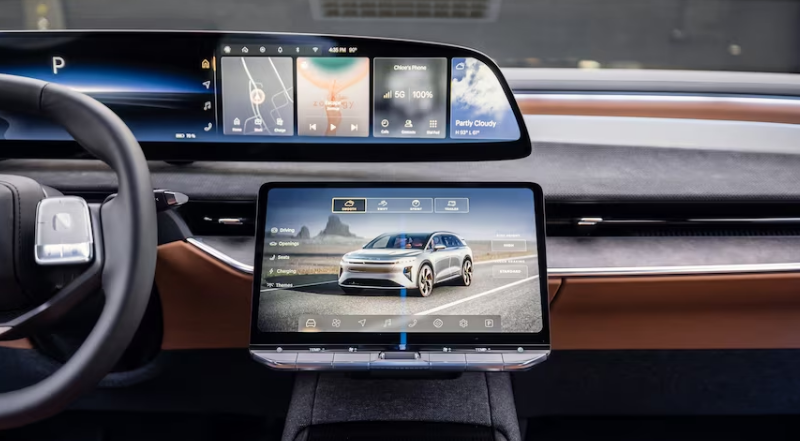
The upgraded OLED screen has all been tweaked and we're told the system should be more reliable than it was on the Air. The top edge of the screen is higher, and the top has slimmer edges. The long 34-inch screen consists of a small control menu to the left of the steering wheel, the instrument cluster, and the top infotainment screen. Below that, the lower center screen is now oriented horizontally and measures 12.6 inches instead of 12.5.

One trick we enjoyed while on air was hiding the bottom screen, but that feature is missing from Gravity. However, there's a relaxing setting that blacks out the bottom screen and simplifies the top screen to only show what you need to see. On a long trip at night, this is the one to drive.

Then there's Lucid Sanctuary, a fantastic mode that only works when you're not driving. Every screen in the car showed the same natural scene—the one we saw in Joshua Tree, California. This is what you see on the Calm app's home screen. These visuals and sounds are combined with massage and enhanced LED mood lighting. We've seen similar features from Mercedes and Genesis, but this seems to go a step further

We can't imagine feeling comfortable enough parking at a charging station to meditate, but Lucid also has a connection with Meditopia, where you can be guided through short sessions. Some of these features may require a long-term subscription, but Lucid is working out the details.

On the other hand, we are told that a car karaoke feature will also be offered. There's a lot to unpack with the Gravity, so while some will be impressed by the in-car apps or enormous head-up display, we're also intrigued by how this SUV drives, its range, and how well it performs. the interior is functional.
2025 Lucid Gravity SUV Interior

Gravity, 3 Row SUV

By the way, as of this writing, Lucid is still determining how the second row of seats will fold to improve access to the third row. The prototype we saw had a lever on the underside of the second row of seats, which could adjust the backrest angle. Will there also be a Honda-Pilot-like button to recline the backrest and push the seat forward? We will see later. At least the rear doors can be opened to about 90 degrees—that's another feature we like when in the air.

No matter how you fold those seats, access to the third row is fine. The windows back there also don't provide a good view of your surroundings. No steel-roofed Gravity is planned—so at least you'll get a view of the trees above. Living in Los Angeles, our glass-roofed Air often cooks in the summer sun, so we were happy to hear that Gravity's glass-roof has a different thermal coating that can reduce cabin temperatures. In the future, an electrochromic glass roof feature may be offered, like the one on the Toyota Venza.

Key Fob And Glass

Ironically, in a car as sophisticated as the Lucid Air, one of the problems that often occurs is a flimsy key fob that requires frequent battery replacement and doesn't always recognize the car. Yes, we have good news: There's a new regular-sized key fob in the Gravity, which can accommodate a longer-lasting battery.

And if that doesn't excite you, let's talk about glass. We love the rich look of the wood covering over the Air's front cupholders. On Gravity 2025, the lid is now made of tempered glass. When we took a look inside a Gravity Dream Edition prototype before the SUV's debut, the glass with its etched lines was unexpected but rich. We were told that different trims will have different etching patterns. Beneath the cover and fold-back armrest is ample storage.

Interested in Gravity?

Gravity 2025 has a very clear design and way of reaching the future. However, trying to be ahead has its pros and cons, so we're curious to see how well Lucid can live up to Gravity's promise.

Additionally, the 2025 Gravity undeniably expands the reach of the Lucid brand in a way that no executive sedan ever could. And a starting price estimate of "under $80,000" should also help; The Air just got a lower-cost version at the same price, after launching in the six figures.
Share:

2024 Chevrolet Blazer EV

2024 Chevrolet Blazer EV Review
The march toward electrification is in full swing, and Chevrolet's electric vehicle lineup continues to expand. The latest model announced is the 2024 Chevrolet Blazer EV. The truck will go on sale in summer 2023, which is also when the Chevrolet Silverado EV pickup truck is scheduled to debut. It will join the smaller Equinox EV, which will arrive a few months earlier, as well as the existing Bolt EUV and Bolt EV compact hatchbacks.

The Blazer EV is a mid-size two-row SUV with an estimated maximum range of 320 miles. Despite its name, this electric SUV is a completely different model from the current gas-powered Chevy Blazer, although its styling is just as sharp and aggressive, with a touch of sporty Camaro. Since many midsize SUVs are available with three rows of seating, which can limit cargo space, we expect the two-row Blazer to benefit from plenty of room for the rear seats and cargo.

Currently, the Tesla Model All the other electric SUVs on sale today are smaller, but the list of large models coming in the next two years continues to grow. The mid-range Blazer EV 2LT and RS trim levels will go on sale first. The performance-focused SS will follow a few months later, and the entry-level 1LT is expected in early 2024.
2024 Chevrolet Blazer EV Back side

Positive

Bigger than current electric SUVs. Performance-focused SS model. The Super Cruise driver assistance system is available.

Consideration

The lowest-priced 1LT model was not available at launch.

Indictment

The 2024 Chevrolet Blazer EV is part of a larger wave of electric SUVs. With a variety of affordable models, including the high-performance SS trim, the Blazer has a lot of potential.

What's New for 2024

The Blazer EV is an all-new, all-electric midsize SUV.

Trims and Prices

The 2024 Chevrolet Blazer EV will be available in four trim levels: 1LT, 2LT, RS, and SS. We expect these trims to have varying levels of power and performance as well as typical features found on any contemporary vehicle.

1LT

The entry-level Blazer EV 1LT will be priced at $44,995 (excluding destination charge). Information regarding feature content is scant at this time, but we do know that Chevrolet plans to include the following standard features: 19-inch alloy wheels, LED exterior lights, a hands-free power liftgate, a keyless entry/start, digital instrument panel. , and interior ambient lighting.

2LT

The 2LT trim ($47,595) will come standard with front-wheel drive and the option for all-wheel drive. This will increase the driving range, depending on the drive configuration. Given the model's longer range and modest price increase, this is currently the trim we recommend.

RS

The RS trim ($51,995) will be a sportier model with more aggressive styling and a two-tone paint scheme. Initial feature highlights include 21-inch wheels, upgraded LED headlights, heated and ventilated front seats, and a heated steering wheel.

SS

Priced at $65,995, the SS performance model includes all-wheel drive, 22-inch wheels, Brembo front brakes, sport-tuned suspension, Super Cruise hands-free driver assist, head-up display, virtual rearview mirror, faux suede. upholstery, and heated rear outboard seats.
2024 Chevrolet Blazer EV Exterior

Battery and Performance

The battery and most performance specs are not yet available for the 2024 Chevrolet Blazer EV, but we do know that the 1LT will only be offered with front-wheel drive. The 2LT will provide all-wheel drive as an option, while the RS will be available in front, rear, or all-wheel drive.

The high-performance SS will come with all-wheel drive and produce an impressive 557 horsepower and 648 pound-feet of torque. It will have a feature called Wide-Open Watts, which temporarily allows for maximum power output. In this mode, Chevrolet estimates the Blazer will accelerate to 60 mph in less than 4 seconds.

As with any electric vehicle these days, the Blazer will store its heavy battery on the floor. This low center of gravity allows it to corner more like a sporty car than a mid-sized SUV. It will also feature a one-pedal drive that can bring the vehicle to a complete stop without touching the brake pedal.


Charging Range and Time

We don't have official battery specs for the 2024 Chevrolet Blazer EV yet, but we do have the all-important range estimate. The base Blazer EV 1LT is estimated to travel 247 miles on a single full charge. The 2LT is estimated at 293 miles, while the RS is estimated at 320 miles and the SS at 290 miles.

All Blazer models come with DC fast charging capability with a maximum power of 190 kW. Chevrolet estimates it can cover a distance of 78 miles in just 10 minutes. What helps is the Ultium Charge 360 system which combines seven major charge networks for more complete mapping and easier payments from one source.


2024 Chevrolet Blazer EV Interior

Interior

The interior layout of the Chevy Blazer is more traditional than other EVs and should be more intuitive to use. Unlike some EVs that have all the controls on the touchscreen, the Blazer EV's dashboard has physical buttons for climate control as well as knobs for temperature and audio volume. The dashboard is dominated by a large touchscreen with several complicated turbine-like air vents. The quality of the materials is comparable to other non-luxury vehicles, and some elements are made from sustainable sources.

The rear seats are spacious enough to accommodate average-sized adults and the flat floor means the middle passenger doesn't have to deal with the dreaded floor hump. On the top SS trim, buyers can add a bold splash of color with red faux suede seats and contrast stitching. We don't have cargo capacity figures yet, but it's spacious and can easily carry a lot of luggage.


Infotainment and Connectivity

The Chevy Blazer EV comes with a standard 17.7-inch touchscreen with sharp graphics. While not yet confirmed, we expect Apple CarPlay and Android Auto to be included. The built-in navigation system features automatic trip planning around charging stations. Maps should be updated regularly (and owners can add new features as available) via over-the-air software updates.
Security


2024 Chevrolet Blazer EV Wheel
We expect crash test evaluations of the 2024 Chevrolet Blazer EV to be released from the National Highway Traffic Safety Administration ( NHTSA ) and the Insurance Institute for Highway Safety ( IIHS ) closer to the SUV's 2023 launch date.

All Blazer EVs will come with the Chevy Safety Assist suite of advanced safety features. These include forward collision warning with automatic emergency braking, lane keep assist, and automatic high beams. Reverse automatic braking and advanced parking assist are available as options.

GM's Super Cruise hands-free driver assistance system is included with the SS trim and is available on other models. This is one of the best driving systems on the market and can be activated on an increasing number of roads. Drivers can take their hands off the wheel while driving, but they must keep their eyes on the road and be prepared to take over driving responsibilities when necessary.

Chevrolet Blazer EV vs. Competition

The 2024 Chevrolet Blazer currently has no direct competitors. The Tesla Model X comes close in some ways, but its high price puts it out of reach for many buyers. If that weren't enough, the unusual falcon-wing rear doors and lack of a folding rear seat could be the downside.

There are plenty of similar-sized electric SUVs coming soon, which should debut around the same time as the Blazer. These include the Fisker Ocean, VinFast VF9, Hyundai Ioniq 7 and related Kia EV9, as well as the Volkswagen ID.8. Then there's the VW ID Buzz which combines charming Microbus aesthetics with modern minivan sensibilities. There will also be electric versions of the Ford Explorer, Genesis GV70, and Volvo XC60 or XC90.

TrueCar Expert Review Methodology

TrueCar works with a select group of automotive industry experts who test drive nearly 300 vehicles per year. TrueCar experts rate vehicles based on key attributes including driving dynamics, comfort, interior design, technology, storage, and efficiency. Our experts also assess current model updates, prices and values, trims, options, comparable vehicles, and safety ratings (such as those provided by the NHTSA and IIHS) to inform their recommendations and help car buyers choose the right vehicle for them.

TrueCar also ranks the best vehicles in each category based on a data-driven methodology. Each vehicle is carefully rated using our internal rating system, which systematically evaluates every car, SUV, truck, and van. Leveraging ALG industry research, consumer surveys, a team of data scientists, and vehicle experts, TrueCar provides unique and useful insights to help you find the best vehicle for your driving needs.
Share:

2024 Lotus EMEYA! 905

2024 Lotus EMEYA! 905 Review
Lotus today took the wraps off its new flagship car, the Emeya, at a glittering event in New York City.

Known as the Type 133 until now, this electric four-door sedan will provide a new challenge to the Tesla Model S and Porsche Taycan Turbo.

The car showcased cutting-edge technology and was the brand's first four-door sedan after the Opel Omega-based Carlton from the 1990s.

Active Aerodynamics

Aerodynamics is at the forefront of this sedan. The car has an active grille at the front, first seen on the Eletre SUV, to reduce drag and increase efficiency when closed and cool the battery and brakes when open.

There is also an active front spoiler, an active motorsport-inspired diffuser, and an active rear spoiler to maximize downforce when traversing canyons and traversing the track.

The active rear spoiler is 11.0 inches (280 millimeters) wide, 3.9 inches wider than the one on the Eletre, resulting in a net downforce of 474 pounds (215 kilograms) at unspecified speeds.
2024 Lotus EMEYA! 905 Interior

Sustainable Materials

Sustainable materials take center stage in Emeya's interiors.

Lotus is the first car manufacturer in the world to use a new type of thread.

For the passenger compartment seats, this brand uses thread derived from cotton waste from the fashion and clothing industry. This is not only a sustainable form of luxury, but also saves weight compared to leather.

Lotus also uses processes such as physical vapor deposition (PVD) for a metal-coated finish on certain cabin surfaces. There's also Alcantara, ultra-fabric polyurethane, and Nappa leather in other areas.

Advanced Technology

The interior is more than just eco-friendly materials. The KEF 3D surround sound system integrates noise cancellation.

The brand has installed vibration sensors on the exterior to detect tire and suspension movement. The algorithm then generates an “anti-phase acoustic signal” through the speakers to reduce interference.

There's also a 55-inch augmented reality head-up display for quick access to important driving information. It also has a digital mirror and LiDar module like Eletre.

Performance and Range
Emeya uses the same platform as Eletre, namely Electric Premium Architecture (EPA) which comes from Geely's Sustainable Experience Architecture (SEA).

The car is expected to have the same range as the Eletre, which can cover an optimistic 373 miles (600 km) on the WLTP cycle.

The car has a 102 kWh battery pack, slightly smaller than the Eletre's 112 kWh pack, which can charge at 350 kilowatts.

A range of 93 miles (149 km) can be added in five minutes - 10-80 percent takes 18 minutes with a 350 kW DC fast charger.

The performance numbers straddle hypercar territory. With 905 horsepower and 726 pound-feet of torque, this sedan can accelerate from 0-62 miles per hour (0-100 km/h) in just 2.8 seconds.

The top speed of all-wheel-drive EVs is limited to 159 mph (255 km/h). Power is sent to all four corners via a two-speed transmission, and Lotus claims the braking system is "racing grade."

In terms of chassis technology, the adjustable suspension can analyze the road ahead 1,000 times per second.

"This is a completely new Lotus, something that has never been seen before. Building on what Lotus has achieved to date, we have created a luxury car that delivers exceptional performance for driving enthusiasts, designed to inspire confidence and excitement," said Ben Payne, Lotus Group vice president of design.
2024 Lotus EMEYA! 905 Exterior

Production and Availability

The company will reveal further details in the fourth quarter of 2023, and production is scheduled to begin in 2024 at Geely's factory in Wuhan, China, where the Eletre is already produced.

The Emeya will arrive in the US in Q4 2024, Lotus vice president and chief commercial officer Mike Johnstone told InsideEVs.

Once production of Emeya and Eletre is in full swing, perhaps by 2025, the brand expects 30 percent of its total sales to be in the U.S., Johnstone said.

Lotus still has to prove its mettle in the electric car era. After selling just 576 Emirates last year - its last gas-powered car - citing supply chain issues, the Geely-owned brand has taken more than 17,000 orders this year from the Eletre and Emira combined.

Production of the latter car is progressing smoothly, according to Johnstone.

Its current order book has broken all previous sales records, and new models like the Emeya could contribute to turning its fortunes around.
Share:

2024 Kia EV9

2024 Kia EV9 Review

2024 Kia EV9 Price and Specifications

One of Australia's first seven-seat electric SUVs arriving in showrooms now
The most expensive vehicle Kia has sold in Australia to date
Three models with prices starting at $97,000 (Air), $106,500 (Earth), $121,000 (GT-Line)

Australian pricing and specifications have been released for the Kia EV9 – one of the first seven-seat electric SUVs to be sold locally – as the first deliveries begin to arrive in showrooms.

As expected, prices approach or exceed $100,000 before road costs such as registration, stamp duty, and arbitrary dealer delivery charges are added.
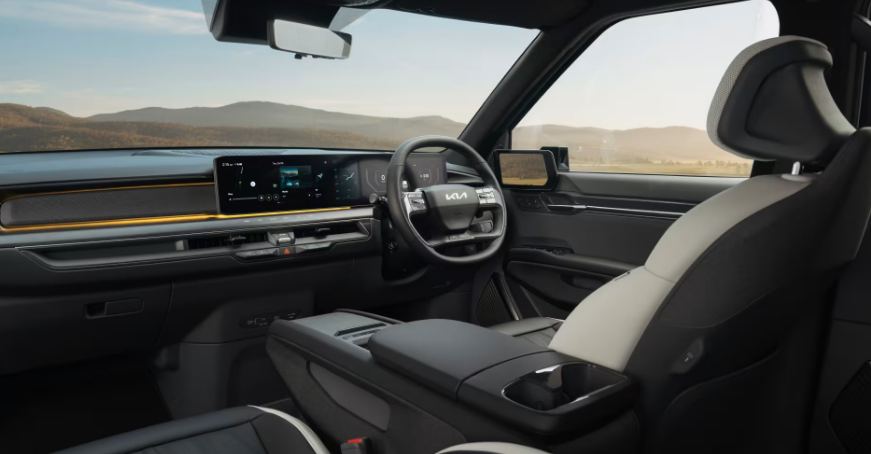
2024 Kia EV9 Interior
Dealers have been told that the first deliveries of Kia EV9s to arrive in Australia will be the base Air and flagship GT-Line models.

There is a delay in the local arrival of midrange Earth models, which will follow in a few months.

The EV9 isn't the first seven-seat electric SUV to be sold in Australia; The Tesla Model

But it's the biggest seven-seater electric SUV sold in Australia – and the first from a carmaker to feature in the top 5 sellers.
2024 Kia EV9 Pictures
A price range of $97,000 to $121,000 plus on-road costs makes the Kia EV9 the most expensive Kia sold in Australia to date.

The company says it has received interest from customers in wealthier ZIP codes who have never previously owned a Kia.

With only 100 Kia EV9 units arriving nationwide each month next year, Kia dealers expect wait times to range from three to four months.

The Kia EV9 is based on the South Korean automaker's new dedicated electric car platform – not a remake of a petrol-powered SUV – and is the company's largest battery-powered vehicle to date.

Due to its size – and battery capacity – the Kia EV9 is also the heaviest passenger vehicle the company has ever sold, with a weight ranging from 2312kg to 2636kg, putting it in Toyota LandCruiser territory.
2024 Kia EV9 Dashboard

Standard equipment Kia EV9 Air 2024:

LED 'projector' headlights, LED daytime running lights and LED taillights
Low-profile roof rails
Noise-cancelling windshield and side windows
Retractable door handle
Electric folding rearview mirror
Column shift stick with start button
Paddle shifters to regulate regenerative braking
Faux leather seats and steering wheel rim
Two-way powered lumbar support on the front seats
60:40 split-folding second-row seats (tilt and slide)
Quick-release button in the cargo area to store the second row of seats
The third row of seats is stowed via a pull strap
LED interior lighting for all three rows of seats
LED lighting for under-hood storage
One-touch automatic up-and-down power windows for all four doors
12.3-inch infotainment touchscreen with 'over the air' Wi-Fi updates
12.3 inch digital instrument cluster
5.0 inch AC control screen
Apple CarPlay and Android Auto
Embedded navigation
Eight-speaker audio system (AM/FM/digital radio)
Wireless phone charger with a higher notch for better connectivity on smartphones with large camera 'islands'
1 x 12V power socket, 2 x USB-C charging ports at the front of the center console
1 x USB-C charging port on each front seatback
2 x USB-C charging ports for third-row seats
1 x 12V power socket and 1 x 250V household power socket in the cargo hold
Rain sensing wipers
Auto-dimming rearview mirror
Heated and ventilated front seats
Heated steering wheel
Power-operated rear door
Remote engine start
Kia Connect smartphone app support
Fingerprint sensor in the center console to remember driver settings
2024 Kia EV9 standard safety features:
Autonomous emergency braking with intersection assistance
Blind spot warning and rear cross-traffic alert
Lane maintenance assistance
Radar cruise control
Tire pressure monitor (valve type)
Nine airbags include a center airbag between the front seats, 'curtain' airbag coverage for all three rows of seats, and seat-mounted side airbags for the first two rows of seats
Introduction to speed signs
Driver fatigue monitoring
Rear camera
Front and rear parking sensors
Electronic parking brake
Tire repair package
19-inch rims, Nexen tires
2024 Kia EV9 Back side

2024 Kia EV9 Earth (in addition to or in place of the Kia EV9 'Air' features above):

Dual motor, all-wheel drive, 283kW/700Nm (vs single motor, rear-wheel drive, 160kW/350Nm for Air)
Extended range battery: 99.8kWh (vs 76.1kWh for Air)
Gloss black fender flares and side moldings
Ambient cabin lighting
The Kia logo lights up on the steering wheel
360-degree camera
Monitor side view
19-inch rims, Continental tires
2024 Kia EV9 Images

2024 Kia EV9 GT-Line (in addition to or instead of the Kia EV9 'Earth' features above):

Small cube projection LED headlights
Black roof rails
Tinted rear window
Digital rearview mirror
double sunroof
Two-tone leatherette seats
The head-up display reflects on the windshield in the driver's line of sight
Meridian 14-speaker premium audio system
Digital rearview mirror
The outer rear seats are heated and ventilated
Remote parking assistance
21-inch rims, Continental tires
2024 Kia EV9 Wheel

There were initially three models in the Kia EV9 range in Australia:


Kia EV9 Air
Single motor, rear-wheel drive
76.1kWh battery pack
range 443 km
0-100km/h: 8.2 seconds
$97,000 plus travel expenses
Kia EV9 Earth
Dual motor, all-wheel drive
99.8kWh battery pack
range 512 km
0-100km/h: 6.0 seconds
$106,500 plus travel expenses
Kia EV9 GT-Line
Dual motor, all-wheel drive
99.8kWh battery pack
range 505km
0-100km/h: 5.3 seconds
$121,000 plus travel expenses
Share:

Popular Posts

Followers