luxury cars-images This blog contains various forms of cars and at a glance most of the new information, present and future, this blog will always feature luxury cars, and sports cars, and provide information about the content, Toyota, Ford, Honda, BMW, Rolls-Royce, Tesla, Mitsubishi, Mazda, Chevrolet, SUV, Automotive, Pick-up, Sports Cars
  • LAMBORGHINI MODEL

    The most visionary models, these unique specimens are set to define the highest limits of technology and design. Unveiled at the most prestigious international Motor Shows, they offer an exclusive look at the most innovative solutions that Lamborghini may adopt in its future series-production models.

  • RAV4 Interior

    Premium materials and a focus on comfort raise RAV4 Hybrid’s level of refinement. Whether appreciating the views through the available panoramic glass roof or finding inspiration from RAV4 Hybrid’s attention to detail, you’ll enjoy a ride that’s ready to go the distance. Explore Interior

  • Ford F-150 Raptor

    The Ford F-150 Raptor pumps out so much fun and such oversize thrills, you'd assume that it had been outlawed years ago

  • Ford Mustang GT500

    Ford Mustang Shelby GT500 makes this car the most powerful car ever made by the American manufacturer. This is because the Ford Mustang Shelby GT500 is equipped with an engine capable of 760 horsepower

  • Tesla Roadster Fastest Electric Car

    Tesla claims the Roadster to be the fastest production car ever made! The second-generation Tesla Roadster can go from 0 to 60 miles per hour in under 1.9 seconds, and this is just for the base model.

Showing posts with label Volkswagen. Show all posts

2024 Volkswagen Golf GTI

The Volkswagen Golf GTI is closing in on its 50th birthday, as the car is arguably more synonymous with the term 'hot hatch' than any other. The entire Golf GTI lineage is not the only one nearing a milestone. The current eighth-generation GTI is about nine months away from a facelift in Australia, with refreshed styling, more power, and an upgraded interior intended to address criticism of today's model. In the meantime, Volkswagen Australia is offering the current Golf GTI with both option packs for $59,990 drive-away – a saving of $6614 to $9713 compared to the regular price, depending on the state of registration. The Golf GTI is priced from $56,090 plus on-road costs for Model Year 2024 builds on sale now. Volkswagen is currently offering the car with both option packs – the $2600 Sound and Style, and $4000 Luxury – as standard for a $59,990 nationwide drive-away price, down $6614 to $9713 on the regular price with those options ticked. It is a lot more expensive than a Mk7.5 GTI was five years ago – $46,190 RRP for a five-door automatic – but today's Mk8, even before the option-pack deal, has a much longer list of technology and convenience features the previous model could never dream of. Volkswagen claims the special $59,990 offer makes for the “best value” Golf GTI ever, given the level of equipment for the price. The option packs have effectively joined the standard equipment list until the offer is discontinued – it is not possible to order a Golf GTI without these features. It includes a 10-inch touchscreen with wireless Apple CarPlay/Android Auto, a 10.25-inch instrument display, LED headlights, tri-zone climate control, wireless phone charging, adaptive dampers, an electronically controlled limited-slip differential, and a suite of advanced safety technology. The Sound and Style pack adds 19-inch alloy wheels, a head-up display and Harman Kardon stereo, while the Luxury pack introduces a glass sunroof, Vienna leather upholstery, heated and ventilated front seats, a heated steering wheel and a power-adjustable driver's seat. The GTI's closest rival is its twin under the skin, the soon-to-be-updated Cupra Leon VZ ($57,990 drive-away before options) – as well as the harder-edged Hyundai i30 N DCT ($50,000 to $55,500 plus on-roads , or about $55,000 to $62,000 drive-away depending on the state of registration).
The Honda Civic Type R is much more expensive – at $74,100 drive-away nationwide – while other key rivals, including the Toyota GR Corolla hatch ($64,190 plus on-roads) and Subaru WRX sedan (from $49,990 plus on-roads with auto) are all-wheel drive and therefore a closer match to the Golf R (currently $69,990 drive-away). Key details 2024 Volkswagen Golf GTI Price $56,090 plus on-road costs Color of test car Grenadilla Black Options Luxury Package – $4000 - Power-adjustable driver's seat with memory - Heated and ventilated front seats - Heated steering wheel - Power-opening sunroof - Vienna leather upholstery Sound and Style Package – $2600 - 19-inch alloy wheels - Head-up display - Harman Kardon audio Price as tested $62,690 plus on-road costs (regular price) Drive-away price $59,990 (offer pricing until 31 December 2024) Cupra Leon VZ Rivals | Hyundai i30 N | Subaru WRX
The Mk8 Golf GTI measures 4287mm long, 1789mm wide and 1463mm tall, on a 2631mm wheelbase. It's a near-identical footprint to its Mk7 predecessor, and isn't much larger than the Mk6 launched more than 15 years ago. This means the Golf is small enough on the outside for easy maneuvering in the city, while still offering a reasonably spacious interior for the standards of today's small-car category. Red stitching and GTI badges differentiate the hot hatch from base-model Golfs inside, as do the front seats – shared with the R-Line and R – which are comfortable on longer drives while providing enough support for faster road (although not racetrack) driving . The Luxury Package in this test vehicle replaces the standard tartan-patterned cloth trim with supple white and gray Vienna leather – a useful upgrade, in my view – plus heating and ventilation for the front seats, and power adjustment on the driver's side, with memory and a wide range of adjustment, including lumbar. The thick-rimmed perforated steering wheel feels sporty, with a flat bottom, heating, and enough height and reach adjustment for taller drivers to find a comfortable position. But we found the paddle shifters to be too small for a sporty car, and the steering wheel carries fiddly touch-sensitive buttons that manage to be unresponsive to all but very deliberate presses much of the time – yet surprisingly easy to activate accidentally on other occasions . The heated steering wheel button sits where the driver's right palm tends to rest when holding the wheel at the nine-and-three positions, so I found myself accidentally and repeatedly activating the heating function during fast driving. Volkswagen is aware of these complaints, and has already removed the touch-sensitive steering wheel buttons from the facelifted Mk8.5 Golf GTI on sale in Europe now – but not due in Australia until early next year. It's a change worth waiting for. There were soft-touch materials on the top of the dashboard, and the armrests – although the lower dashboard and center console wore hard plastics – and there were no squeaks or rattles in our near-new test vehicle. Amenities include keyless entry and start, 30-colour ambient interior lighting, a wireless phone charger – with a cover to keep the phone's display out of view while driving – two USB-C ports, one 12-volt socket, tri-zone climate control , a head-up display, and a power-opening sunroof with a manual sunshade. Flock-lined door pockets are a signature Volkswagen trait – and prevent items rattling around – while the glovebox is large, and there's a handy slot next to the gear selector for the key fob, but the center console is on the small side.
Space in the rear is accommodating enough to fit my 186cm (6ft 1in) tall frame behind my driving position in the outboard seats – knees brushing the front seatback, and a couple of centimeters between my head and the roof lining – but it's a less pleasant experience for the middle-seat passenger, thanks to the large tunnel under the floor. Rear-seat occupants get their own climate-control zone – with temperature controls next to the rear air vents – as well as two map pockets, smartphone holders on each front seat, space for bottles in the flock-lined door pockets, two more USB -C ports, and a fold-down armrest with cupholders. The 374-litre boot capacity is respectable for a small car – for a full-sized suitcase and some smaller soft bags – with a two-position boot floor for increased flexibility, and 60:40 split-folding rear seats, including a ' ski port' for long but narrow items. There are bag hooks, LED lights, a 12-volt socket, and four tie-down points for securing, powering or illuminating cargo, plus a space-saver spare wheel under the floor, and a manual tailgate that opens high, so it's less likely tall owners will hit their heads on it. 2024 Volkswagen Golf GTI Seats Five Boot volume 374L seats up 1230L seats folded Length 4287mm Width 1789mm Height 1463mm Wheelbase 2631mm
Standard in the 2024 Golf GTI is a 10-inch infotainment touchscreen with wireless and wired forms of Apple CarPlay and Android Auto, satellite navigation, Bluetooth, and AM, FM and digital DAB+ radio. Volkswagen has improved the system since this generation of Golf GTI launched in Europe more than four years ago – including a processor upgrade in late 2021 – but there is still room for improvement. It's well featured, wireless CarPlay worked almost flawlessly in our week of testing, and the software was quick enough to respond, although it could still be a fraction snappier. However, nearly every control in the car runs through the touchscreen – or a panel of fiddly, touch-sensitive sliders or buttons. Among them are the climate controls. There are haptic touch-sensitive sliders under the screen for air temperature (and audio volume) but they are difficult to use accurately while driving, and – for some reason – are not illuminated, so they're even more difficult to operate at night. The row of touch-sensitive sliders happens to be placed where your palm tends to rest while operating the screen, so we found ourselves frequently adjusting the volume or air temperature while trying to do something else on the display. There are four shortcuts under the sliders, which among other functions open the climate-control menu that includes the fan speed control – as well as other air-conditioning functions – but they are touch-sensitive, not illuminated, and fiddly to use while driving . Fortunately, Volkswagen is aware of all of these issues, and the Mk8.5 facelift due in Australia next year introduces a larger 12.9-inch touchscreen with a row of climate controls pinned to the bottom of the display at all times – and adds backlighting to the touch sliders. The new screen is quicker to respond than the current item, and brings even bigger icons. We can't wait for that new system to come to this car – and if you're also not a fan of the infotainment system in the current Golf, the 2025 model is worth the six-month wait. The facelift also fixes another gripe of ours with the Golf GTI's interior: the fiddly touch-sensitive steering wheel buttons. The 2025 car reverts to clicky push-button switches. What is good about the current GTI's cabin technology is the 10.25-inch instrument display, which is one of the most customizable on the market, and lets drivers show anything from a full-screen map to a central tachometer for sporty driving. Our GTI test vehicle was optioned with the nine-speaker Harman Kardon sound system, which delivers excellent punch for a small car, no matter the song you run through it.
The Volkswagen Golf GTI is covered by a five-star ANCAP safety rating from 2022, based on testing conducted by sister organization Euro NCAP under now-supervised 2020–22 crash-test protocols. It is the second ANCAP rating for this generation of the Volkswagen Golf. The car was put through its paces by Euro NCAP in 2019 under then-current protocols when the Mk8 was launched in Europe, but after a series of safety upgrades in 2022, Volkswagen submitted the Golf for re-testing against newer and more stringent criteria. It was intended to reset the six-year expiry on the star rating, so the current 2022-dated five-star result is valid until December 2028 – rather than December 2025, not long after the Mk8.5 facelift is rolled out to global markets . In the more recent test, the Golf earned category scores of 88 per cent for adult occupant protection, 87 per cent for child occupant protection, 74 per cent for vulnerable road user protection (pedestrians and cyclists) and 76 per cent for safety assist technology. 2024 Volkswagen Golf GTI ANCAP rating Five stars (tested 2022) Safety report ANCAP report Upgrades to the Golf range in 2022 added revised software for the lane-keep assist and adaptive cruise control, as well as a center airbag between the front seat occupants, for a total of nine. Hundreds of other new cars can quote a similar long list of standard safety technology to the Golf, but few in this class can match its smooth and user-friendly calibration. The adaptive cruise control is smartly tuned, and doesn't have other cars' tendency to slam the brakes when a car pulls out in front – although as with other VW Group cars, it does not like passing cars to its right when in the left lane, as is often required on Australian roads. The lane-keep and lane-centring assist systems were not intrusive in our testing, while the rear-view camera resolution was adequate for parking at night. If the safety systems aren't to your taste, there is a quick-access button at the end of the indicator stalk that opens up a menu in the instrument cluster, where the likes of lane-keep assist and autonomous emergency braking can be disabled . One omission is the lack of speed sign recognition, as well as direct tire pressure monitors – instead, there is a tire pressure loss warning that only sounds when it detects a puncture, rather than showing the current pressure in each of the tires in normal driving . The Golf GTI is covered by a five-year/unlimited-kilometre warranty, as with other new Volkswagen cars in Australia. Servicing is called for every 12 months or 15,000km, which ever comes first, but it is expensive, totaling $2083 for three years/45,000km – or a steep $4019 for five years/75,000km. Volkswagen offers prepaid service packs to lower the cost – $1875 for three years/45,000km, or $3400 for five years/75,000km – but they are still expensive compared to key rivals. Maintenance over five years/75,000km costs $3646 for a Cupra Leon VZ and $3607 for a Skoda Octavia RS – the Golf GTI's sibling – while five years/50,000km for a Hyundai i30 N hatch costs $1885, or just $995 for a Honda Civic Type R. Only a Toyota GR Corolla – which has six-month/10,000km service intervals – is dearer over five years, at $4038 (also over 100,000km). A year of comprehensive insurance coverage with a leading provider is quoted as $1625, based on a comparative quote for a 35-year-old male living in Chatswood, NSW. Insurance estimates may vary based on your location, driving history, and personal circumstances. For context, a Hyundai i30 N Premium with Sunroof DCT hatch returns $2129 under the same parameters. At a glance 2024 Volkswagen Golf GTI Warranty Five years, unlimited km Service intervals 12 months or 15,000km Servicing costs $2083 (3 years) $4019 (5 years) Volkswagen claims fuel consumption for the Golf GTI in mixed driving of 7.0 liters per 100 kilometers. Over 650km of urban, highway and country driving, we returned fuel use of 9.8L/100km. It is high for a small car, but much of our time behind the wheel was skewed towards city traffic – as well as spirited driving on twisty roads – neither of which is good for saving fuel. Around town, we saw consumption of about 10 to 11L/100km – compared to Volkswagen's urban fuel-use claim of 9.3L/100km – while on the open road, consumption was closer to 7.0L/100km, against VW's extra-urban rating of 5.6L/100km. In any case, we weren't trying to drive in a fuel-efficient manner, so your mileage will, of course, vary. As with most European cars, the Golf GTI requires 95- or 98-octane premium unleaded petrol for its 50-litre fuel tank which, if consumed at 6.0L/100km on the freeway, would translate to a driving range of 833km.
Share:

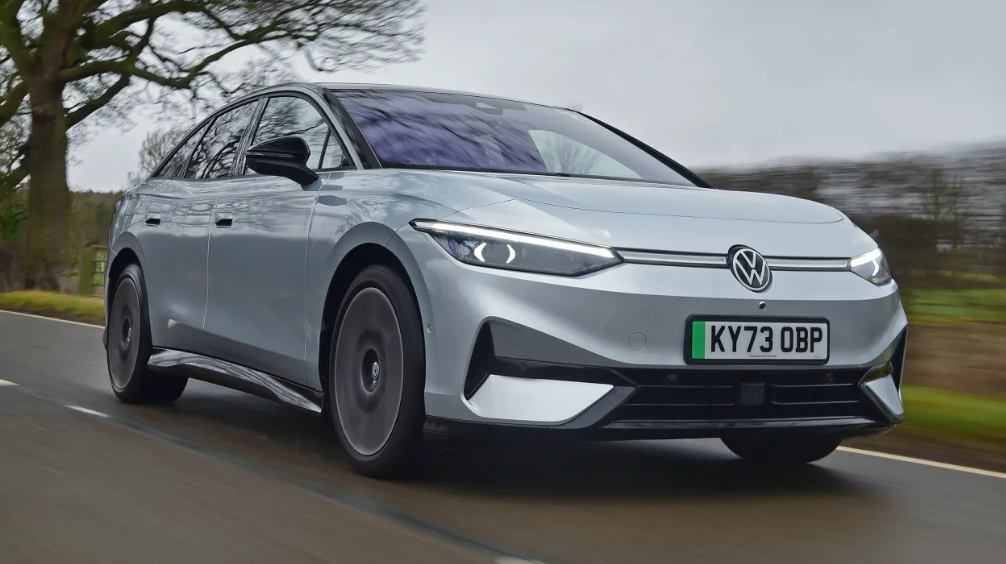
Volkswagen ID.7 2024

Volkswagen ID.7 2024 review
People will quite rightly cross-shop this new ID.7 with the all-conquering Tesla Model 3, although in reality the Volkswagen is a much larger car. The maker has worked hard to right its early-EV mistakes, and the cabin, technology and general driving experience easily justify this model's £50k-plus price tag. The ID.7 has every right to be considered in the same sentence as industry leaders like Tesla – as well as bigger, more practical rivals costing significantly more.

Even if the reaction to Volkswagen's early EV efforts was a little lukewarm, you could hardly accuse the car maker of resting on its laurels. Following limp launches for the ID.3, ID.4 and ID.5, the bold-looking ID. Buzz won hearts for its charming personality and practical interior.

But now it's the turn of VW's flagship range. The new ID.7 may look sleeker than its bus-bodied sibling, but this new saloon-cum-hatchback is a full 249mm longer than the Buzz. That means, despite the 7's circa-£50k price, it's more closely aligned with the Tesla Model S, than a Model 3.

Let's first address the elephant(s) in the room. Volkswagen's ID cars came under heavy criticism for their lackluster interior quality, plus fundamental technology and infotainment failings. With the ID.7, the maker is looking to right those wrongs.
Volkswagen ID.7 2024 Interior
Indeed, from the driver's seat, all appears well. The general cabin ambience has been lifted to a level that easily competes with cars in this class; there are soft-touch materials on the doors and dash, and the seats offer plenty of support. The main controls are a little confusing at first – the wipers are embedded on a stalk to the left of the steering wheel, rather than the right, for example – but at least they're not buried within the touchscreen like on the Tesla.

Speaking of which, the ID.7's big, bright, 15-inch central display instantly feels more responsive than in the maker's previous electric offerings. The menu layouts aren't the most intuitive, but playing around for a few minutes proves everything is not lost; a BMW i4's clickwheel is easier to use, but the functionality is all there.

Best of all, Volkswagen has finally deemed it appropriate to fit backlit climate controls, which means you can now accurately adjust the temperature at night. They're still touch-sensitive, but they feel infinitely more responsive than before.

The ID.7 is definitely the most grown up of Volkswagen's all-encompassing electric-car range – a feeling that continues as soon as you set off. Double-glazed side windows make this an almost-eerily quiet car at low speeds, but even on the motorway this 4.96-metre-long five-door remains impressively refined – despite our test model being fitted with the largest 20-inch wheels.
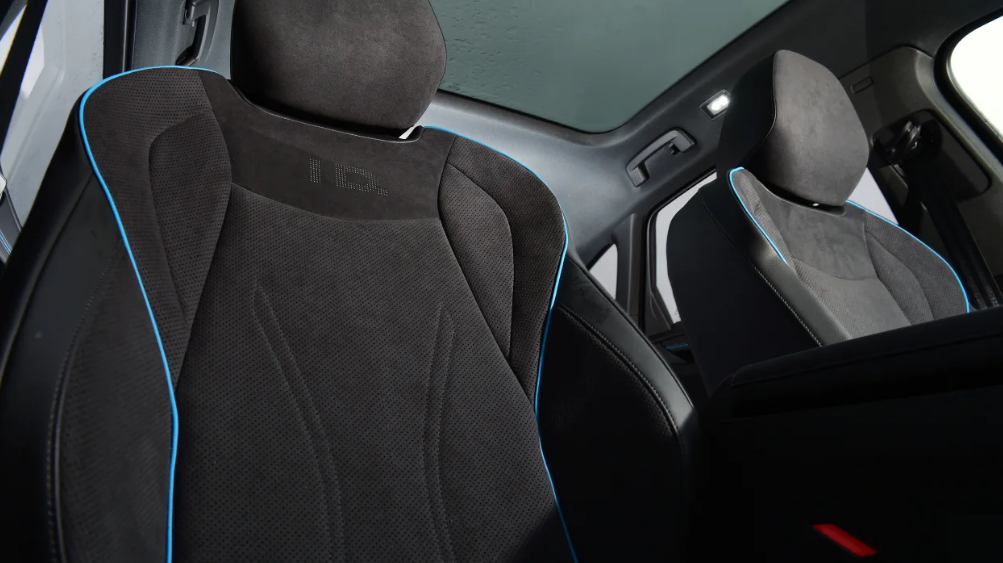
Volkswagen ID.7 2024 seat
Yet that sense of being isolated from the outside world doesn't come at the expense of body control. The ID.7's wide track and excellent damping means it's comfortable but firmly tied down at all times – even in the pouring rain. And this despite the fact that (for now) VW's executive range-topper is only available in single-motor guise; a dual-motor GTX is due before the end of the year.

Performance is sufficient, if some way off the best class. That's not necessarily a bad thing, though, with a linear power delivery that still manages to pin you in your seat if you request all 282bhp in a single hit. That said, it's probably the 545Nm of torque that better tells the story here; put your foot down at almost any speed and the ID.7 picks up with urgency, never struggling to transfer its grunt to the ground.

In short, the ID.7 does a good job of hiding its size, feeling just as agile as a Model 3 point to point. But whereas it merely matches the Tesla from a handling perspective, it punts it into the next week when it comes to practicality. Length alone means the Volkswagen is a much more spacious car for rear-seat passengers; six feet-tall adults will have no trouble getting comfortable. Both knee and headroom are generous enough.

Then there's the fact that despite the ID.7's saloon shape, the VW has fitted a roof-hinged hatch, which works wonders for accessibility. Open it up and you'll not only find a much bigger boot (532 liters playing the Model 3's 425-liter maximum) but you're not limited by a narrow, letterbox-like opening. The VW's seats fold almost flat in a 60:40 formation, and there's even an ID.7 Tourer estate on the way.

But while the Volkswagen wins points for practicality, it sits in second place (just) with regards to range and charging. VW says the ID.7 Pro Match can do up to 383 miles on a charge, equating to a pretty punchy 4.9mi/kWh. We didn't come anywhere close to that during our test, though the weather was poor and the stop-start nature of nailing down pictures and driving impressions meant it wasn't remotely representative of a real-world result. Still, you'd need to average almost 3.9mi/kWh to crack 300 miles in normal driving – an ambitious number, if you ask us.

Rapid charging is possible at up to 170kW – matching the base Tesla, but falling short of the similarly priced (£49,990) Model 3 Long Range, which is capable of 250kW top-ups. Either way, VW's charging curve is flat enough that the maker claims a 5-80 per cent refill is possible in 28 minutes, give or take the same as the range-topping Tesla.

For all intents and purposes, there's only one ID.7 available to buy right now; VW tells us the limited-run Pro Launch Edition will be removed from sale imminently. That means that if you approach your local dealer today, you'll be pointed towards the similarly well-equipped Pro Match version with the same 77kWh battery, which actually undercuts early cars by a little over £5,000.

Every Pro Match model gets matrix-LED lights, 19-inch wheels, and two-tone paint, plus three-zone climate control, wireless Apple CarPlay and Android Auto, plus the 15-inch Discover Pro infotainment system and augmented-reality head- up display. Frustratingly, a range-preserving ‘energy efficient’ heat pump is a £1,050 option, as were our car’s 20-inch wheels (£480).
Volkswagen ID.7 2024 side back
Model: Volkswagen ID.7 Pro Match 77kWh 286PS
Price from: £50,670
Price as tested: £59,450
Power/torque: 282bhp/545Nm
Transmission: Single-speed auto, rear-wheel drive
0-62mph: 6.5 seconds
Top speed: 112mph
Range/charging: 383 miles/170kW, 5-80% in 28 mins
L/W/H: 4,961/2,141/1,536mm
On sale: Now
Share:

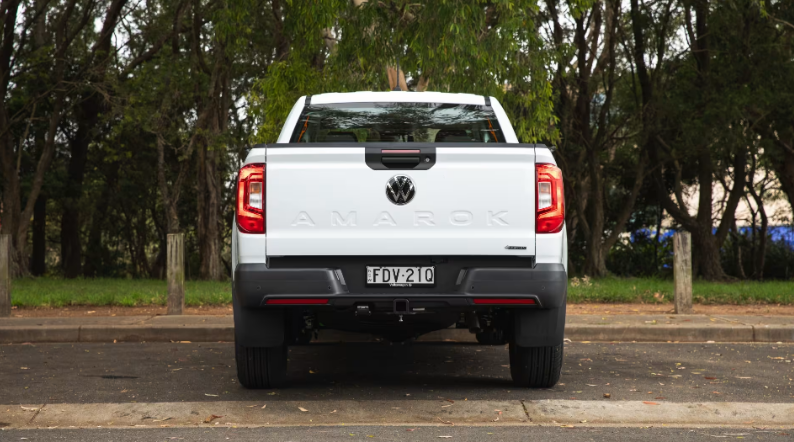
2024 Volkswagen Amarok TDI405 Core

2024 Volkswagen Amarok TDI405 Core
In the world of Australia’s thriving dual-cab ute culture, it’s the headline-stealing range-topping variants that grab the limelight. Think Ford Ranger Raptor, or Nissan Navara Warrior, or Volkswagen Amarok Panamericana and Aventura. They’re the dual-cab generals, the headline act leading an army of hard-working foot soldiers.

And as in any hierarchy, it’s the foot soldiers that do the heavy lifting. In the world of dual-cab utes that means entry-level workhorses; pick-ups without the fancy sticker packs and the increasingly common add-ons.

Meet the Volkswagen Amarok Core, the German brand’s most affordable dual-cab ute in Australia.

But don’t be deceived by the ‘entry-level’ tag underpinning the Amarok Core. Volkswagen has gone to some lengths to ensure its ‘tradie spec’ utilitarian workhorse can serve double time as a workaday truck during the week, and a comfortable family lugger on weekends.

Plenty has been written about the Amarok’s relationship to the best-selling Ford Ranger, and we’re not going to go over old ground here other than to say that Volkswagen and Ford shared the development of their respective utes to keep costs down.

Instead, the focus is, and should be, on whether this base-spec Amarok Core is the answer for those whose budget doesn’t stretch to the big bucks the headline-grabbing dual-cabs are asking for – and getting – these days.

How much does the Volkswagen Amarok cost in Australia?
Things don’t get much simpler than the Volkswagen Amarok Core we have here. It’s finished in Clear White, the only no-cost shade in the range’s eight-colour palette (the remaining seven metallic hues attract a $990 premium) and it’s fitted with exactly zero options. Because, other than metallic paint, there are none available. What you see is what you get.

The Amarok Core is priced at $52,990 plus on-road costs, and according to Volkswagen Australia’s website that translates to $54,990 drive-away nationally for MY23 stock. That places VW’s most affordable Amarok in a fair fight against some of its key rivals.

It's worth noting that pricing is for the MY23 Amarok Core, with the imminent arrival of 2024 models coming with a price rise thanks to Volkswagen adding some safety technologies missing from the base model. When new stock arrives later this year, the Volkswagen Amarok Core will be priced from $55,490 plus on-road costs, an increase of $2500 over the MY23 model.

The most obvious rival is the Ford Ranger XL Auto Double Cab – which shares the same engine and transmission as its Amarok Core sibling – and is priced at around $56,000 drive-away in NSW.

A comparable Toyota, the HiLux Workmate Auto 4x4 Double Cab, is also priced at around the $56K mark drive-away, while a Nissan Navara SL Auto 4x4 Dual Cab sits at around $55,380 drive-away, prices may vary by location.

At the more affordable end, buyers might also consider a challenger brand from South Korea. The SsangYong Musso in ELX Auto 4x4 specification is priced at a very sharp $40,000 drive-away, undercutting its rivals by some margin – even the most expensive Musso XLV Ultimate, fully optioned still only comes to $48,500 drive-away.

So that places the Amarok Core at the upper price range of entry-level dual-cab utes, but still more affordable than some of its main rivals. But VW has done enough to justify the Core’s price which presents, largely, as anything but a bare-bones tradie-spec workday utility.

While our test car came finished in basic white, its 17-inch alloy wheels are anything but basic at the end of the dual-cab ute playground, where steel wheels rule the day.

Other exterior features include side steps, tie-down rails along the top of the tub, LED headlights and daytime running lights, as well as a towbar.

Inside, there’s a large 10-inch infotainment portrait-style touchscreen with Apple CarPlay and Android Auto smartphone mirroring, wireless smartphone charging, digital radio, and an 8.0-inch digital instrument display.

A good range of Volkswagen’s advanced safety technologies is bundled into the Amarok Core, but there are some key omissions in this entry-level model... for now, but with a fix on the way. We’ll detail those later in this review.


Key details 2024 Volkswagen Amarok TDI405 Core
Price $52,990 plus on-road costs
Colour of test car Clear White
Options None
Price as tested $52,990 plus on-road costs
Drive-away price $54,990 (National)
Rivals Ford Ranger | Nissan Navara | Toyota HiLux

How much space does the Volkswagen Amarok have inside?
The cabin of the Amarok Core is a blend of niceties and some features that lean towards basic. There’s cloth seating and a polyurethane steering wheel, there’s a manual handbrake (against the more modern electronic park brake), while to start the Core is a good old-fashioned key in the barrel affair.

The standard-fit side steps are a welcome addition, and while the vinyl floor mats inside might look low-rent, they’re eminently practical in what is essentially a workhorse.

The front seats are comfortable, eight-way manually adjustable for the driver, although the passenger side only scores four-way adjustment, missing out on height adjustment.

There are plenty of storage nooks up front, including the obligatory cupholders, bottle holsters in the door pockets, a huge glovebox, as well as a handy and useful dash-top storage compartment with lid. The centre console features a storage bin, although the lid is finished in hard plastic; no comfy elbow rests here.

The second row is spacious, as you’d expect in a dual-cab, but it’s a pretty spartan affair back there. Missing in action are niceties like air vents or USB charging points, with just a single 12V outlet doing the heavy lifting of keeping smartphones and devices topped up.

There are cupholders located in a fold-down armrest, while the outboard seats are equipped with ISOFIX child seat mounts. Additionally, two top-tether anchors are located on the outboard seat backs.

Aside from the immediate impact of that impressive tablet-style touchscreen, the cabin remains largely a work zone, with hard plastics in abundance, durable seat trims and easy-to-clean vinyl flooring.

Out back is where the Amarok Core earns its stripes, with a workmanlike (and unlined) tub measuring in at 1544mm long, 1224mm wide between the wheel arches and 529mm deep. It’s capable of accepting an Australian standard pallet. There are six-tie down points in the tub, rated to 400kg each, although noticeable by its absence is a 12V plug available higher up the Amarok range.

Payload is rated at 1042kg, the best of any Amarok in the range. The next model up the range ladder, the Amarok Life, is rated to 988kg, dropping to 872kg in the range-topping Aventura.

The Core’s 1042kg payload is decent for a workhorse, and mid-pack when compared against its main rivals, not quite at the level of the Navara SL Auto and its 1117kg, or the Ranger XL’s 1054kg, but ahead of the HiLux Workmate’s even 1000kg.

The Amarok Core comes standard with a tow bar and 12-pin trailer plug. Towing is rated at 3500kg braked or 750kg unbraked, par for the segment.

2024 Volkswagen Amarok TDI405 Core
Seats Five
Tray size 1544mm (load length)
1224mm (between wheel arches)
529mm (height)
Length 5362mm
Width 2208mm
Height 1884mm
Wheelbase 3270mm

Does the Volkswagen Amarok have Apple CarPlay and Android Auto?
A 10-inch portrait-style touchscreen hosts the Amarok Core’s infotainment system. It’s pretty basic at this end of the range, fundamentally playing host to your smartphone.

Apple CarPlay and Android Auto able to be paired with either a cabled or wireless connection. There’s AM/FM/DAB+ radio, and Bluetooth phone and audio streaming. While a basic four-speaker sound system sounds pretty grim on paper, it proved surprisingly adequate with good sound quality.

There’s no satellite navigation, so you’ll need your smartphone if you need route guidance. That's no big deal, as we have found time and time again that mapping via Apple or Android is usually superior to native systems.

Using the climate controls is an exercise in frustration. Buried inside the touchscreen, accessed via a ‘Climate’ tab on the screen, it takes several inputs to adjust things like temperature, fan speed or even the direction of airflow. We’re looking forward to the day when car makers realise that some things simply shouldn’t be digitised.

Is the Volkswagen Amarok a safe car?
The entire Volkswagen Amarok range was awarded a five-star ANCAP independent safety rating in 2023.

It scored well in adult occupant protection at 86 per cent, an excellent 93 per cent for child occupant protection, 74 per cent in vulnerable road user protection and 83 per cent for its safety assist systems.

2024 Volkswagen Amarok TDI405 Core
ANCAP rating Five stars (tested 2022)
Safety report ANCAP report

What safety technology does the Volkswagen Amarok have?
The Amarok Core is equipped with autonomous emergency braking with pedestrian and cyclist monitoring, lane-keeping assist with departure warning, intelligent speed limiter with speed sign recognition, adaptive cruise control, a rear-view camera, tyre pressure monitoring, driver attention alert, and front and rear parking sensors.

The Amarok Core misses out on a couple of key safety items including blind-spot minoring and rear cross-traffic alert, while higher grades of Amarok also get a 360-degree camera. For new vehicles ordered after February 1, 2024 the Core adds the missing blind spot and rear cross-traffic tech which accounts for the price rise on MY24 models.

A suite of nine airbags, including the relatively new front-centre ’bag that mitigates head clashes between occupants in the event of an accident, is standard across the Amarok range.

Crucially, for those who use their dual-cabs as family haulers, the airbag coverage in this all-new Amarok now extends to the second row, which was a glaring omission in the previous-generation model.

How much does the Volkswagen Amarok cost to maintain?
The entire Amarok range is covered by Volkswagen’s five-year, unlimited-kilometre warranty. Servicing is recommended every 12 months or 20,000km, whichever comes first.

Volkswagen is currently offering five years’ complimentary servicing for Amarok Cores purchased before 31 March, 2024.

After that, scheduled workshop visits will set you back $1800 over five years or 100,000km under VW’s Five Year Care Plan.

For context, the Amarok’s Ford Ranger cousin asks for $1385 over four years/60,000km of scheduled services.

Comprehensive insurance for the Amarok Core runs to $1739 per annum, based on a comparative quote from a leading insurer for a 35-year-old male driver in Chatswood, NSW. Insurance estimates vary based on your location, driving history, and personal circumstances.

That’s a not insignificant $300 or so more than the premium asked for the Amarok Core’s identical twin under the skin, the Ford Ranger XL, which attracts a $1421 fee for comprehensive insurance from the same provider.

At a glance 2024 Volkswagen Amarok TDI405 Core
Warranty Five years, unlimited km
Service intervals 12 months or 20,000km
Servicing costs Complimentary (5 years - vehicles purchased before 31/03/2024)
$1800 (5 years, prepaid - vehicles purchased after 31/03/2024)

The Volkswagen Amarok Core is the lone ranger in the line-up when it comes to engine and transmission. It’s powered by a single-turbo 2.0-litre four-cylinder diesel mated to a six-speed automatic transmission.

Other Amaroks, depending on the model, are boosted variously by a twin-turbo four-cylinder diesel, a 3.0-litre turbo-diesel V6 or a turbocharged 2.3-litre four-cylinder petrol. All are matched with a 10-speed automatic transmission.

But the lack of one turbo and four gear ratios doesn’t take away from the Core’s driving merits. With 125kW and 405Nm, the latter available at a very user-friendly 1750–2500rpm, the Amarok Core feels sprightlier than its numbers suggest on paper.

It’s never going to win the traffic light dash, but neither is it a sluggard when moving away from a standstill. And it’s adequate at speed too, getting up to highway cruising speeds reasonably well, although once there, effecting an overtake will take some circumspection.

The six-speed auto is a good ’un, and arguably more accomplished and user-friendly than the 10-speed auto found in more expensive models, which has a tendency to shuffle through cogs more than it needs to.


Instead, the six-speed in the Core never feels overly intrusive or jerky. Instead, the transmission simply gets on and does the job of being in the right gear. It can be caught out when a brisk downshift is required, the transmission sometimes taking a smidge too long to react after a more urgent step on the throttle demanding a burst of acceleration.

It’s worth noting that while the Amarok Core is indeed an off-road-capable four-wheel-drive when you want it to be, its part-time four-wheel-drive system is only suitable for loose surfaces. That means, around town and on the highway, the Core is rear-wheel-drive only. Drive modes – 2H (rear-wheel drive), 4H (four-wheel drive high) and 4L (low) – are selected via a dial located in the centre console.

V6 Amarok models further up the food chain feature a different 4x4 system with a 4A (automatic) setting that can be used on sealed surfaces for extra grip in slippery conditions and a little bit of peace of mind, as well as off-road. All Amaroks are fitted with a locking rear differential that can be activated by the press of a button in the centre console.

The Amarok Core’s ride comfort is acceptable for the segment, if a little jiggly when unladen. Like just about every dual-cab ute, the Amarok’s suspension tune has been calibrated with a full payload in mind, and that means when unladen, the back can feel a little bouncy. It’s not terrible by any stretch, and we’ve encountered much worse in dual-cabs of all persuasions.

The saving grace here is the Amarok’s excellent Continental highway-terrain tyres that wrap around the standard 17-inch alloys. With a nice fat sidewall, the Contis play their part in absorbing some of the lumps and bumps that blight out roads, flattering the dual-cab ute’s ride comfort.

The steering feels nicely tuned too, responsive to inputs without that laziness we sometimes see in the segment, especially in older utes. It doesn’t feel overly heavy either, making for a surprisingly easy time of navigating urban enclaves and parking.

The brakes, though, do require some adjustment to your thinking behind the wheel. Discs up front but decidedly old-school and low-tech drums at rear, the Core does require a little longer to pull up than if it were fitted with discs all around like those Amaroks higher up the range ladder.

While we did not have the opportunity to take the Core off-road this time around, we have previously tested both its abilities on loose surfaces as well as seeing how it composed itself with 900kg in the tray. You can read more here.


Instead, our largely urban week with the Amarok demonstrated that despite its entry-level standing in the broader range, the Amarok Core is perfectly adept at handling daily driving duties with the family on board.

Key details 2024 Volkswagen Amarok TDI405 Core
Engine 2.0-litre four-cylinder turbo diesel
Power 125kW @ 3500rpm
Torque 405Nm @ 1750–2500rpm
Drive type Part-time four-wheel drive
Transmission 6-speed torque converter automatic
Power-to-weight ratio 56.6kW/t
Weight (tare) 2208kg
Spare tyre type Full-size
Tow rating 3500kg braked
750kg unbraked
Turning circle 12.8m


As more and more Australians are buying dual-cab utes as their multifunctional vehicle, it’s not surprising that manufacturers everywhere have upped the ante. Once the domain of tradies and hardcore off-roaders, buyers today are looking for more comfort, more features, and more safety technology than ever before.

The Volkswagen Amarok Core delivers on all fronts, although the omission of some key safety technologies is a bit of a letdown. Still, in terms of where it once was to where it sits now in the segment, the most affordable Amarok can serve three masters – the weekday tradie, the weekend off-road warrior, and the family hauler – all in one handsomely designed package.

Sure, the limelight remains firmly on those more family-focussed variants further up the range, but if your needs run to a dual-cab that can comfortably carry the family while serving capably as a rough-and-tumble work truck, then the Volkswagen Amarok Core is well worth a spot on your shortlist.

While it would be easy to suggest that Amaroks higher up the food chain – such as the Life or the Style – might represent better value in terms of standard equipment and a more powerful engine and transmission combination, there’s a simple charm to the entry-level Core that’s hard not to like. And we’d argue the six-speed auto is a better bet than the busy 10-speed found in those models.

And if you can live without blind-spot monitoring and rear cross-traffic alert, snaffling a 2023 Amarok Core will save you around $2500 over updated 2024 models that will start arriving in dealerships soon.

For those looking to enter the Amarok fray, Volkswagen Australia says it has “good stock on the ground for immediate delivery, depending on the dealer”. It’s worth checking with your local dealer, which you can do online here.


You can also search new and used Amaroks for sale at Drive.com.au/cars-for-sale.

As always, we’d recommend test-driving the Amarok Core against some of its rivals in the segment such as the Nissan Navara, Toyota HiLux or Ford Ranger.

And if you want to stay updated with everything that's happened to this car since our review, you'll find all the latest news here.
Share:

2025 Volkswagen ID7

2025 Volkswagen ID7 Review
We must admit that cars continue to be outnumbered by the many SUVs dominating the roads. Even though they are busy, electric vehicles are still outnumbered by internal combustion engine vehicles. Into this fray, Volkswagen gamely unveiled the 2025 Volkswagen ID7, a premium mid-size electric hatchback sedan. VW will first offer it in Europe before reaching North American showrooms in the summer of 2024 with a semi-affordable price tag expected to start at around $50,000.

We'll initially get a single-engine, rear- or all-wheel-drive car with an 82 kWh battery, a new powertrain, a driving range of more than 300 miles, and some innovative new features inside designed to make road trips more enjoyable. comfortable.

It all comes in a solid if not exciting hatchback design. In this sense, the 2025 VW ID7 is a spiritual successor to the Volkswagen Phaeton, with design cues that hint at its big brother's kinship to the VW ID4.


2025 Volkswagen ID7 Exterior
The 2025 VW ID7 is the seventh member of the company's global ID family, but currently, only the ID4 is offered in North America, and the ID Buzz is coming next year. These vehicles use the MEB electric platform that underlies several vehicles within the Volkswagen Group.

The single-engine VW ID7 will now be sold in Europe, and the same version will arrive in North America next year. We drove the top-of-the-line ID7 Pro S along a stunning coastal region outside Marseilles, France, a location that felt right for cruising in a car with a large panoramic glass roof with a tint that can be adjusted to change from opaque to clear.
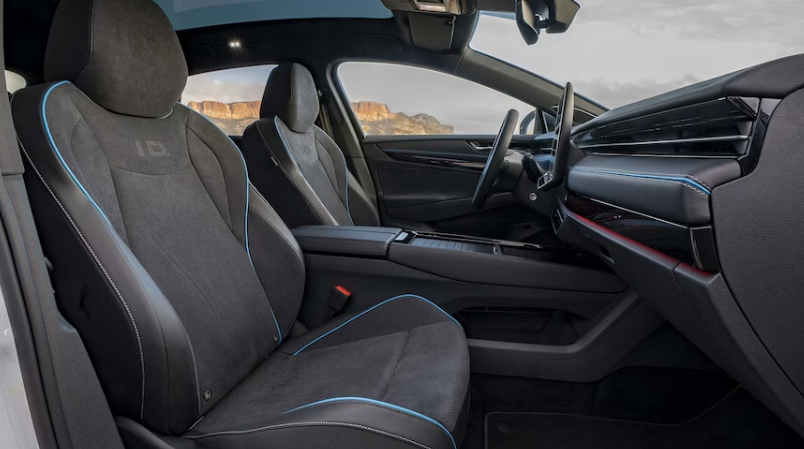
2025 Volkswagen ID7 Interior

New Powertrain Makes a Difference

The 2025 VW ID7 introduces a second-generation PSM e-motor and a new inverter as part of Volkswagen's new APP 550 drivetrain that will also be used on the long-wheelbase Volkswagen ID Buzz electric bus slated for the US. The permanent magnet synchronous motor develops 282 horsepower and 402 lb-ft of torque.

This new powertrain allows the ID7 to get more power from the same 82 kWh battery compared to the ID4. And increased range, helped by the low-slung car's 0.23 drag coefficient, makes it the slipperiest VW.

Range with standard batteries will exceed 300 miles; the exact figure is still unknown. ID7 can charge up to 127 miles of range in 10 minutes with charging speeds of up to 175 kW. To go from 10 percent to 80 percent charging takes 28 minutes.


2025 Volkswagen ID7 Seat

GTX Came But Not With That Name

Next year, Volkswagen will introduce a more powerful ID7 GTX model with a second motor for Europe. North America will also get an all-wheel-drive variant; however, it won't be called GTX in the US. The ID7 family will also have a wagon for Europe based on the Tourer concept, and there are no plans to bring it to this market.

VW will also next year add a larger 91 kWh battery for the European market. North American-based company executives are also working to bring it here, hopefully in time for the second model year.

Regardless, the standard powertrain and battery are more than enough for now. Firing the ID7 with the standard battery puts you back in the seat, although the burst of torque and speed is followed by a noticeable hesitation before acceleration resumes.
2025 Volkswagen ID7 Back

Enter into

VW calls the ID7's interior a "second-generation ID" with upgraded software, an optional Harmon Kardon audio system, and a heating and cooling system with smart air vents that start conditioning the cabin as you approach the vehicle.

The car introduces new premium seats with sensors to detect when your bottom needs warming up or cooling down. Climb into an ergoActive chair with extra air pockets to stimulate your pelvis and spine with a new pressure point massage. This is just one of many massage options, all of which allow you to adjust the intensity level, and we can attest to their effectiveness—they're the best. One reason: Activating massage via the infotainment screen may be a bit difficult for passengers because the icon is on the far left of the center touchscreen.

Our ID7 Pro S test car had black perforated suede seats with blue piping and white stitching. The cabin is minimalist but not so frill-free that it feels cold or uninviting. There's a USB outlet, a wireless charger that holds the phone in place, cup holders in the cockpit with glossy black and wood trim, and more Alcantara on the doors to create a warm atmosphere. Indeed, the materials are more premium than we've come to expect from VW these days. The rear seats are also heated, with controls behind them, and there are USB outlets in the rear seats. There's plenty of legroom, and headroom is decent, but taller passengers will have to regret the fastback. On the other hand, the hatch opens to a large opening and has a cargo cover.

Introducing the VW Big Screen

The introduction of VW's first 15-inch display dominates the cabin. It's mounted on the front of the dashboard, sits low enough so as not to obscure visibility, and displays excellent graphics. Most commands are created on the screen, divided into vertical lines with a permanent menu at the top, a large icon library in the middle, and permanent HVAC commands at the bottom. Below the screen, there are sliders to adjust the volume and temperature. VW says it has restructured its system to make it easier to use; still needs some digging, but it's much better.

Voice control is problematic. You can activate the digital voice assistant by saying "Hi IDA" or even "Hi ID". But after a few days of driving, the system suddenly turned on, leaving me and my co-driver confused about what we should say to wake it up. The radio also turns on randomly. When we did need help, the assistant sometimes responded. While working, IDA can change the ambient lighting, open the roof color for stargazing, change modes for sportier driving, or answer trivia questions. Tell him your hands are cold and he'll set the smart vents to direct hot air if you don't want to open the screen and adjust the vents manually. But in what appears to be a last-minute decision, “Hey IDA” will not be activated for the US market.

Not Your Standard Driver View

When behind the wheel, the driver may be surprised to see only a small display of the driver's screen. The screen is small because most of the information is placed on the augmented reality head-up display. As a driver, you quickly learn to rely on the HUD for everything you need to drive, from speed to navigation to range. You can adjust the display to your line of sight, it's easy to see and use, and it's instantly comfortable to use. One cool feature: Set a lane with the navigation system, and blue lights move across the width of the car, under the windshield, indicating the direction of the turn ahead.

Drivers can choose D for drive or B for electric drive with more braking energy regeneration. However, you can't adjust the regen amount, and the 2025 VW ID7 doesn't offer one-pedal driving. This means the car will slow down when you release the accelerator, but will not stop completely. Braking isn't hard at all—you'd never know it was an electric vehicle if someone didn't tell you.

VW says it designed the steering to provide a better turning radius. It's tough and can be a little unsettling at times, but it's better than feeling numb or disconnected from the path. Engineers say they didn't consider rear steering for the ID7.
Adaptive suspension dampers provide a very smooth ride. It's true, the ID7 offers an upgraded five-link rear axle with new bushings for better damping. There's little body roll with a low center of gravity, and the car handles corners well. The overall result is a quiet, comfortable, and capable—if not always exciting—driving experience. Think poached eggs but not eggs Benedict.

Engineers also worked to create greater differentiation between Comfort and Sport modes (there are also Eco and Individual settings). The steering tightens up, and the throttle becomes more sensitive in Sport, but the difference isn't huge. Switching modes must be done on the screen, as there are no physical buttons to make changes.
2025 Volkswagen ID7 Wheel

Assisted Driving

Most driver assistance systems worked well during our evaluation. Adaptive cruise control moderates traffic speeds smoothly. A function that adjusts the ID7's speed to changes in speed limits is a welcome feature in Europe but won't be offered, or perhaps overlooked, in North America. Lane-keeping assist is excellent, keeping the vehicle perfectly centered with no gradual sway to either side of the lane.

Travel Assist adds automatic lane changes to the driver assistance features. We have had varying degrees of success with the lane change function. This works in some cars and not others, and sometimes and not others. Tap the turn signal, and the car's sensors make sure it's safe before changing lanes. It is designed to work on mapped highways when the vehicle is traveling faster than 56 mph and the driver is holding the steering wheel.

The new VW ID7 is built in Emden, Germany, and goes on sale in the US in late summer with prices expected to start around $50,000 for the Pro and $55,000 for the Pro S. Of course, there's more to come. bigger battery.

The 2025 VW ID7 is the most advanced vehicle in the ID family, and the automaker says it will incorporate some of its advances into the ID3, ID4, and ID5. The new car shows that VW can learn from its mistakes, with more premium materials, better technology, and an improved driver interface. It may not be the sexiest new electric car on the market, but it should be a solid choice once some of its bugs are ironed out.

2025 Volkswagen ID7 Specifications

Base price $50,000-$55,000 (MT estimate)
Front and rear motor layout, RWD/AWD, 5 passengers, 4-door sedan
282-hp/402-lb-ft permanent magnet Electric Motor
Motor Type 82 kWh
1-speed Automatic Transmission
Limit Weight 4,500 pounds (MT estimate)
The wheelbase is 117.0 inches
L x W x H 195.3 x 73.3 x 60.6 inches
0-60 MPH 6.5 seconds (estimated mfr)
EPA Fuel ECON TBD
EPA Range, COMB 300 miles (MT estimate)
On sale Summer 2024
Share:

2023 Volkswagen Golf 110TSI R-Line

2023 Volkswagen Golf 110TSI R-Line Review
Peter Anderson enters his favorite type of car, a hatchback. This one is a lightweight Volkswagen Golf R-Line hatchback for the kind of money one would buy a GTI for.
What we like
Nice to drive
The addition of the R-Line is cool
Looks great

2023 Volkswagen Golf 110TSI R-Line

Imagine this nightmare scenario. You missed the launch of the Mark 8 Golf and you show up at your local Volkswagen dealer with cash to buy a Golf GTI. Who wouldn't want a Golf GTI? Whoever is tough. You're pleased with yourself for ponying up forty-plus thousand dollars, and seconds into your visit, you discover that the GTI is way out of your league, financially speaking.

VW's product planners had envisioned something very similar, and like many other car companies, they had realized the power of sporty branding on not-so-sporty cars. M Sport, AMG package, S Line, N Line, the list goes on. The Volkswagen R is emblematic of its sportiest variants (although the Golf is the king of the GTI badge), so the carefully crafted R-Line package will cater to those who can't – or don't want to – make the financial leap to a GTI.

How much does a Volkswagen Golf cost in Australia?
The R-Line is the third and final car in the mainstream Golf range before things get even more interesting with the Golf GTI and even more interesting with the Golf R. Priced at $41,690 before on-road costs, it has broken the $40K mark in recent years; the kind of money used to buy you a Golf GTI.

Of course, the Golf isn't alone, but where it once fit perfectly with Korean and Japanese brands, like the Polo, VW has managed to break into the ever-shrinking high-end hatchback market.

The R-Line ships with 18-inch alloy wheels, keyless entry and start, 'performance' LED headlights, adaptive cruise control, reversing camera, front, and rear parking sensors, three-zone climate control, 10-inch media touchscreen, satellite navigation, charging cordless phones, space-saving backups.

The R-Line adds a styling package inside and out, a pair of excellent bucket-style front seats, a choice of driving modes, and some cool color options – like 30 for the ambient cabin lighting.

Its specification is largely based on the Golf Life, with some sportier additions, but it also has suspension tweaks to make it more fun to drive. The car has the optional Sound & Vision package, but you can also add a panoramic sunroof and choose paint options at varying prices.
2023 Volkswagen Golf 110TSI R-Line Interior side

Important details of the 2023 Volkswagen Golf 110TSI R-Line

The price is $41,690 plus travel costs
The color of the test car is Atlantic Blue
Sound & Vision Package Option – $1650
- Nine-speaker Harman Kardon stereo with subwoofer
- Head-up display
Metallic paint – $700
The price as tested was $44,040 plus travel costs
Drive away price $44,490 (through 12/31/23)
Hyundai i30 N Line Rivals | Kia Cerato GT | Mazda 3 G25 Astina

Let's start with the most disappointing part of the hatchback experience, at least in this segment – boot space. The Golf equips itself well with 374 liters of space in a tidy space that's easy to load. When you remove the 60/40 split fold, you have the 1230L, which is also quite good and can handle a moderate Swedish flat pack purchase. Excuse me.

Into the back seat and it's not bad, at least for my 180cm behind my driving position. The fabric trim seems sturdy enough and the seats themselves are comfortable. The large rear window lets in plenty of light and you get an armrest with two cup holders, two USB-C ports, and bottle holders in the doors. Considering many hatchbacks don't even have armrests, this isn't a bad thing, but then again this is a forty grand plus car.

The Golf and Golf Life seats are ditched when you tick the R-Line box, and replaced by R-style seats that look great and are very comfortable. They hold you up well and only very tall or large people might not like them; the first because of the lack of an adjustable headrest, and the second because of the comfortable support.

Volkswagen's switch-style gear shifter means the console is roomy enough for two cup holders and the wireless charging pad is within easy reach. You don't have to negotiate a traditional shifter, which sometimes involves a bit of 'writing'. The bottle holders in the doors are quite large and the center console holder with the armrest above it is also a good size.

It's a beautiful view from the driver's seat, and there's only the thick C-pillar to contend with. Even though the touch screen is large, it doesn't dominate the room. The fact that so many controls are baked into the software means there are very few buttons, which seems to be something car companies are leaning toward. As usual, most of the cabin materials are quite nice, and in some cases almost luxurious.
2023 Volkswagen Golf 110TSI R-Line Performance

20 23 Volkswagen Golf 110TSI R-Line

Seat Five

The Seat 374L boot volume is up
1230L folding seat
Length 4284mm
Width 1789mm
Height 1456mm
Wheelbase 2636mm

Like most VW Group cars, the Golf's media system includes wireless Apple CarPlay and Android Auto, features on Golf Life and up. The system on the Golf is slightly better than the old system and is more adept at holding a CarPlay connection.

The DAB+ selection screen is understandable, which makes a nice change, plus there's standard AM/FM and Bluetooth streaming. There's also built-in satellite navigation that communicates with the digital instrument cluster and optional head-up display.

Luckily, it's also a large 10-inch display that's mostly easy to use. So many functions are crammed into the display that you have to tweak the temperature controls more than you'd like. Lots of cars are like this and it's annoying. The second generation Peugeot 308 had almost no physical controls, but interior designers quickly saw the light for the 3008 and other models by adding them back.

The software system is easy enough to navigate when you're sitting still and not on the move, with plenty of color options to suit your mood.

In addition to the standard digital dashboard, the car has a Sound & Vision package that adds a comprehensive head-up display and a nine-speaker, 480-watt Harmon Kardon-branded system. Is it worth $1600? Maybe not, but the heads-up display is great.
2023 Volkswagen Golf 110TSI R-Line Dasboard side
The Golf was originally tested in 2019, but Volkswagen's latest safety upgrades mean it meets 2022 safety criteria while maintaining its five-star ANCAP rating. This rating applies to all new variants made from November 2022 and on sale from February 2023.

It scored well with 88 percent for adult occupant protection, 87 percent for child protection, 74 percent for vulnerable road user protection, and 76 percent for safety assistance systems.

The Golf's safety list gets a slight upgrade for 2023 with the addition of a ninth airbag – a front-center airbag to help prevent head impacts from side impacts. This applies to front, front side, and curtain airbags, as well as rear side airbags.

You also get the usual ABS, stability, and traction control, lane centering, lane keeping assist, blind spot monitoring, rear cross-traffic alert, occupant protection system, reversing camera, driver attention detection, safe exit warning, front AEB, cross traffic alert rear, and automatic high beams.

The semi-autonomous Travel Assist is well calibrated for the most part, and polite rather than forceful. But it's not very smart if you manage to get your hands on the wheel, because you have to keep pushing it to remind it you're there.
2023 Volkswagen Golf 110TSI R-Line Seat
Volkswagen offers a five-year/unlimited kilometer warranty on its range, which is in line with almost everyone these days.

You can pay as you go for servicing and over three services pay $1751 or $3356 over five years, both of which are high as the segment goes. You can save most by paying up front, with three years dropping to $1550 and five years to $2650, which is a pretty healthy savings over pay-as-you-go. Over $500 per service is still a bit steep, but here we are.

Annual insurance costs $1680 based on comparative quotes for a 35-year-old male driver living in Chatswood, NSW. Insurance estimates may vary based on your location, driving history, and personal circumstances.

202 3 Volkswagen Golf 110TSI R-Line at a glance
Guarantee Five years, unlimited kilometers
Service interval 12 months or 15,000km
Service fee $1550 (3 year prepaid)
$2650 (5 year prepaid)
$1751 (3 year postpaid)
$3356 (5 year postpaid)
2023 Volkswagen Golf 110TSI R-Line Cabine
We have a slight downside to the Golf's claimed fuel figure of 5.8L/100km, whereas previously it was only 7.2L/100km, to be fair to the Golf, which is mostly city and suburban driving, I don't see any reason why that figure it won't improve with a mix of highway and city.

Even so, you will cover a distance of almost 700 km on a fill of 95 octane fuel even with those figures.

Fuel Usage Fuel Statistics
Fuel cons. (claimed) 5.8L/100km
Fuel cons. (on test) 7.2L/100km
Premium unleaded 95 octane fuel type
Fuel tank size 50L

despite the R badge adorning the grille and rump, this isn't an extremely warm hatchback. It's not even as focused as the GTI, which can now be very comfortable in Comfort mode.

But the suspension changes are useful. Using larger 18-inch wheels means the ride is a little firmer, but doesn't feel noisier than the Life I drove not long after this Golf was launched. The usual complaints about concrete or rough surfaces also apply, but there is a bit of rubber under the R-Line, so that's to be expected.

I always get too excited about driving hatchbacks because many of the cars I drive aren't, and SUVs dominate our market. The Golf feels very light on the feet, my wife and I smiled the entire time we had it, and it's a car we'd each recommend taking for solo trips. I guess it's the kind of car we had in our youth, not requiring quite a push of the accelerator to get moving, and generally being a great deal of fun without all that weight under you.

The steering is well-weighted and, on the R-Line, has a progressive rack, meaning less lock is required to fire into a corner than would be needed on a regular car. This also means you don't always have responsiveness when you don't want it to. This feature is also shared with the GTI, in case you were wondering. Even the size of the steering wheel itself is just right.

So we come to VW's much-loved 1.4-litre turbo four petrol engine. You can find it best in the Tiguan Allspace, which hauls a seven-seat SUV quite well. As a result, the much lighter Golf has more power, 110kW and 250Nm rising quite quickly.

Driving the front wheels, the Golf R-Line doesn't have the six- or seven-speed dual-clutch transmission commonly found in other Volkswagen applications, but instead an eight-speed torque converter. So there's no more backtracking and less hesitation at parking speeds, especially compared to a seven-speed.

Important details 202 3 Volkswagen Golf 110TSI R-Line
1.4-liter four-cylinder turbo petrol engine
Power 110kW @ 5000rpm
Torque 250Nm @ 1500–4000rpm
Drive Type Front wheel drive
Transmission 8-speed torque converter automatic
Power to weight ratio 79.8kW/t
Weight (tare) 1379kg
Spare tire type Space saver
Tow rating 1500kg braked
660kg unbraked
Turns a 10.9m circle
2023 Volkswagen Golf 110TSI R-Line Exterior
If you're not interested in a sportier suspension or nicer seats, the R-Line probably isn't worth the Golf Life as there's not much else that matters beyond these things. But if you like a car with more attention than the immaculately handled Golf Life, it's worth it. And let's be honest, you're probably buying a hatchback because you don't want a high-end SUV, so you might as well go for it.

If you need more space in the trunk, it's a bit annoying that you can no longer fit the wagon into the R-Line (or screaming R).

If the Golf is the right car for you, start with Volkswagen's website and its stock finder. Both the website and a Volkswagen Australia spokesperson confirmed there is plenty of stock available across the Golf range, so if the R-Line is a little richer for your tastes, the Golf 110TSI Life is available in plenty.

I quite like the R-Line and for me it's the car, but for the less emotional buyer Life is the place to go, with most of the good stuff of the R-Line but in a more comfortable package.

When you're ready to buy, you can visit Drive.com.au/cars-for-sale or visit the VW website or dealer. If you are a bit tall or wide, make sure you sit comfortably in the R-Line seat. And don't let the dealer ignore these concerns because if you don't like the front seats, ownership will be a real hassle.
Share:

Popular Posts

Followers